Your retargeting audience contains two people. One bounced off your homepage in four seconds. The other configured a $1,200 table for Saturday, added two bottles, and stopped one tap from paying. If your setup is "retarget all site visitors, 30 days, party montage creative," you are bidding the same amount to reach both — and because the four-second bouncer is cheaper to reach, most of the budget goes to them.
Retargeting for a nightlife venue works when five things are true: audiences are split by intent depth — viewed a zone, opened a package, started checkout — not lumped by visit; the pools are fed by server-side events rather than the pixel alone; the creative shows the exact table the guest configured; frequency is capped to the event clock; and booked revenue posts back so the platform optimizes for bottle buyers instead of clickers.
Segment by intent depth, not by visit
A nightlife booking flow produces a natural intent ladder, and each rung deserves its own audience, bid, and message:
- Zone viewers — opened the venue map, looked at the VIP mezzanine or the dance-floor tables, left. Interested, uncommitted. Cheap reminder creative, low bids.
- Package openers — got as far as a specific package: table plus bottles, minimum spend visible. These guests priced the night out. Mid-funnel creative that answers the objection — what's included, what the minimum covers.
- Checkout starters — entered payment and stopped. The warmest audience your venue generates, usually the smallest, and worth multiples of the other two in bid terms.
Lumping these together wastes money on the shallow end and underspends on the deep end, because the platform averages your bid across the pool. Three audiences, three bids, three messages — the ladder is the strategy.
Feed the pools from real events, not the pixel alone
The guests most likely to be missing from your retargeting pools are the ones you most want in them. Nightlife booking traffic is overwhelmingly mobile and late — on Clubtech, 82% of bookings happen on a phone after 10pm — and mobile is exactly where pixel-based tracking dies. iOS tracking prompts get declined, Safari throttles cookies, ad blockers strip the pixel entirely. A pixel-only audience is a sample biased toward desktop browsers with permissive settings, which is nobody's Saturday crowd.
The fix is server-side events. When the booking system itself reports "this guest opened this package" and "this guest started checkout" — via the Conversions API rather than a browser script — the pool fills from what actually happened instead of what the browser permitted. On Clubtech, abandoned-cart CAPI events fire within seconds, carrying the zone, date, and price, which keeps checkout-abandoner audiences fresh enough to act on the same night. The full mechanics are in our guide to the Meta Conversions API for venue bookings; the short version is that retargeting quality is set upstream, by event quality.
Show the exact table, not a party montage
Generic nightlife retargeting creative — crowd shots, strobe lights, a logo — asks the guest to restart their decision. Dynamic creative continues it. A guest who configured the mezzanine table for Saturday should see the mezzanine table for Saturday, at the price they already accepted, with one tap returning them to that exact selection.
This is the same mechanism that makes retail dynamic ads work, applied to furniture and dates: on Clubtech, dynamic ads return the guest to the exact zone, date, and price they left. The creative asset is the venue itself — the interactive map and 360° walkthroughs that sold the spot the first time are the strongest possible retargeting frame: the guest isn't being sold a night out; they're reminded of a decision they nearly finished. For the booking flow this plugs into, see nightclub table booking.
Frequency caps and the event clock
Nightlife inventory expires on a schedule, and your frequency logic should follow it:
- Compress, don't extend. A 30-day window makes sense for sneakers. For a Saturday event, most of the winnable audience decides within days. Concentrate impressions in the final 72 hours before the event, when the decision is live.
- Hard-stop at the date. An ad for last Saturday's event running on Sunday is pure waste. Retargeting windows should be tied to the event date, not a default lookback.
- Exclude purchasers immediately. Nothing burns goodwill like retargeting a guest who already paid a deposit. This only works if purchase events reach the platform in real time — another reason batch-uploaded conversions quietly cost money.
- Cap the shallow tiers harder. Zone viewers might warrant a handful of impressions; checkout starters justify more. Inverting that — hammering casual browsers because they're cheap — is what happens without per-tier caps.
Optimize for bottle buyers, not clickers
The last piece decides what the machine learns. If your campaigns optimize on clicks or landing-page views, the platform hunts for people who click — a population that overlaps generously with people who never buy. If booked revenue posts back as the conversion value, the platform hunts for people who look like your $1,200 table buyers.
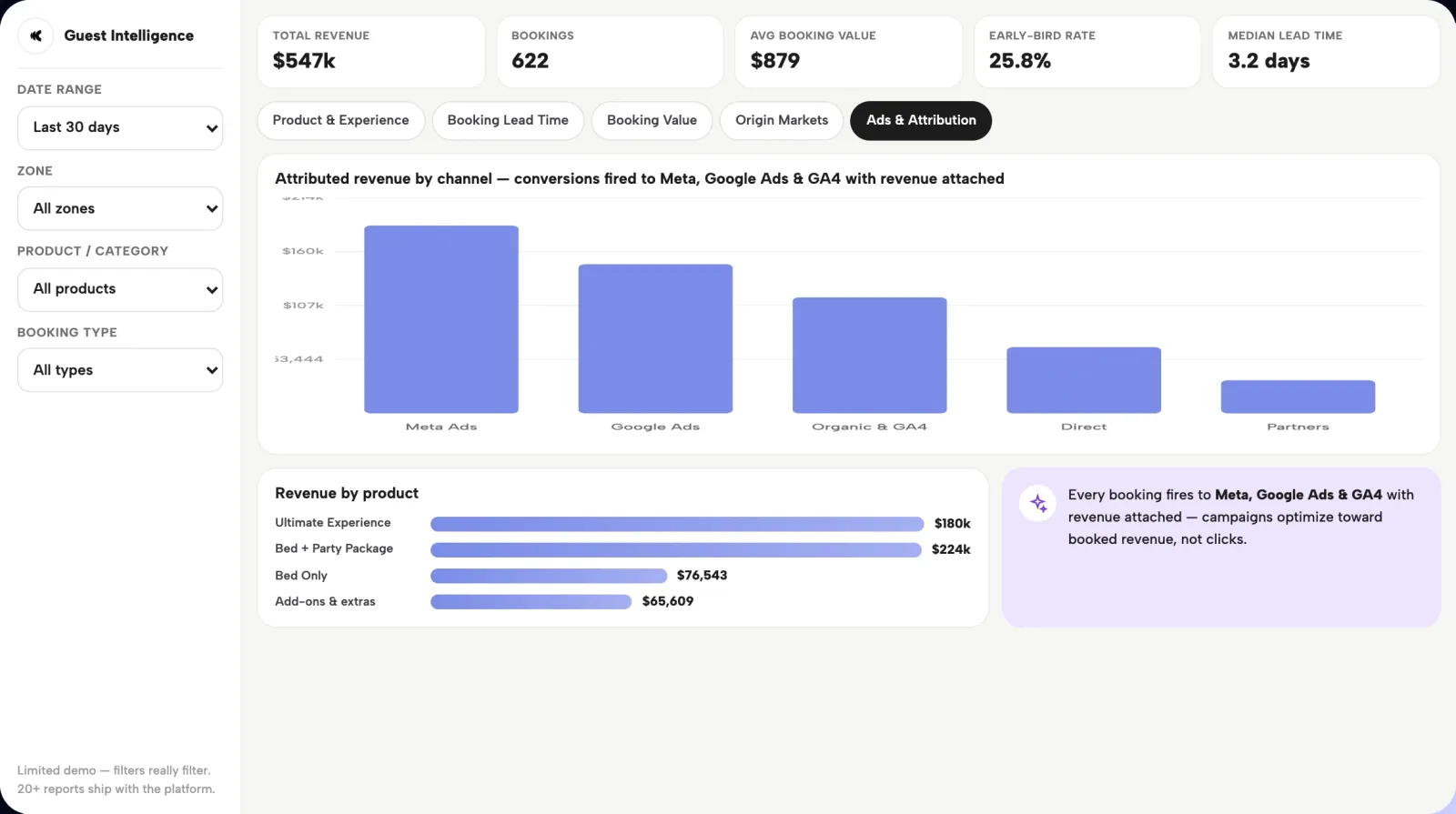
That means the purchase event must carry real transaction values, not a flat "conversion." On Clubtech, bookings fire to Meta, Google, and GA4 in real time with revenue values posted back, which unlocks value-based optimization — and seeds lookalikes from your highest-LTV bookers rather than your most clickable followers. Your analytics should mirror the same discipline; our GA4 for venue bookings guide covers booker-seeded audiences. Retargeting is one loop of a larger machine — prospecting, lookalikes, recovery, attribution — mapped in the beach club marketing strategy guide, which applies to nightclubs as much as daybeds.
Retargeting is where venues most visibly pay for measurement debt. Fix the events, and the same budget starts buying back bottle buyers instead of bounces.
Questions operators ask
What is retargeting for a nightlife venue?
Retargeting shows ads to people who already visited your booking flow — viewed a zone, opened a table package, or started checkout — to bring them back before the event date. For nightlife it differs from retail retargeting in three ways: the inventory expires on a fixed date, intent depth varies enormously between visitors, and the highest-value guests browse on mobile late at night, where pixel-based tracking is weakest.
Which audiences should a nightclub retarget?
Three, split by intent depth: guests who viewed zones or tables, guests who opened a specific package, and guests who started checkout without paying. Bid lowest on the first and highest on the last, give each its own creative, and exclude anyone who has already booked. A single "all visitors" audience overspends on casual browsers and underspends on the guests one tap from a table.
Why are my retargeting audiences so small?
Usually because they're built from the pixel alone. iOS tracking prompts, Safari's cookie limits, and ad blockers stop the pixel from seeing much of your mobile traffic — which for nightlife is most of your high-intent traffic. Feeding audiences from server-side events via the Conversions API rebuilds the pools from bookings and checkouts that actually happened, rather than the subset a browser agreed to report.
How often should retargeting ads show before an event?
Concentrate impressions where the decision is live — roughly the final 72 hours before the event — rather than spreading them across a 30-day default window. Cap casual browsers at a few impressions, allow more for checkout abandoners, stop everything the moment the event date passes, and suppress purchasers in real time so paying guests never see an ad for the table they already bought.
Does retargeting work for table bookings?
Yes, when the events and creative match the product. A guest who configured a specific table and stopped at payment is the warmest lead a venue generates; dynamic ads that return them to the exact zone, date, and price convert because they resume a decision instead of restarting one. With revenue posted back on each booking, the platform also learns to find more guests who buy tables, not more guests who click.
See your retargeting pools fill from real bookings. We'll show the event flow, the audiences, and the dynamic return path on a venue like yours. Book a 30-minute demo