Compare

The SevenRooms alternative for venues that sell furniture, not covers

The SevenRooms alternative built for furniture, zones, and dayparts — not covers. See what breaks in a dining model, and where SevenRooms still wins.

clubtechglobal.com/compare
Beach club furniture map on a tablet beside a restaurant floor plan

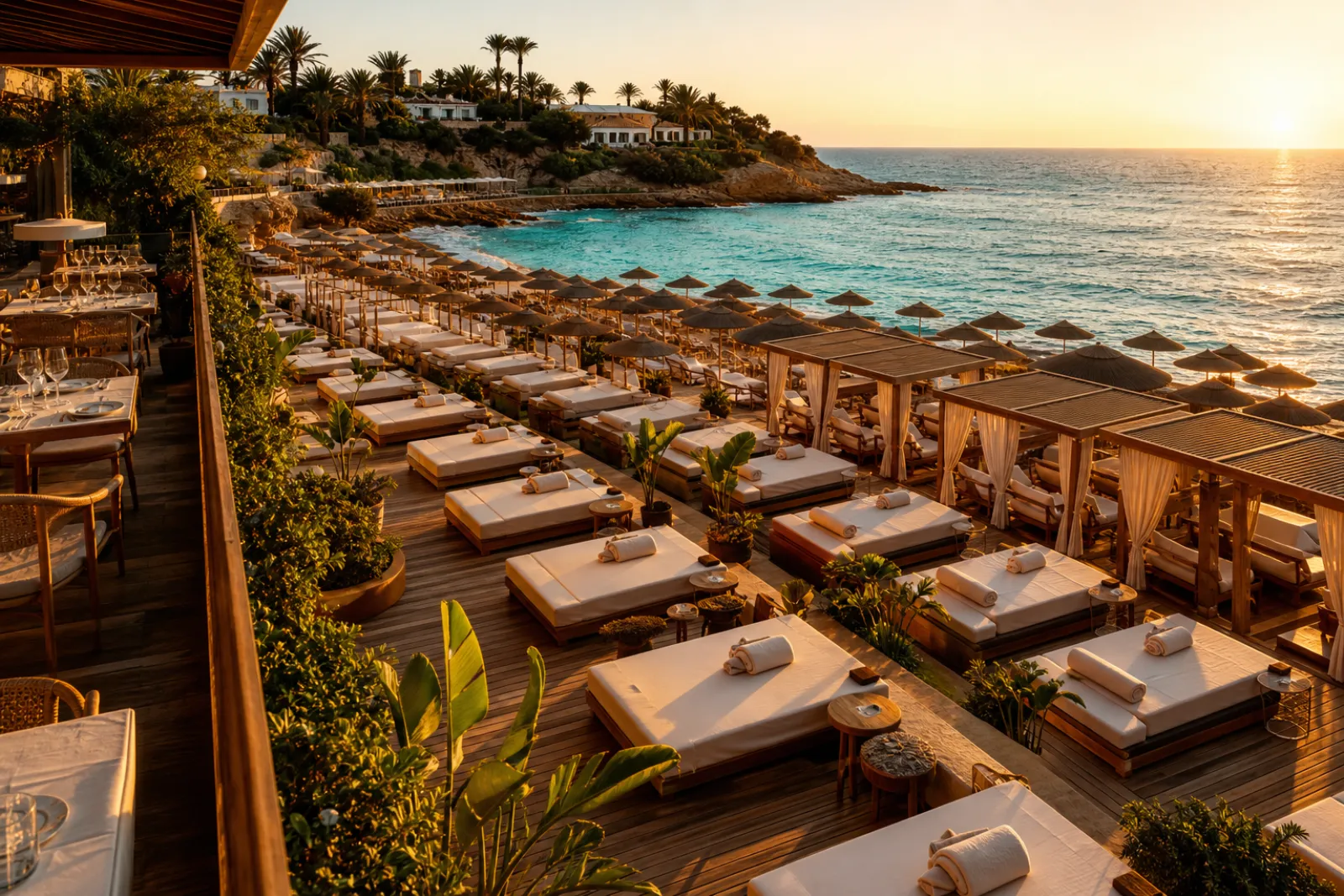
SevenRooms is very good software — for restaurants. But a beach club's revenue doesn't live in covers and turn times; it lives in a $450 front-row daybed, a $2,000 cabana package, and the bottle pre-sales stacked on top. If you're forcing that inventory through a dining reservation model, you're not looking for a better SevenRooms setup. You're looking for a different kind of platform.

What SevenRooms does well — an honest summary

Credit first. SevenRooms built its reputation on restaurant reservations, table management, and guest CRM: detailed diner profiles, visit history, tags a host team can act on, and marketing built around bringing diners back. For restaurant groups running multiple rooms, waitlists, and service periods, it's a serious, mature product — and it isn't dining-only. SevenRooms markets a dedicated nightclub-and-bar solution: guest-list and table-reservation management, real-time minimum-spend and table-spend tracking, and the ability to sell tickets, VIP packages, premium tables and upgrades through its branded booking system.

If your core business is dinner service — covers, courses, turn times — SevenRooms is a strong choice, and this page won't pretend otherwise. The mismatch starts when the venue's real product isn't a table for two at 8pm.

Beach clubs sell furniture, zones, and dayparts — not covers

A covers model asks: how many people, what time? A beach club guest is answering a different question: which spot is mine?

  • The inventory is physical and unequal. Front row is not third row. Swim-up is not shade line. A daybed next to the DJ booth and a daybed by the walkway are different products at different prices — even though both "seat four."
  • The unit of sale is the package, not the seat. Bed only, bed plus minimum spend, party package, ultimate experience — with bottles, cakes, and transfers stacked on top at booking. The upsell happens at checkout, not on the deck.
  • The day has dayparts, not turn times. Morning and afternoon sessions on the same furniture, sunset premiums, event-day pricing. Your Saturday isn't a series of covers; it's one map sold several ways.

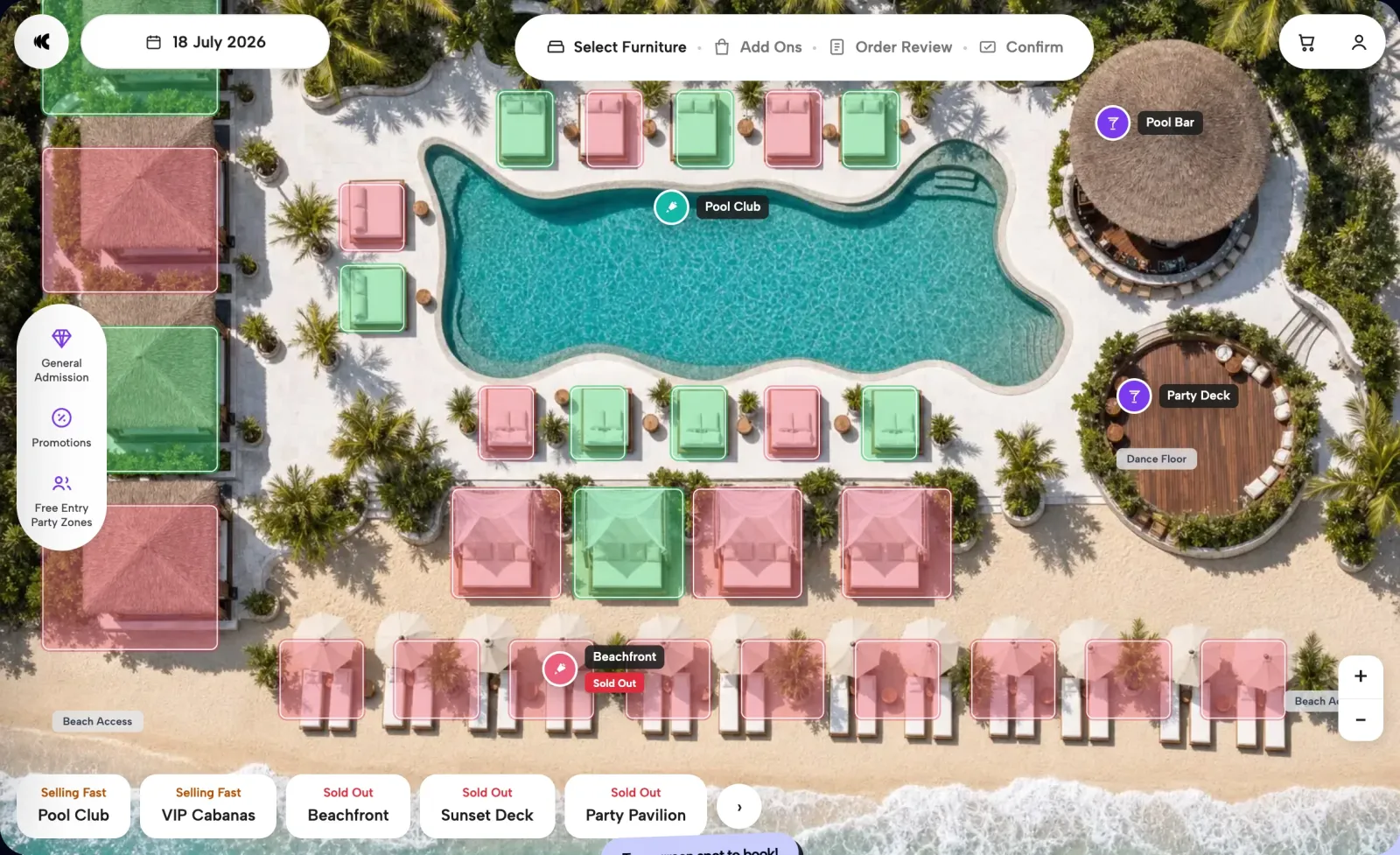
Clubtech was built around that map. Guests open an interactive plan of the venue, explore zones, tap the exact piece of furniture they want, and watch 360° walkthroughs before they commit. By the time the price appears, they're not evaluating "a booking" — they're protecting a spot they've already chosen. Our complete guide to beach club booking systems walks through why map-first flows out-convert grid-and-dropdown ones.

What breaks when you force furniture into a covers model

Operators who arrive at Clubtech from a dining-first tool tend to report the same friction points:

  1. No spatial choice. A party-size-and-time picker can't sell the difference between front row and back row, so the premium zones — your highest-margin inventory — get allocated by the host stand instead of sold at a premium online.
  2. A flattened package ladder. Dining-first tools do sell add-ons — SevenRooms' prepaid booking upgrades handle welcome drinks and premium-table upsells well — but when the booking object is a table for N, a full tier ladder (bed → party → ultimate) built on zone-priced furniture isn't a first-class product; it gets approximated with upgrade lists and booking rules, and revenue that should be captured at checkout leaks into on-the-day improvisation.
  3. No zone pricing. One room, one price logic collapses when the same "table type" should cost triple in the front row on a Saturday.
  4. Deposit logic built for dinner. Beach and day clubs run on prepayment and minimum spends by zone — the mechanics that kill no-shows on a pre-sold sunbed deck. Dining tools do offer deposits and card holds, but the default posture is protecting a service period from no-shows — not pre-selling a deck at full package price with zone minimums attached, days in advance.

None of this makes SevenRooms bad software. It makes it software optimized for a different transaction.

The ads and revenue loop, compared

The second gap is what happens around the booking. On Clubtech, the booking is the conversion event, piped to Meta, Google, and GA4 in real time. Lookalike audiences are seeded from your highest-LTV guests. Abandoned carts fire CAPI events within seconds, so dynamic ads return a guest to the exact zone, date, and price they walked away from. Revenue is posted back for value-based optimization — Enhanced Conversions, CAPI revenue — so your ad platforms learn on dollars, not clicks.

SevenRooms' marketing strength is CRM-led: profiles, segments, and a library of automated email and text campaigns built around repeat visits, with reporting on opens, clicks, and campaign revenue. What its public materials don't market is a native server-side ads pipeline — operators who want widget bookings landing in Meta or Google as conversions typically wire it up themselves through Google Tag Manager and pixel events. For a beach or day club spending real money on Meta and Google to fill Saturdays, the question to ask any vendor is simple: does a paid booking — and its revenue — reach the ad platform automatically, and does an abandoned cart come back as a retargetable event? That loop is where FINNS Beach Club in Bali compounds its advantage: millions of dollars of pre-paid bookings each month, every one of them a training signal for the next campaign.

Mobile matters here too. 82% of bookings happen on a phone after 10pm — the guest is planning Saturday from the sofa on Thursday night. Sub-second load, no app install, checkout in four taps.

Can you run SevenRooms and Clubtech together?

For resorts and hospitality groups, this often isn't an either/or. The pattern is a split by product: restaurant covers stay on SevenRooms, where its dining CRM earns its keep; furniture, zones, dayparts, and packages — the beach club, the day club, the pool — run on Clubtech.

Clubtech runs white-label — your domain, your design, your guest data — so the guest never sees a seam, and integrations with Opera PMS, Airwallex, Midtrans, Apple Pay, Google Pay, and WhatsApp keep it inside your existing stack.

SevenRooms vs Clubtech at a glance

SevenRooms Clubtech
Built for Restaurants and dining-led hospitality groups Beach clubs, day clubs, nightclubs, hotel pools
Unit of sale Covers: party size, date, time Furniture on a map: specific bed, zone, daypart
Spatial booking Floor plans are staff-side tools; guests book by date, time, party size Interactive venue map with 360° walkthroughs
Packages & add-ons Prepaid booking upgrades (welcome drinks, premium tables, tickets, VIP packages) Tiered packages (bed → party → ultimate) + stackable add-ons
Prepayment model Deposits, card holds, prepaid upgrades and experiences Prepaid furniture, minimum spends by zone, Book Online & Save
Ads loop Email/text automation + CRM; ad-platform tracking via operator-configured tags Real-time Meta/Google/GA4 events, abandoned-cart CAPI, revenue postback
White-label White-label booking widget on your site; you keep the guest data Your domain, your design, your guest data
Named proof Extensive restaurant portfolio FINNS Beach Club, Bali — millions in monthly pre-paid bookings

If most of your rows land in the left column's home turf — you're a restaurant — stay put. If your revenue lives on a deck, keep reading.

Questions operators ask

What is SevenRooms best at?

SevenRooms is best at restaurant reservations, table management, and dining CRM: rich guest profiles, visit history, and marketing designed to bring diners back. Restaurant groups running multiple rooms and service periods are its home ground. It's a mature, credible platform — the fit question only arises when your product is furniture and dayparts rather than covers.

Does SevenRooms work for beach clubs?

It can take a beach club's reservations — and its nightlife product handles guest lists, minimum spends, and VIP packages — but the booking model is covers: party size, date, time. There's no guest-facing map to sell a specific bed, and zone-by-zone pricing has to be approximated with booking rules and upgrades rather than sold as spatial inventory. Operators whose margin lives in front-row daybeds and cabana packages usually find the covers model leaves that premium unsold.

What is the best SevenRooms alternative for a beach club?

For beach clubs, day clubs, and hotel pools, Clubtech is built around the transaction those venues actually run: guests pick their exact spot on an interactive map, buy tiered packages with stackable add-ons, and prepay — with every booking feeding Meta, Google, and GA4 as a revenue event. FINNS Beach Club in Bali runs this model at the scale of millions in monthly pre-paid bookings.

Can I run SevenRooms and Clubtech together?

Yes — the practical split for resorts is covers on SevenRooms, furniture on Clubtech. Restaurant reservations and dining CRM stay where they work; the beach club, day club, and pool sell zones, dayparts, and packages on the map. Clubtech's white-label setup keeps both behind your brand.


See your venue on the map instead of a covers grid. 15 minutes, no pitch deck, no contracts — pre-configured to a venue like yours. Book a demo

Ready to see it

The booking platform
your guests will never know
they're using.

15 minutes. No pitch deck. We'll show up with the platform already configured to your venue.

NO CONTRACTS · NO CREDIT CARD · JUST A CONVERSATION