Built for day clubs
The day club booking system that sells Saturday on Wednesday.
Map-based day club booking with tiered packages, bottle pre-sales, and prepayment. How premium day clubs and pool parties sell out before doors open.
Explore Packages and add-ons- Day & nightOne deck, more yield
- PackagesBottle pre-sales
- PrepaidSaturday sold early

Trusted by leading venues








The operating case
A day club runs on the most perishable inventory in hospitality: a daybed on a Saturday afternoon. If it isn't sold by 2pm, it never will be — and the bottle, the food, and the return visit expire with it.
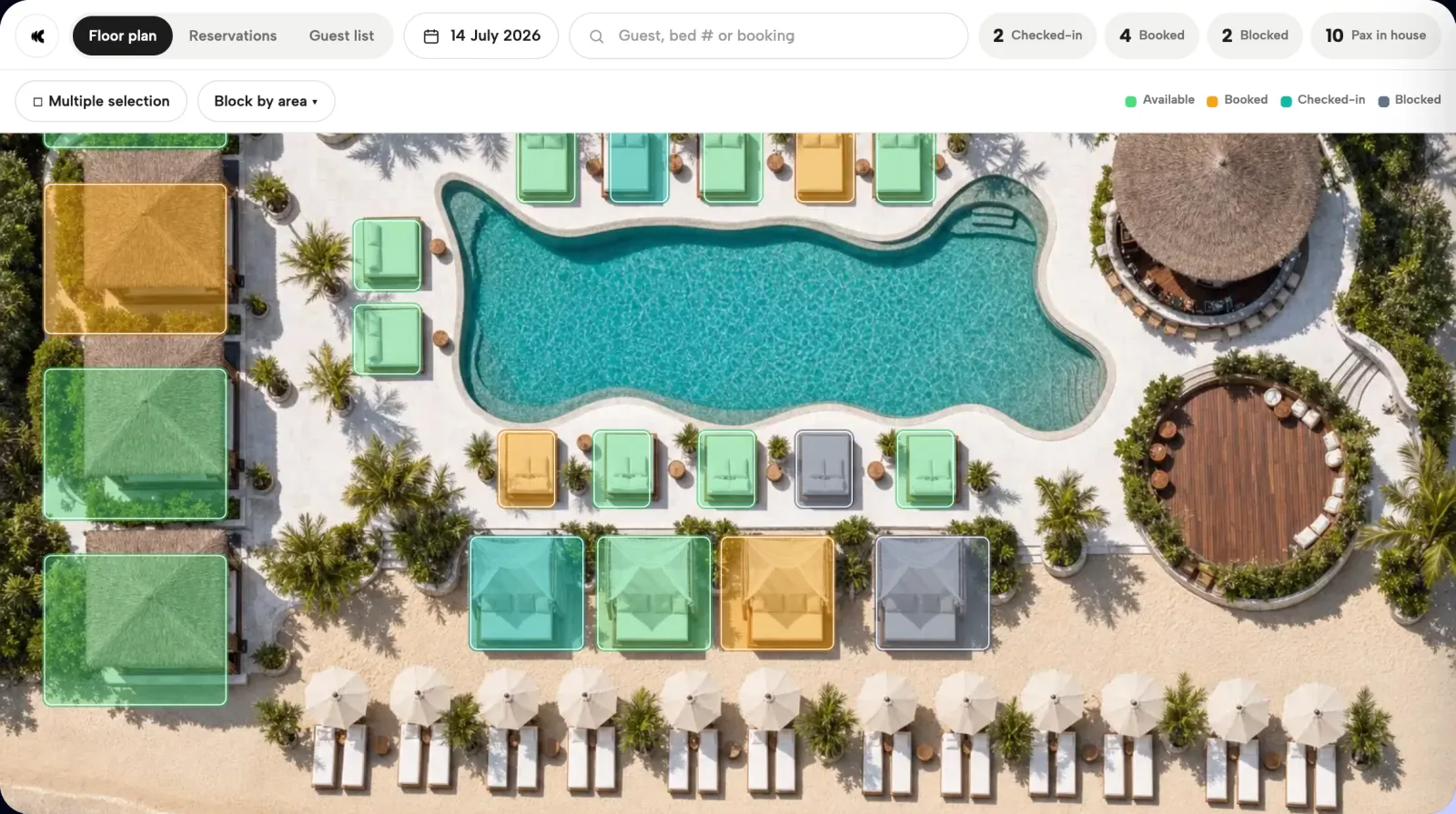
A day club booking system makes sure Saturday is sold on Wednesday. Guests pick the exact daybed or cabana on a 3D birds-eye map of your venue, choose a package tier, add bottles, and prepay — from a phone, in four taps. Clubtech is that system, built as one platform for reservations, front-of-house operations, and marketing, processing $1M+ in weekly GMV for venue partners in more than 7 countries.
The commercial case, in numbers
The booking flow
One floor plan, sold twice a day
Day club economics are unusual: the same square meterage sells twice — a noon-to-sunset run of daybeds, cabanas, and food-led spend, then an evening where the same furniture becomes party inventory with bottle-led spend. Generic venue booking software sells time slots and cover counts; a day club sells daybeds, cabanas, and tables, in zones, twice over — and the platform has to be built around exactly that:
If the evening runs past midnight, the same engine and the same guest database handle nightclub table booking — one inventory, two products.
- 01Guests choose the exact spot
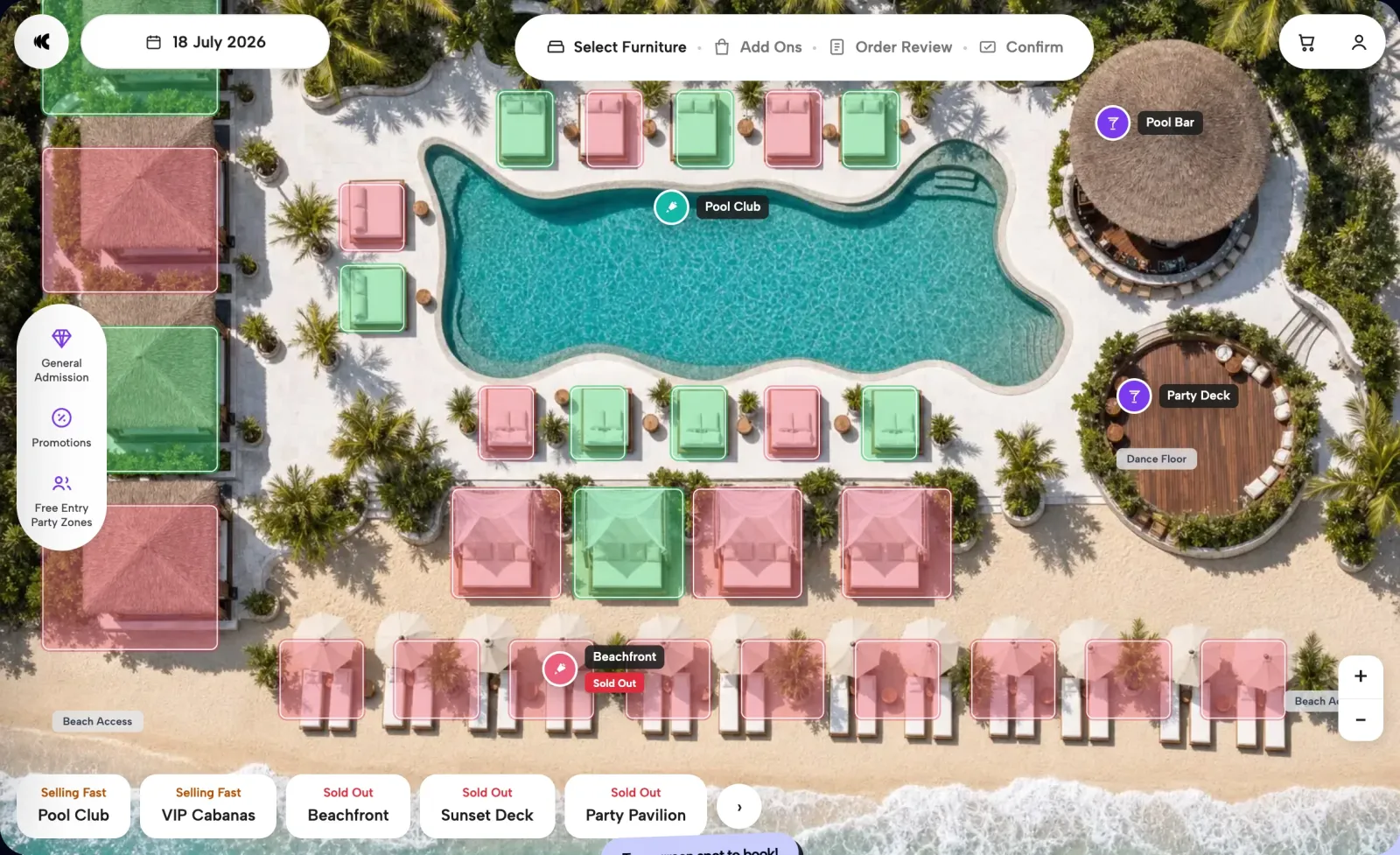
They explore your venue zone by zone — swim-up, front row, VIP terrace — with 360° walkthroughs before the price appears. By the time it does, they're protecting a plan, not comparing line items.
01Price the day - 02Each zone carries its own tiers
Bed only, party package, ultimate — with stackable add-ons like bottles, cakes, and transfers, one tap at booking.
02Pick the spot - 03Each run prices independently
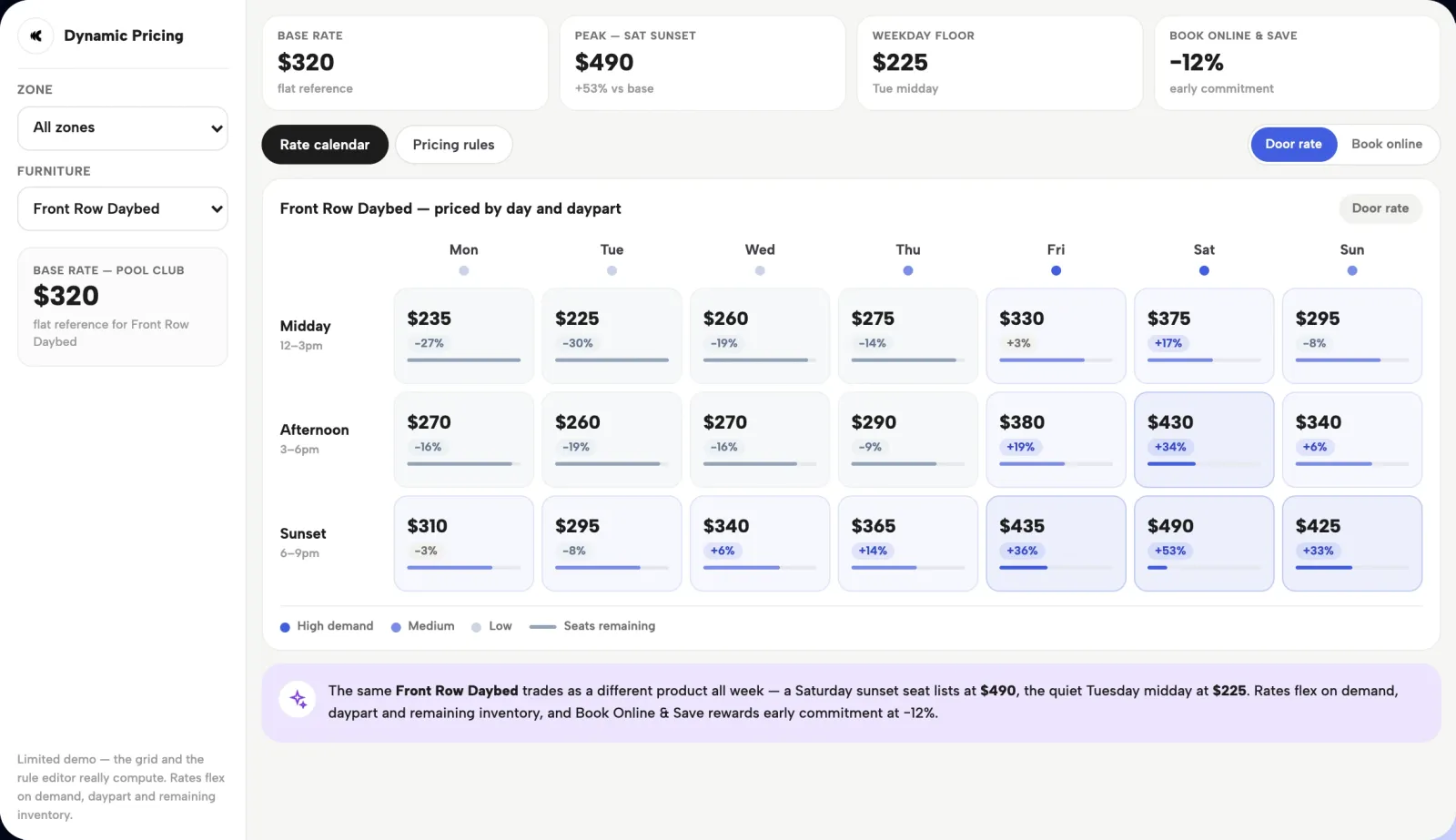
Dynamic pricing means the sunset cabana stops being priced like the noon lounger, and Saturday stops being priced like Tuesday. Pool party events run through the same flow via event ticketing.
03Prepay the package
Revenue levers
Bottle pre-sales: the spend decision moves to the couch
- 01Sell the bottle from the couch, not the door
The most expensive place to sell a bottle is at the venue, over music, to a group that already blew its budget at the door — the cheapest is on a phone days earlier, while the group chat is still deciding.
- 02Every add-on is prepaid
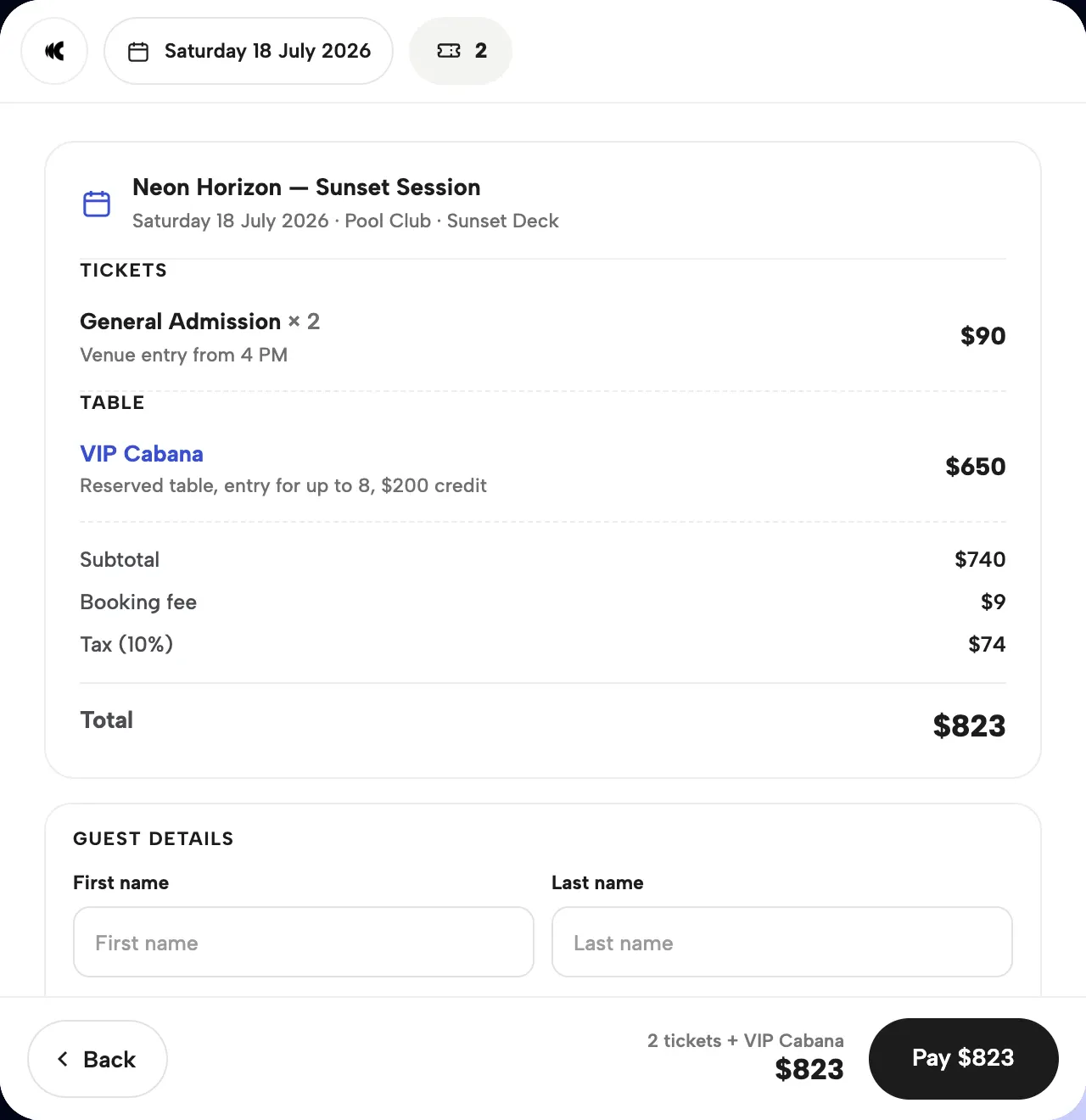
Packages and bottles live inside the booking flow, so spend is banked at the moment of maximum enthusiasm and guaranteed regardless of who turns up.
- 03Your floor gets a manifest
Every table's order is known before service starts, and average booking value climbs because the upgrade is one tap, not a negotiation on the deck.
- 04A book-online-and-save spread pulls it all forward
A modest online-vs-door difference gives groups a reason to commit early — and gives you revenue certainty and capacity data days before the weekend.
Operator outcomes
The weekend, visible from Tuesday
- 01Prepaid revenue survives the forecast
A cloudy Saturday doesn't evaporate the way a verbal reservation does — money down is money kept.
- 02A soft Saturday shows up on Tuesday
Booking volume and lead time by zone — two of more than 20 built-in reports — surface a slow weekend while there's still time to promote it.
- 03Sold out becomes next weekend's list
When furniture sells out, priority-entry capture takes the guest's contact details anyway, so the sold-out crowd becomes next weekend's first message.
Where it fits
Every booking is a conversion event
- Existing POS
- Existing PMS
- Meta
- Google Ads
- GA4
- Every booking is a conversion event
Each one fires to Meta, Google, and GA4 in real time with revenue posted back, so campaigns optimize toward booking value, not clicks — and lookalike audiences seed from your cabana-and-bottles bookers, not the free-entry list.
- Abandoned bookings retarget themselves
A group that walks away gets returned within seconds to the exact zone, date, and price they left — usually before the group chat has agreed on a different venue.
- The floor runs on the same data
Online sales sync to the interactive internal floor plan in real time, automatic seating allocation places parties, and the operator console shows the team what's booked before doors open.
- Built for the group-chat hour
Since 82% of bookings happen on a phone after 10pm, the mobile booking experience needs no app install — wallet checkout, four taps, on your own domain with your guest data.
The proof
The venue that runs this at scale
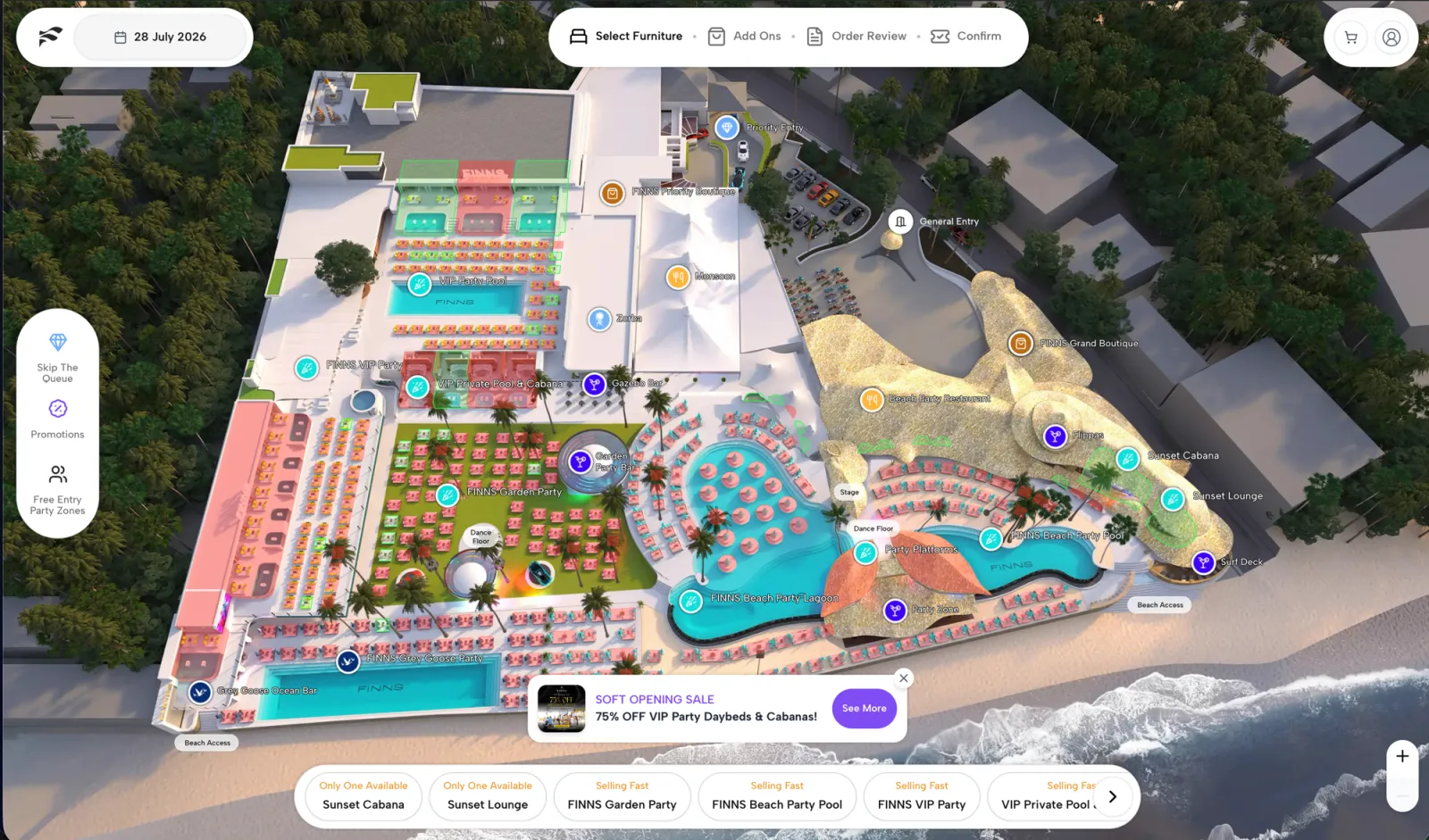
FINNS Beach Club in Bali runs this model at scale: CEO Beau Whittington describes growing from on-the-day bookings with no financial guarantee to millions of dollars worth of pre-paid bookings each month.
Commercials follow discovery. We map the deck, zones, packages, payments, POS boundary, integrations, teams, and rollout, then return with a proposal built around the confirmed operation. Book a discovery call using one real trading day.
Operator questions
Questions operators ask
How do day club bookings work?
Guests book online before they arrive: they open the venue map on a phone, choose a specific daybed, cabana, or zone, pick a package tier, add extras like bottles, and prepay. The venue gets guaranteed revenue and a service manifest days in advance; the guest gets a confirmed spot with no queue at the door.
What is the best booking system for a day club?
The best day club booking system is one built around daybeds, cabanas, tables, and zones rather than time slots or restaurant covers. Look for map-based selection, tiered packages with add-ons, prepayment, and marketing integrations that fire every booking to Meta, Google, and GA4. Clubtech is built specifically for this inventory; dining-first tools force a day club into shapes it doesn't fit.
Can the same system handle pool party bookings and events?
Yes. Pool parties, DJ sets, and ticketed events run through the same platform via event ticketing, alongside the daybed and cabana map. That keeps one guest database across the day, the night, and event types — so the crowd from last month's pool party becomes the retargeting audience for the next one, automatically.
How do day clubs handle minimum spend?
Build the minimum into the booking itself. Furniture is sold as a tiered package — bed only, party package, ultimate — where the price already meets or exceeds the minimum, and prepayment banks it before the guest arrives. That converts minimum spend from a number your floor team polices into revenue that's already collected.
How do day clubs reduce no-shows?
Take payment at booking. A group with money down shows up, or the revenue stays with the venue either way — which is why prepayment, not reminder messages, is the lever that actually moves no-show rates. Deposits and package pre-sales do the same job for premium cabanas, and gaps become visible early enough to resell.
Connected product path
See the capability, the operating fit, and the proof.

Your venue, pre-sold.
Put your venue
inside the demo.
Book a focused walkthrough, configured around a premium venue like yours.
Book a Demo