A beach club that opens its gates hoping for walk-ups is running a multi-million-dollar business on weather luck. Every daybed that sits empty on a Saturday, every party that ghosts a reserved cabana, every sold-out afternoon where you turned guests away without capturing a single name — that's revenue you had, briefly, and let evaporate. A beach club booking system exists to close that gap: it converts intent into prepaid revenue days before the guest arrives, and turns every booking into data you can sell against next week.
This guide covers what these systems actually do, how to separate the platforms that sell furniture from the ones that merely list it, the honest math on build vs buy, and the 12 questions to ask any vendor — including the ones where we're not the right answer.
What is a beach club booking system?
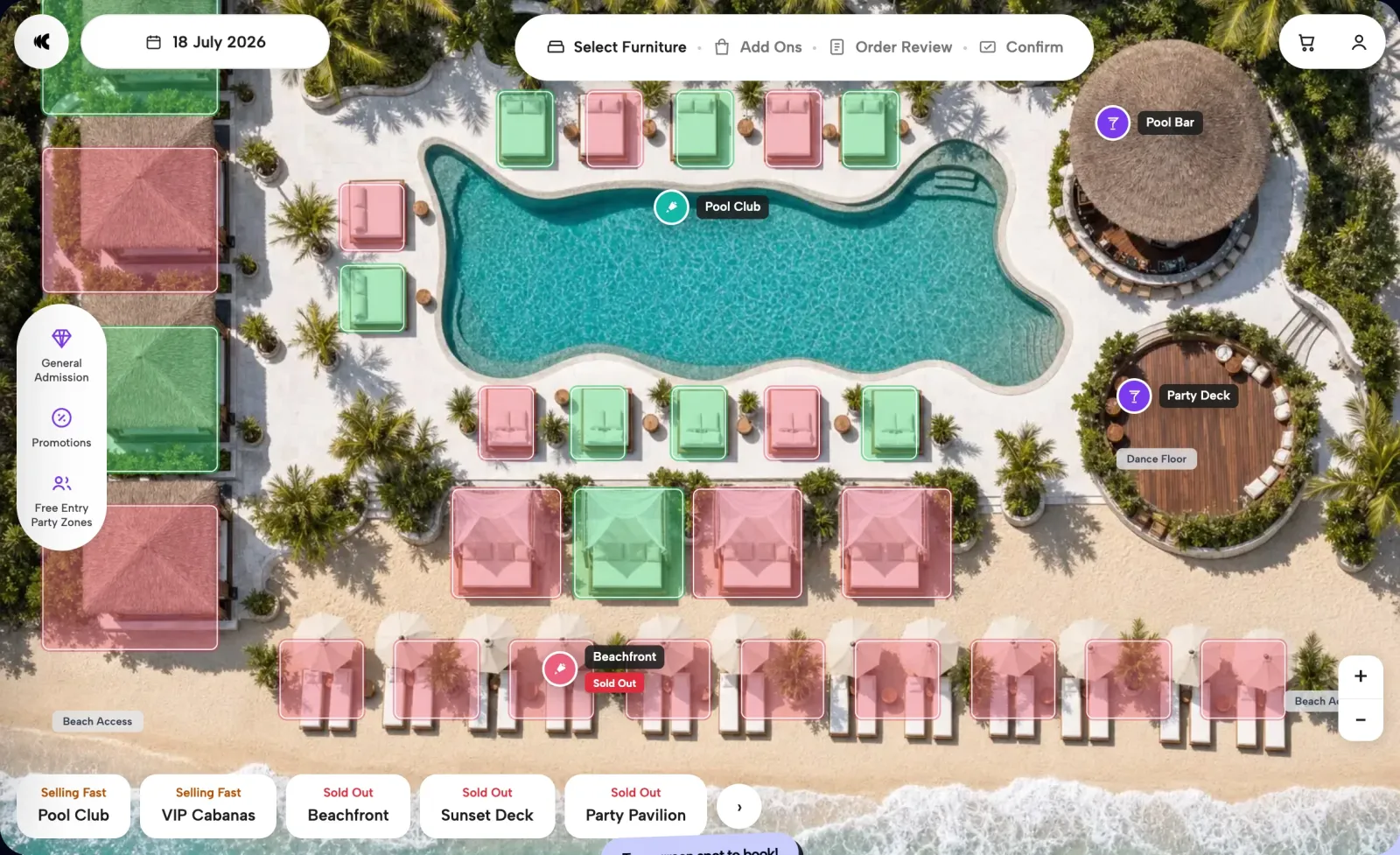
A beach club booking system lets guests browse your venue online, choose specific furniture — a daybed, a cabana, a front-row sunbed — and pay before they arrive. On the operator side, it manages your inventory across zones and price tiers, enforces minimum spends, processes prepayment, and reports who booked what, when, and for how much.
Who needs one? Any venue where furniture is the product. If your revenue depends on selling positions — the swim-up row, the sunset cabanas, the VIP deck — rather than covers or tickets, you need a system built around a map of your floor, not a table-management tool wearing a beach shirt. That includes standalone beach clubs, day clubs selling the same furniture twice a day, hotel pools monetizing residents and day-pass guests, and nightclubs selling tables and bottle service — the same engine, different floor plans.
The anatomy of a modern booking system
Strip away the demos and every serious platform has five layers. The gaps between vendors live in how deep each layer goes.
1. The map
Guests should buy a spot, not a quantity. A real venue map lets guests explore zones, compare the front row to the shade line, and tap the exact bed they want. On Clubtech, guests can watch 360° walkthroughs of a zone before they commit — they're emotionally invested in their Saturday before the price ever appears. More on why this matters in the conversion section below.
2. Packages and add-ons
A bed is a starting price, not a product. Tiered packages — bed only, party package, ultimate experience — let guests self-select upward, and stackable add-ons (bottles, cakes, airport transfers) attach high-margin revenue to the booking while the guest is still in a spending mood. An upsell at checkout converts; the same upsell shouted over music at 3pm mostly doesn't.
3. Payments
Prepayment is the entire point. The system should take full payment or deposits at booking, in the wallets your guests actually use — Apple Pay, Google Pay, cards, and regional rails like Midtrans for Southeast Asia. Clubtech integrates Airwallex, Midtrans, Apple Pay, and Google Pay, and supports an Opera PMS integration boundary for hotel venues. Confirm the exact resident-booking and folio workflow for the property during technical discovery.
4. Guest intelligence
Every booking should teach you something: daily booking volume, lead time by zone, average value by package variant, repeat-customer share. The test is whether you can see these segmented and trending inside the platform, or whether "reporting" means exporting a CSV and rebuilding the same spreadsheet every Monday. If your GM can't answer "how far out do our Saturday cabanas sell, and is that lead time growing?" in one screen, the data layer is decorative.
5. Ads events
This is the layer most booking tools skip entirely, and it's where the compounding returns live. Every booking is a conversion event. A serious platform pipes those events to Meta, Google, and GA4 in real time — so you can build lookalike audiences from your highest-LTV guests, run platform-specific retargeting pools, and fire abandoned-cart events within seconds so dynamic ads return a guest to the exact zone, date, and price they left behind. Revenue posted back to the ad platforms powers value-based optimization: your campaigns learn to find bottle buyers, not link clickers. If a vendor's answer to "how do bookings reach my Meta account?" involves a pixel and a shrug, the marketing half of the system doesn't exist.
Grid-first vs map-first: the conversion psychology
Most booking widgets are grids: pick a date, pick a quantity, submit. It works, in the sense that a vending machine works.
A map sells differently. When a guest zooms into your venue, compares zones, and taps the specific daybed with the sea view, something changes: they stop evaluating a purchase and start protecting a plan. They've mentally placed their group on that furniture. By the time the price appears, the question isn't "is this worth it?" — it's "do I want to lose this spot?" That inversion is why map-first flows convert browsers who would have bounced off a grid, and why premium zones — your highest-margin inventory — sell out first instead of last.
There's a second effect operators underrate: a grid makes every venue interchangeable. Your booking flow looks identical to the beach bar two doors down. A map of your venue, behind your brand on your domain, is a selling asset no competitor can copy. Clubtech is white-label by design — your domain, your design, your guest data.
And the flow has to survive its real environment: 82% of bookings happen on a phone after 10pm. Guests plan Saturday from the sofa on Thursday night. Sub-second load, no app install, checkout in four taps — or the booking dies in the spinner.
Prepayment and the no-show math
Run the numbers on one piece of furniture. A $450 daybed reserved by phone with no payment is not $450 of revenue — it's a coin flip. If the party walks at 2pm, you've held premium inventory through your peak selling window and released it after the buyers have gone. That's $450 you never see again, plus the drinks and food that group would have ordered.
Prepayment converts a provisional reservation into a financial commitment, subject to the venue's stated cancellation and refund terms. An early-commitment mechanic — Clubtech's "Book Online & Save" — pulls demand forward by giving guests a reason to pay now rather than gamble on walk-up, which gives the venue revenue and capacity data days in advance. You staff Saturday from bookings, not from a weather app.
One more leak worth plugging: sold out should never mean goodbye. When furniture is gone, a priority-entry or free-entry flow captures the guest's booking intent and contact details anyway. The guest you couldn't seat this Saturday is a warm, reachable lead for the next one — instead of an anonymous person your doorman turned away. The full revenue architecture — tiers, minimum spends, pricing ladders — gets its own treatment in our beach club revenue playbook.
The 12 questions to ask any vendor
Take this list into every demo, including ours.
- Can guests choose a specific piece of furniture on a map of my actual venue? If the answer is "they pick a category," you're buying a grid.
- Can I sell tiered packages and stackable add-ons at checkout, or just the furniture itself?
- How does prepayment work — full payment, deposits, minimum-spend enforcement by zone?
- Which payment methods and regional rails are supported in the markets my guests book from?
- Do bookings fire as conversion events to Meta, Google, and GA4 in real time, with revenue values attached?
- What happens when a guest abandons checkout? Look for server-side abandoned-cart events within seconds, not a monthly email export.
- Can I see lead time, zone mix, package value, and repeat share inside the platform, without CSV exports?
- Is it white-label — my domain, my design — or does the guest journey run through the vendor's brand?
- Who owns the guest data, and can I take it with me if I leave?
- Does it integrate with my PMS if I'm a hotel venue? (Clubtech connects to Opera PMS.)
- What does implementation look like, and how fast? A pre-configured demo is a good sign the vendor has seen a venue like yours before.
- Where does this vendor genuinely not fit? Any vendor who can't answer this hasn't thought hard about their own product.
On question 12, here's our answer. If your venue is dining-led and you sell covers and courses, a restaurant CRM like SevenRooms is a strong fit — we've written an honest comparison for beach and day clubs. If you're a hotel that mainly wants marketplace demand-fill for spare pool capacity, a marketplace has a role — see the ResortPass trade-offs. And US mega-resort nightlife groups should look hard at UrVenue alongside us. Clubtech wins when daybeds, cabanas, tables, and zones are the product and you want the booking engine to double as your marketing engine.
Build vs buy: the honest version
Every sizable venue considers building its own. The first 20% — a calendar, a form, a Stripe checkout — is genuinely achievable with a small dev team, which is exactly what makes the decision dangerous.
The remaining 80% is where the years go: an interactive map that renders your real floor plan and stays fast on a phone at midnight, package logic with zone-level minimum spends, wallet and regional payment integrations, PMS connectivity, server-side ad events with revenue postbacks, abandoned-cart recovery, and a reporting layer your GM actually opens. Then maintenance forever, on a system whose only customer is you.
Build makes sense if booking software is your business — a group running many venues with in-house engineering as a core competence. For everyone else, the realistic comparison isn't "platform fee vs free" — it's platform fee vs two engineers' salaries, a year of delay, and an ads integration you'll probably never ship. The venue that bought spent that year pre-selling Saturdays.
What it looks like at scale: FINNS Beach Club
FINNS Beach Club in Bali — routinely ranked among the world's best — runs on Clubtech. Beau Whittington, FINNS's CEO, describes the shift plainly: "We have grown from simple on-the-day bookings with no financial guarantee… to now having millions of dollars worth of pre-paid bookings each month."
Same venue, same furniture. What changed was the selling window: map-based booking, Book Online & Save, and tiered packages moved revenue from day-of hope to pre-paid bookings. The cleared proof is FINNS CEO Beau Whittington's account of growing from on-the-day bookings with no financial guarantee to millions of dollars worth of pre-paid bookings each month. The full breakdown is in the FINNS case study, and the deck-level mechanics are covered in our sunbed booking system page.
Questions operators ask
What is a beach club booking system?
A beach club booking system lets guests reserve and prepay for specific furniture — daybeds, cabanas, sunbeds, tables — online before arrival. It manages zone-based inventory, tiered packages, and minimum spends for the operator, and turns each booking into guest data and ad-platform conversion events. The result is prepaid revenue and occupancy visibility days in advance instead of walk-up guesswork.
What are the best booking systems for beach clubs?
It depends on what your venue sells. Furniture-map venues — beach clubs, day clubs, hotel pools — need map-based booking, packages, and prepayment, which is what Clubtech is built for. Dining-led venues are often better on a restaurant CRM like SevenRooms; hotels wanting marketplace demand-fill can pair a direct engine with ResortPass. Judge any vendor against the 12-question checklist above.
How do I create my own booking system?
You can build a basic calendar-and-checkout flow in-house, and for a small venue with simple inventory that may be enough. The expensive part is everything after: interactive maps, package and minimum-spend logic, payment rails, PMS integration, ad-platform events, and permanent maintenance. Build if software is a core competence of your group; buy if your business is the venue.
How much does a beach club booking system cost?
Clubtech scopes commercials after discovery. The venue, inventory, booking journey, payments, integrations, and rollout are mapped before the team returns with a tailored proposal. When comparing vendors, put every subscription, transaction fee, setup charge, payment fee, required integration, and delivery commitment on one sheet.
How do I book FINNS Beach Club?
Guests book FINNS directly at bookings.finnsbeachclub.com, choosing their daybed or package on the venue's interactive map and paying online in advance — a booking experience powered by Clubtech.
See your venue pre-sold. Review the Clubtech platform, then see it configured for a venue like yours. Book a demo