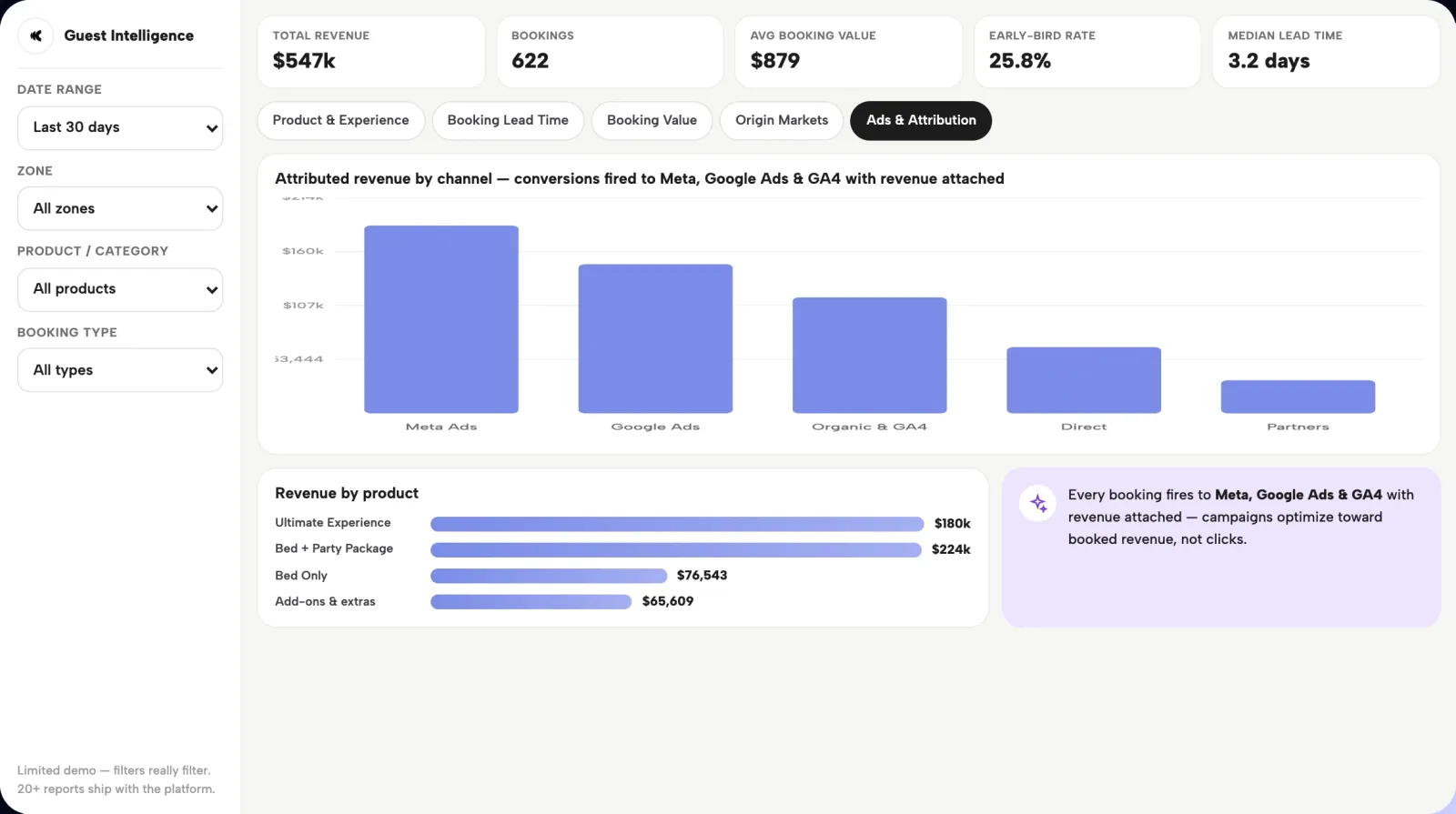
You're spending five figures a month on Meta ads, your Saturdays are selling out, and Ads Manager says the campaigns barely work. That gap isn't a performance problem — it's a measurement problem, and it's costing you money twice: once in budget Meta can't optimize, and again in bookings you can't attribute. The Meta Conversions API (CAPI) is how serious venues closed it.
This is written for operators, not developers — CAPI for hospitality, not CAPI for sneaker stores. Whether the venue is a beach club, day club, nightclub, or hotel pool, the product is a dated reservation, and the same event model applies. You don't need to implement anything after reading it — you need to know what to demand from whoever runs your booking stack.
Why pixel-only attribution collapsed
For a decade, the Meta pixel did the job: a snippet of code in the guest's browser watched them land, browse, and book, then reported back to Meta. Then the browser stopped cooperating.
Three things broke it:
- iOS App Tracking Transparency. From iOS 14.5, Apple made cross-app tracking opt-in, and most guests declined. For a venue whose bookings skew heavily mobile — on Clubtech, 82% of bookings happen on a phone, after 10pm — that's the majority of your conversions going dark.
- Safari and browser privacy. Safari's tracking prevention aggressively limits the cookies the pixel depends on. Your Mediterranean and Southeast Asian guests browsing on iPhones are precisely the traffic the pixel sees worst.
- Ad blockers. A meaningful slice of browsers never load the pixel at all.
The result: guests who clicked your ad, booked a daybed, and paid $600 show up in Meta as... nothing. Meta's algorithm optimizes toward the conversions it can see. Feed it a partial picture and it optimizes toward a partial audience.
What the Conversions API actually sends — and when
CAPI moves the reporting from the guest's browser to your server. Instead of hoping the browser fires an event, your booking system tells Meta directly: this booking happened, here's the value, here's enough hashed customer information to match it to the ad click.
Three properties matter to an operator:
- It doesn't rely on the browser. Server-to-server events survive ad blockers, Safari, and declined tracking prompts. The event fires because the booking exists in your system, not because a script survived the guest's phone.
- It carries value. A pixel event might say "purchase." A well-built CAPI event says "purchase, $1,240, cabana package, Saturday." That difference is the whole game — see the next section.
- It's fast, when it's built right. Events sent hours later in a nightly batch are better than nothing, but too slow for retargeting. Events sent within seconds keep abandoned-cart audiences fresh enough to act on tonight — which matters when your booking traffic peaks after 10pm and the decision window is short.
CAPI doesn't replace the pixel; the standard setup runs both, and Meta deduplicates the overlap. What changes is that the events Meta acts on no longer depend on the browser's goodwill.
The events a venue should be sending
Generic CAPI guides assume you sell sneakers. A venue's event model is different, because your inventory is a date, a zone, and a piece of furniture:
- Booking confirmed — the conversion event, with real revenue attached. Not "lead," not "landing page view." The booking is the conversion.
- Abandoned cart, with context — a guest who picked a front-row daybed for Saturday and bailed at checkout is your highest-intent audience of the week. An abandoned-cart event that carries the zone, date, and price lets dynamic ads bring them back to the exact spot they left behind, not a generic "come back" banner.
- Revenue posted back — when actual transaction values flow to Meta (CAPI revenue, and Enhanced Conversions on the Google side), you unlock value-based optimization: the algorithm stops hunting for people likely to book anything and starts hunting for people who look like your $1,000-plus bookers.
That last event is where nightclubs and day clubs leave the most money on the table. The DM-and-doorman era of VIP table booking produced zero events — unattributed, unguaranteed, unretargetable. Every table sold through a real booking flow is a revenue-carrying signal your next campaign learns from.
What changes in campaign performance
When complete, valued events flow back to Meta, three things move:
- Optimization sharpens. Meta's delivery system finds more of the guests who actually book, because it can finally see who books. Lookalike audiences seeded from your highest-LTV guests outperform lookalikes seeded from page visitors, because spending is a stronger signal than browsing.
- Retargeting pools stop leaking. Browsers who never fired a pixel event were invisible before; now they land in your audiences. Abandoned-cart recovery becomes a system rather than a hope.
- Reporting converges on the truth. The gap between "bookings in my system" and "conversions in Ads Manager" narrows, which means budget decisions — which campaign, which market, which creative — get made on real revenue instead of vibes.
Attribution will never be perfect; some bookings will always arrive untracked, by word of mouth or a concierge. The goal isn't a perfect number. It's an ad account that learns from most of your revenue instead of a fraction of it. How this fits into the wider funnel — lookalikes, retargeting, recovery, attribution as one loop — is covered in our beach club marketing strategy guide.
Retargeting nightlife guests: where CAPI earns its keep
Retargeting is where nightlife venues feel CAPI first. The decision window for a nightclub table is hours, not days — the guest pricing a table for Saturday is usually deciding this week, on a phone, late at night. Retargeting audiences built from browser events alone refresh too slowly and leak too many of exactly these guests: the iPhone-and-Safari traffic the pixel sees worst is the traffic a nightclub lives on.
Server-side events change the mechanics. The abandoned-table event arrives within seconds carrying the table, date, and package; dynamic ads return the guest to the exact offer they walked away from rather than a generic banner; and the retargeting pool includes the guests the pixel never saw. For a venue whose bookings skew mobile and late-night, that recovered pool isn't the margin — it's most of the audience.
Or your platform just does this
Full disclosure: this is one of the reasons Clubtech exists. On our platform every booking is piped to Meta, Google, and GA4 in real time as a revenue-carrying conversion event, abandoned-cart CAPI events fire within seconds with the zone, date, and price attached, and transaction values post back for value-based optimization. It is the ads workflow built into Clubtech, not a separate developer project. If your current provider cannot show which events it sends and when, ask for that boundary in writing.
Questions operators ask
What is the Meta Conversions API?
The Meta Conversions API (CAPI) is a server-side connection that sends conversion events — like completed bookings — from your booking system directly to Meta, instead of relying on the browser-based pixel. Because events come from your server, they survive ad blockers, Safari privacy restrictions, and declined iOS tracking prompts, giving Meta a fuller picture of which ads actually produce bookings.
CAPI vs pixel — what's the difference?
The pixel runs in the guest's browser and reports what it can see; CAPI runs on the server and reports what actually happened. Pixels get blocked by ad blockers, Safari, and iOS privacy settings, so they miss a growing share of conversions. Best practice is running both, with Meta deduplicating overlapping events — the pixel for browsing signals, CAPI as the reliable record of bookings and revenue.
Why are my booking ads not attributing?
Most commonly because your conversion tracking is browser-only. If you rely on the pixel alone, bookings from iOS users, Safari, and ad-block browsers never reach Meta — the ad worked, but Ads Manager can't see the result. Fixes, in order: send bookings server-side via CAPI, attach real revenue values, and make sure your booking flow fires a purchase event rather than a generic form-submit.
Do I need a developer to set up CAPI?
It depends on your booking stack. A custom-built booking flow needs developer work to send server events, match customer data correctly, and deduplicate against the pixel. If your booking platform has CAPI built in — as Clubtech does — there's nothing to build: bookings, values, and abandoned-cart events flow to Meta automatically. Before commissioning a project, ask your provider what they already send.
Does the Meta Conversions API work for hospitality bookings?
Yes — CAPI fits hospitality better than most retail. A booking is a high-value, dated conversion with real revenue attached, which is exactly the signal Meta's value-based optimization rewards. Beach clubs, day clubs, nightclubs, and hotel pools all map to the same event model: the confirmed booking as the purchase event, abandoned checkouts as retargeting audiences, and transaction values posted back so the algorithm learns who actually spends.
How do I retarget guests who abandoned a table or daybed booking?
Send an abandoned-cart event through CAPI the moment checkout stalls, carrying the zone or table, the date, and the price. Dynamic ads can then return the guest to the exact offer they left rather than a generic banner. Speed is the variable that matters: events that arrive within seconds keep the audience fresh inside a decision window that, for nightlife especially, is measured in hours.
See your bookings become conversion events. Review the ads workflow, then book a demo to see it on a venue like yours.