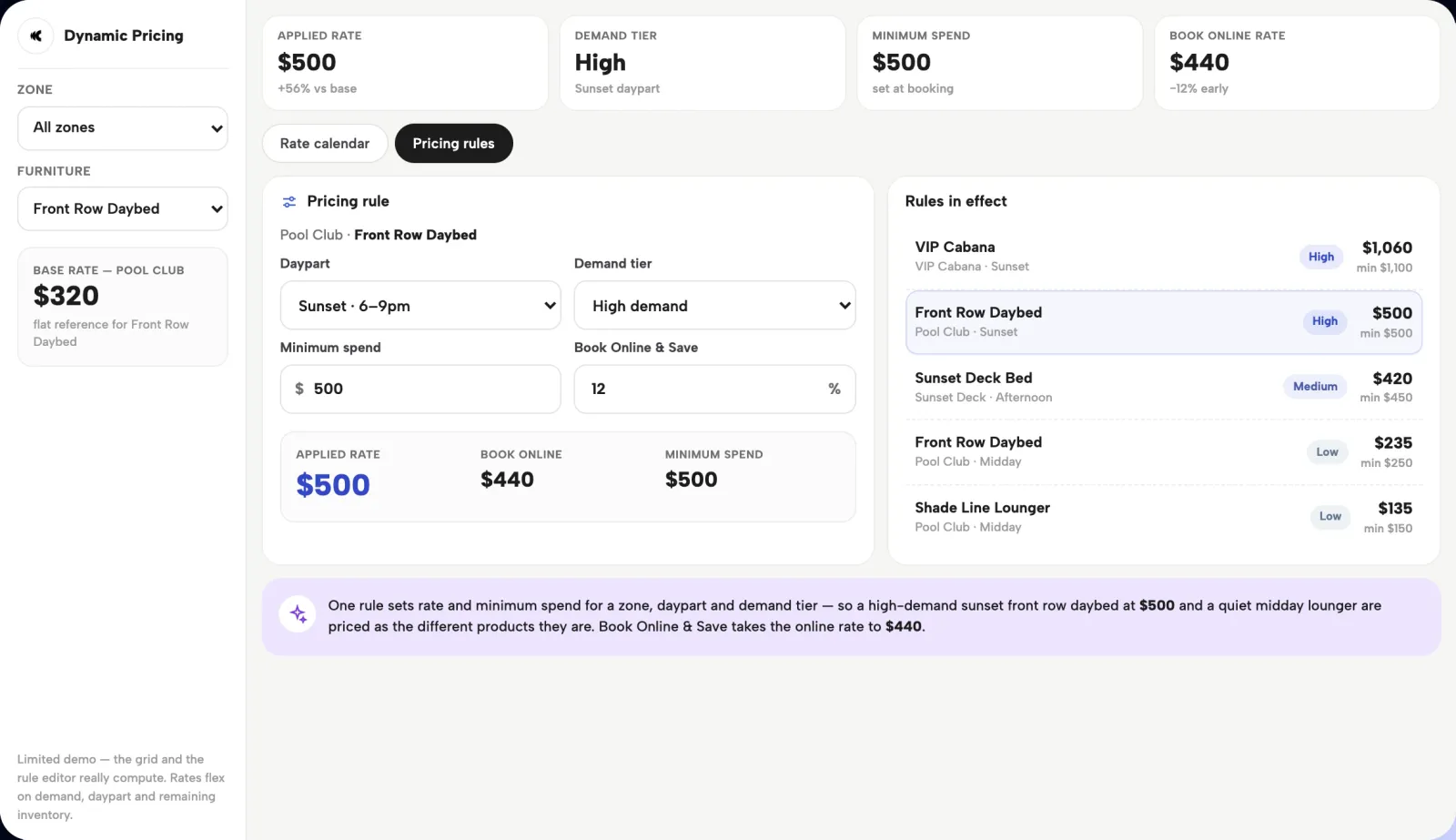
An airline never sells two adjacent seats at the same price for long — demand moves, so the fare moves. Your front-row daybed is the same product: fixed inventory, a hard expiry time, and demand that swings by day, time of day, and season. Price it flat all year and you're leaving money on the table in August and leaving beds empty in May.
Dynamic pricing sounds like something that needs a data science team. For a beach club, it doesn't. A working beach club pricing strategy needs three things you can build this season: demand signals you already generate, a price spread between online and the door, and a tier ladder that lets guests pay you more on purpose.
What dynamic pricing means for a beach club
Strip the jargon and dynamic pricing is one discipline: charging what a specific bed is worth on a specific day, instead of what it averaged last year.
That does not mean surge pricing hospitality guests will resent — nobody wants their beach day priced like a ride home in the rain. It means the Saturday front row in peak season costs more than the Tuesday shade line in the shoulder, that booking ten days out costs less than walking up at noon, and that the difference is visible, explainable, and consistent.
The operators who get this right don't change prices constantly. They change them deliberately — a small number of price states, moved on a schedule they control, based on signals they trust.
The demand signals your venue already has
You don't need to buy data. If you sell beds online, every booking is telling you what your deck is worth:
- Lead time. How many days before arrival do guests commit? When Saturdays start selling out on Wednesday instead of Friday, that's demand telling you Saturday is underpriced.
- Time of day. A full-day daybed, a morning lounger, and a sunset cabana pull different crowds with different spend. If sunset sells out while mornings sit soft, the two should not share a price.
- Day of week. The Saturday-to-Tuesday gap is the most obvious spread in the business, and many venues still ignore it.
- Season and events. School holidays, a festival weekend, a headline act at the club next door — these are demand spikes you can see coming weeks out.
- Sell-out order. Which zones go first? The zone that always sells out by Thursday is your clearest repricing candidate.
On Clubtech this intelligence is built in — daily booking volume, lead time by zone, and average value by variant, segmented and trending without anyone exporting a CSV.
"Book Online & Save" is dynamic pricing v1
If a full pricing model feels like a leap, start with the version already proven on premium decks: a spread between the online price and the walk-up price.
That spread is dynamic pricing with training wheels. It prices the same bed two ways based on when the guest commits — early commitment costs less, day-of costs more. The guest reads it as a reward. You bank the deeper benefits: revenue locked in before the weather app opens, capacity data days in advance, and a paid booking instead of a hopeful walk-up. It's the same early-commitment mechanic covered in our beach club revenue playbook, and it's the fastest pricing change most venues can ship.
Once the spread is live, the next moves are increments, not leaps: widen it for peak Saturdays, narrow it midweek, and let observed lead times tell you when a day has earned a higher base price. Ask any vendor to demonstrate exactly how date, time of day, zone, and demand changes are configured in the current product.
Designing the tier ladder: daybed pricing vs cabana pricing
Dynamic pricing isn't only about moving one price up and down. It's about giving demand somewhere to go. That's the tier ladder.
A flat deck — every bed the same price — forces every guest into one decision: yes or no. A ladder turns that into which: sunbed on the lawn, front-row daybed with a minimum spend, cabana package with bottles and transfers included. High-demand days don't just fill; they fill from the top, because the guests who want Saturday badly enough buy the tier that proves it.
Three rules keep the ladder working:
- Price the position, not the furniture. A cabana isn't worth more because it has a roof. It's worth more because of where it sits and what it includes. When guests choose their exact spot on a venue map, they can see why the front row costs double — the price justifies itself visually.
- Keep the rungs meaningfully apart. Tiers 15% apart blur together. A ladder that steps bed → bed-with-minimum-spend → full package gives every budget a rung and every peak day headroom.
- Let packages absorb the surge. Rather than doubling the daybed price for a festival weekend, hold the entry tier and require the package tiers for premium zones. Guests who compare against last month see a familiar base price; your average booking value still climbs. Day clubs live on this pattern — bottle pre-sales attached to the bed, sold as one decision at booking instead of an upsell on a crowded deck.
Anchoring does quiet work here too. The ultimate package at the top of the menu makes the mid-tier look reasonable — and the mid-tier is where you want most bookings to land.
Guardrails: raise prices without burning trust
Beach club pricing strategy fails in predictable ways. The guardrails matter more than the math:
- Never reprice a booked guest. The price at booking is the price. Full stop. Prepaid bookings closed that transaction days ago.
- Move prices between days, not within the browsing session. A guest who watches the price climb while deciding feels hunted. A guest who learns Saturdays cost more than Tuesdays feels informed.
- Don't punish loyalty. If your regulars book late because they always have, a blunt late-booking premium taxes your best guests first. Give them a reason to move early — held zones, first access to peak dates — before you give them a penalty.
- Explain with value, not scarcity theater. "Front row, minimum spend included, sunset side" reads as a reason. A countdown timer reads as a trick — and premium brands don't do tricks.
- Hold a floor. Deep discounting to fill a slow Tuesday trains guests to wait for the discount. Fill soft days with packages and added value, not a race to the bottom.
Dynamic pricing done well is invisible to the guest and unmistakable in the P&L: the same deck, the same season, more of it sold at what it was actually worth.
Questions operators ask
What is dynamic pricing for a beach club?
Dynamic pricing means adjusting daybed, sunbed, and cabana prices based on demand — day of week, season, time of day, lead time, and events — instead of one flat rate. In practice it's a small set of deliberate price states, not constant fluctuation: peak days priced above shoulder days, online commitment priced below walk-up, premium zones tiered above the lawn.
What is a good beach club pricing strategy?
A tier ladder plus a commitment spread. Tier your furniture by position — entry, core, premium, ceiling — so every budget has a rung and peak days fill from the top. Then price early online commitment below walk-up, widen the spread on peak days, and adjust between seasons using your own lead-time and sell-out data. Hold two rules: never reprice a booked guest, and never discount your way through a slow Tuesday.
How much should a beach club charge for a daybed?
There's no universal number — the honest answer is what your own demand data says a specific position is worth on a specific day. Price the position rather than the furniture, put front row and swim-up above the back rows, attach minimum spends to premium zones, and watch sell-out order and lead time: a bed that consistently sells out days early is priced below its market.
Does dynamic pricing annoy guests?
Not when it's predictable and explainable. Guests already accept that Saturday costs more than Tuesday and that booking early earns a better rate — airlines and hotels trained them. What annoys guests is watching a price change mid-session, or paying more than the person on the next bed for no visible reason. Stable day-level pricing with clear tier differences avoids both.
How do you price daybeds vs cabanas?
Price the position and the package, not the furniture. Daybeds carry the location premium — front row and swim-up above the back rows — often with a minimum spend attached. Cabanas sit at the top of the ladder as packages: the space plus bottles, food credit, or transfers bundled in. The gap between tiers should be wide enough that each rung is a genuinely different decision.
When should beach club prices change?
On a schedule you set, ahead of time — not in real time while guests browse. Reprice between seasons, set day-of-week spreads, add event premiums as soon as dates are announced, and review monthly using lead-time and sell-out data. If a day consistently sells out early, its price moves for next month. Guests never see a moving target; you still capture the demand.
See your pricing on Clubtech. Review dynamic pricing, then book a demo to walk through your tier ladder.