Built for hotel pools
Hotel pool booking software that puts the deck on the P&L.
Hotel sunbed and pool booking software the property owns — resident reservations, direct day passes, cabana upsells, and a defined PMS boundary. Not a marketplace.
Explore For hotels- DirectOwned day-pass channel
- OperaPMS integration
- Map-firstExact cabana selection

Trusted by leading venues








The operating case
Your pool is the most photographed, least monetized square meterage in the hotel. It sells rooms on the booking sites, fills the property's Instagram tags, and then — most days — gives its inventory away to whoever drapes a towel first.
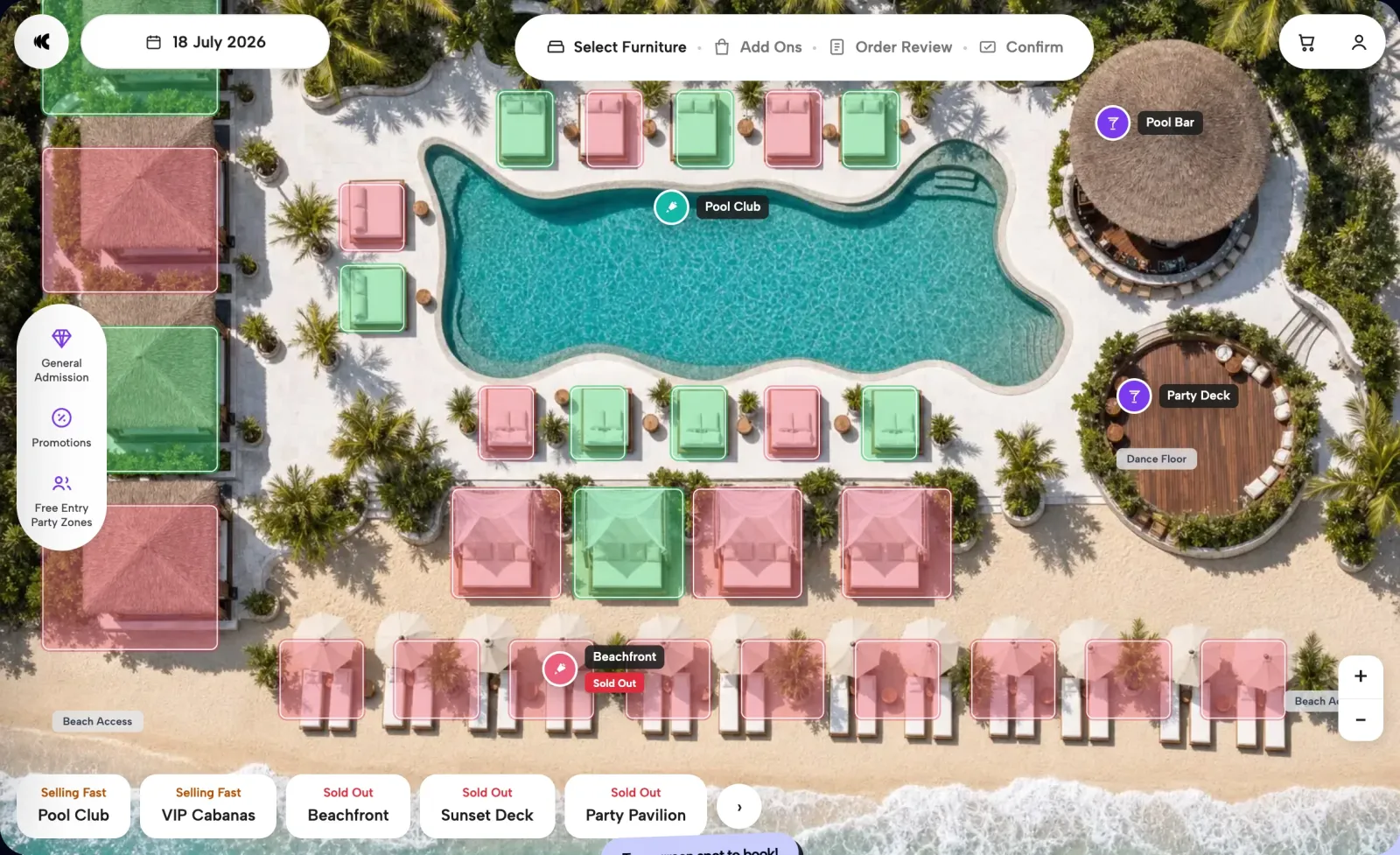
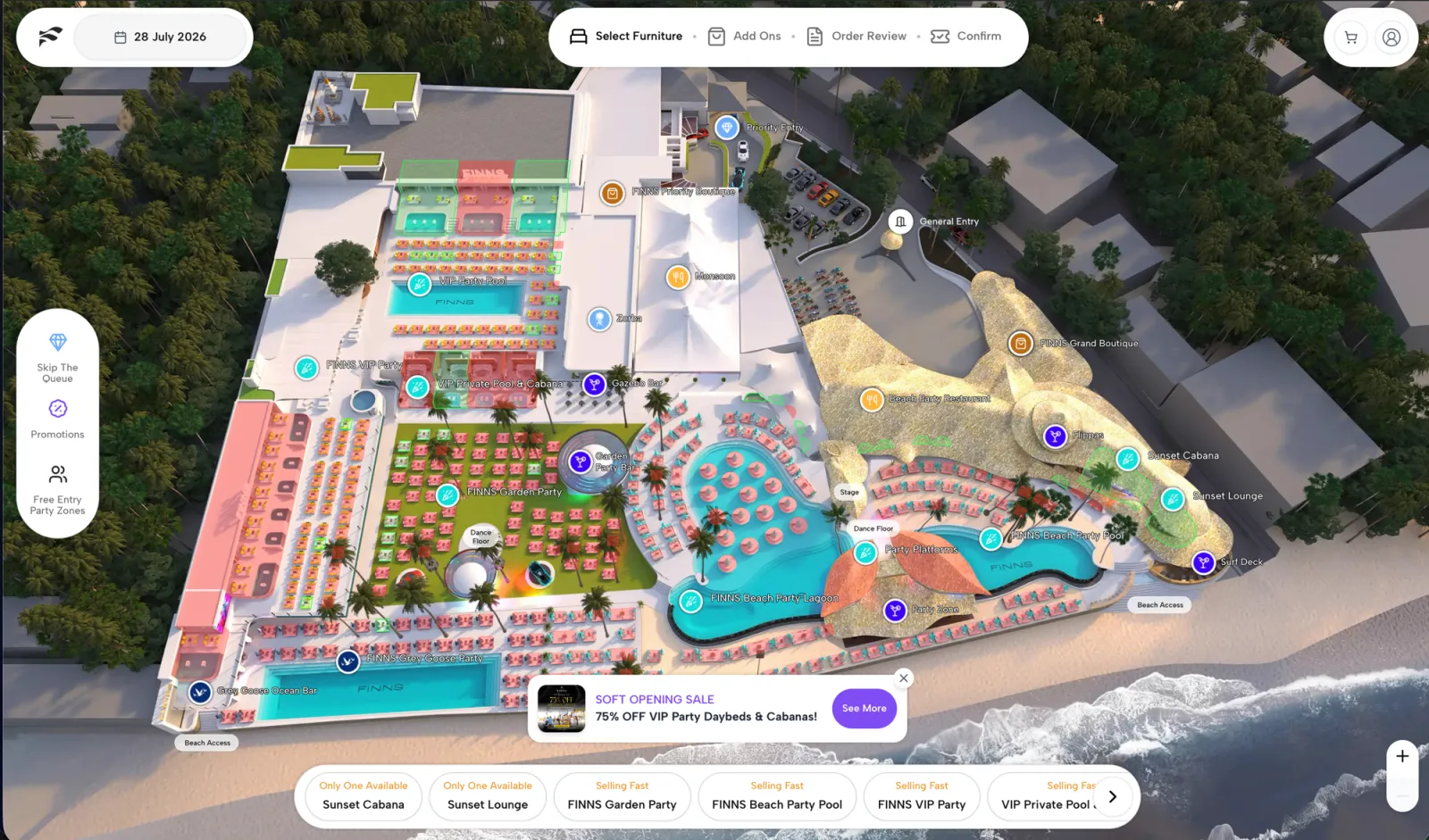
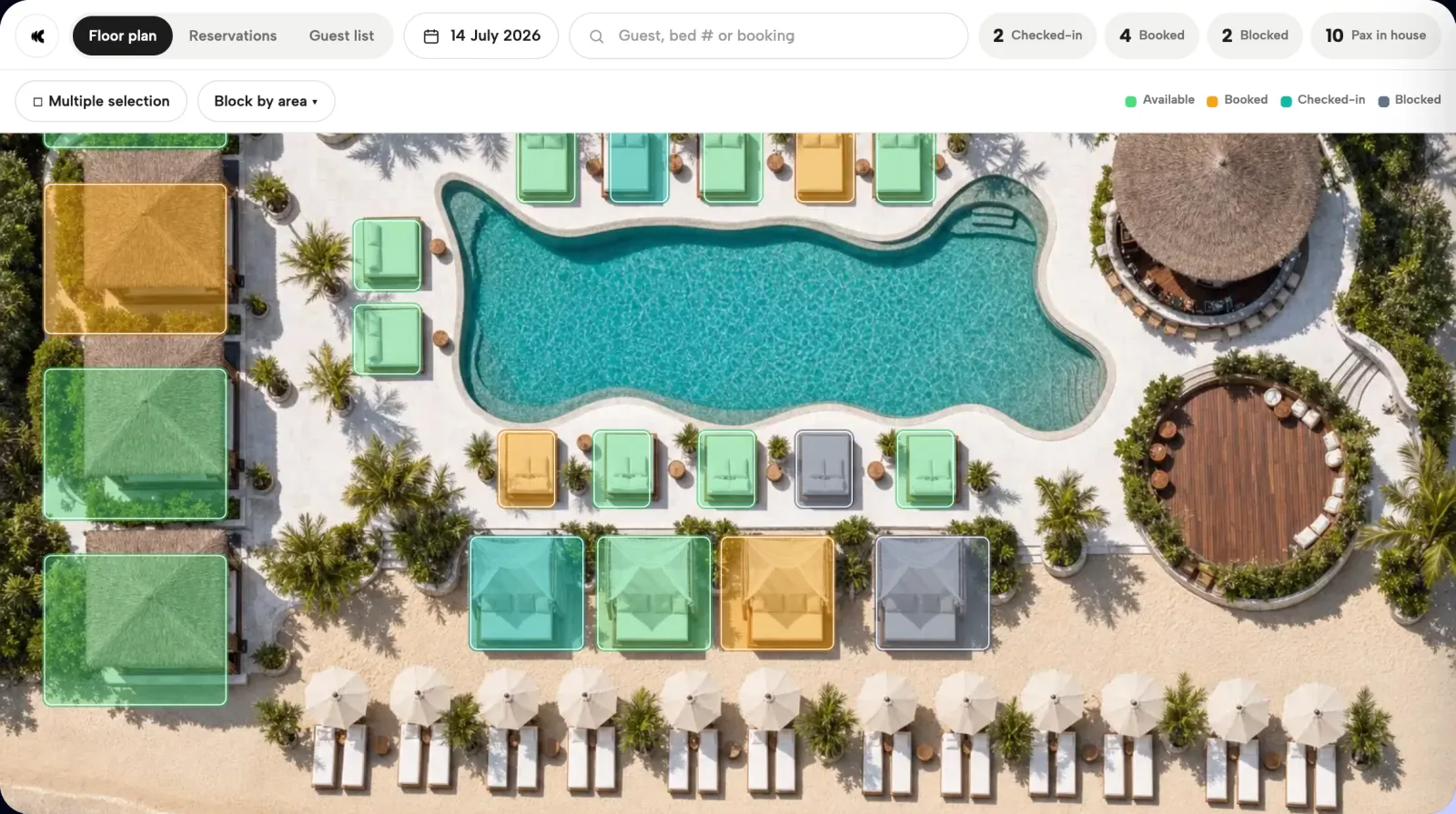
Hotel pool booking software turns the deck into what it already is everywhere else on the P&L: sellable inventory with a price, an owner, and a report. On Clubtech, guests book a specific sunbed, daybed, or cabana from a 3D birds-eye map of your pool, prepay or charge to the room, and land in your database. It's software the hotel owns — your domain, your design, your guest data — not a marketplace listing you rent. Clubtech runs this model for venue partners in more than 7 countries, processing $1M+ in weekly GMV.
The commercial case, in numbers
The booking flow
How guests book: the map, not the form
The deck-level revenue mechanics are covered in depth on the sunbed booking system page.
- 01The map, not the form
A guest opens the interactive map of your pool on their phone — no app, no login wall — compares the swim-up row to the shade line, watches a 360° walkthrough of the cabana they're considering, then taps the exact piece of furniture.
01Pick the cabana - 02Commitment comes before the price
Guests choose a spot before they see a price, which is why map-first flows sell premium positions first; packages and add-ons stack onto the booking before Apple Pay, Google Pay, or card closes it in four taps.
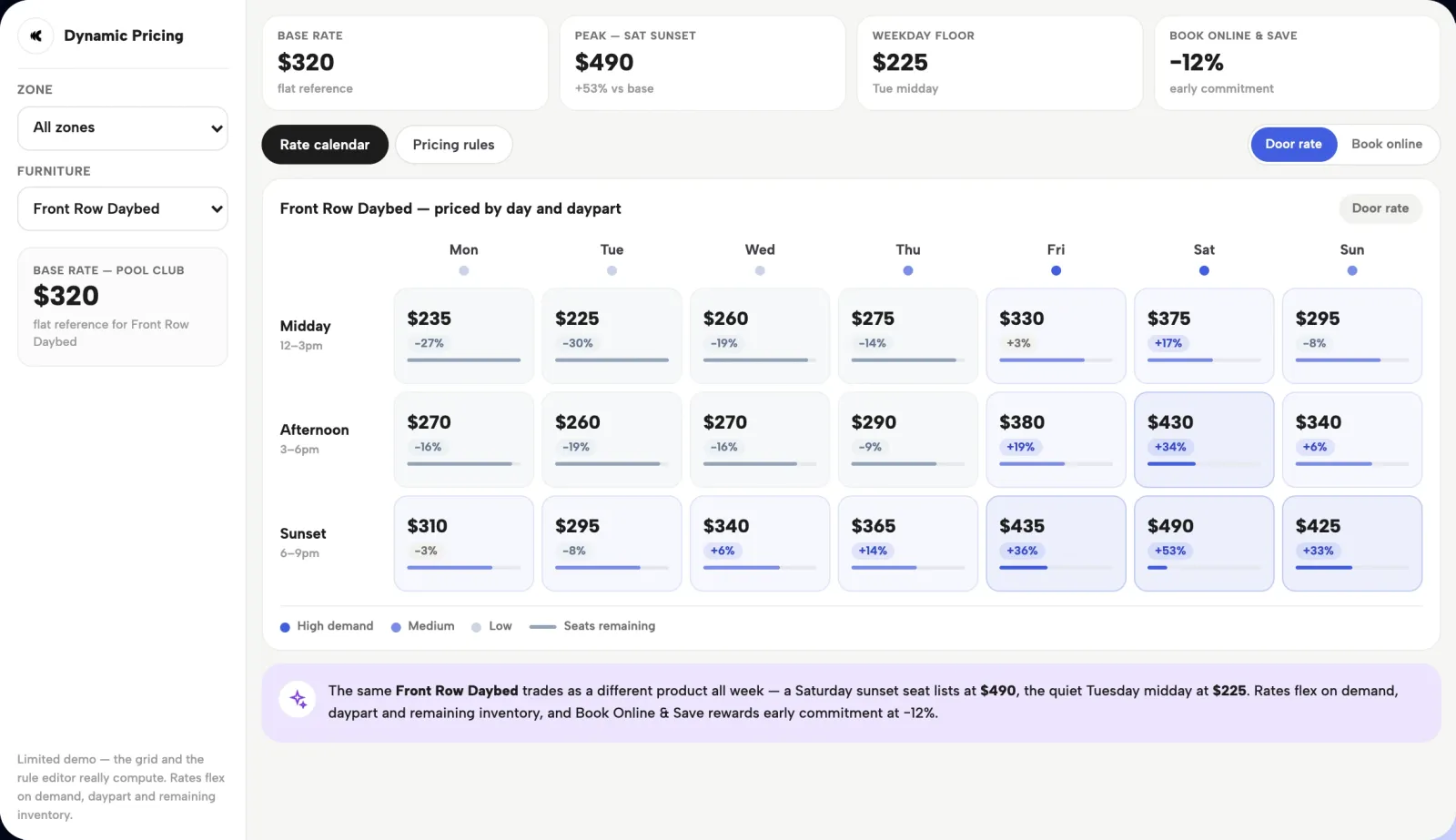
02Resident vs day rate - 03A book-online-and-save spread pulls the weekend forward
The discount hands you occupancy and staffing data days ahead — and when the deck sells out, priority-entry capture takes contact details anyway, so a full Saturday still builds Tuesday's audience.
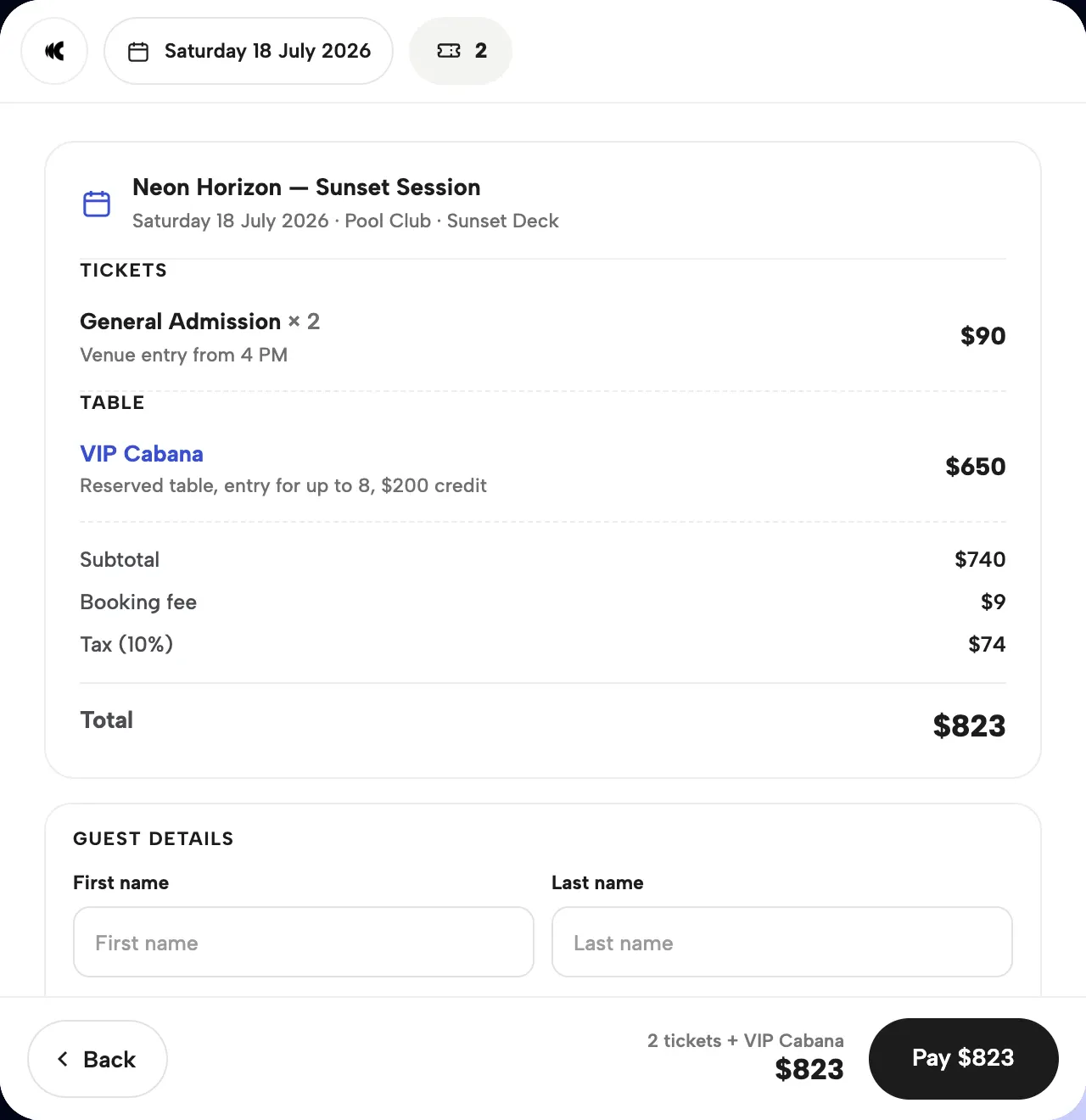
03Prepay or room-charge
Revenue levers
Room-rate discipline, applied to the deck
- 01Room-rate discipline on the deck
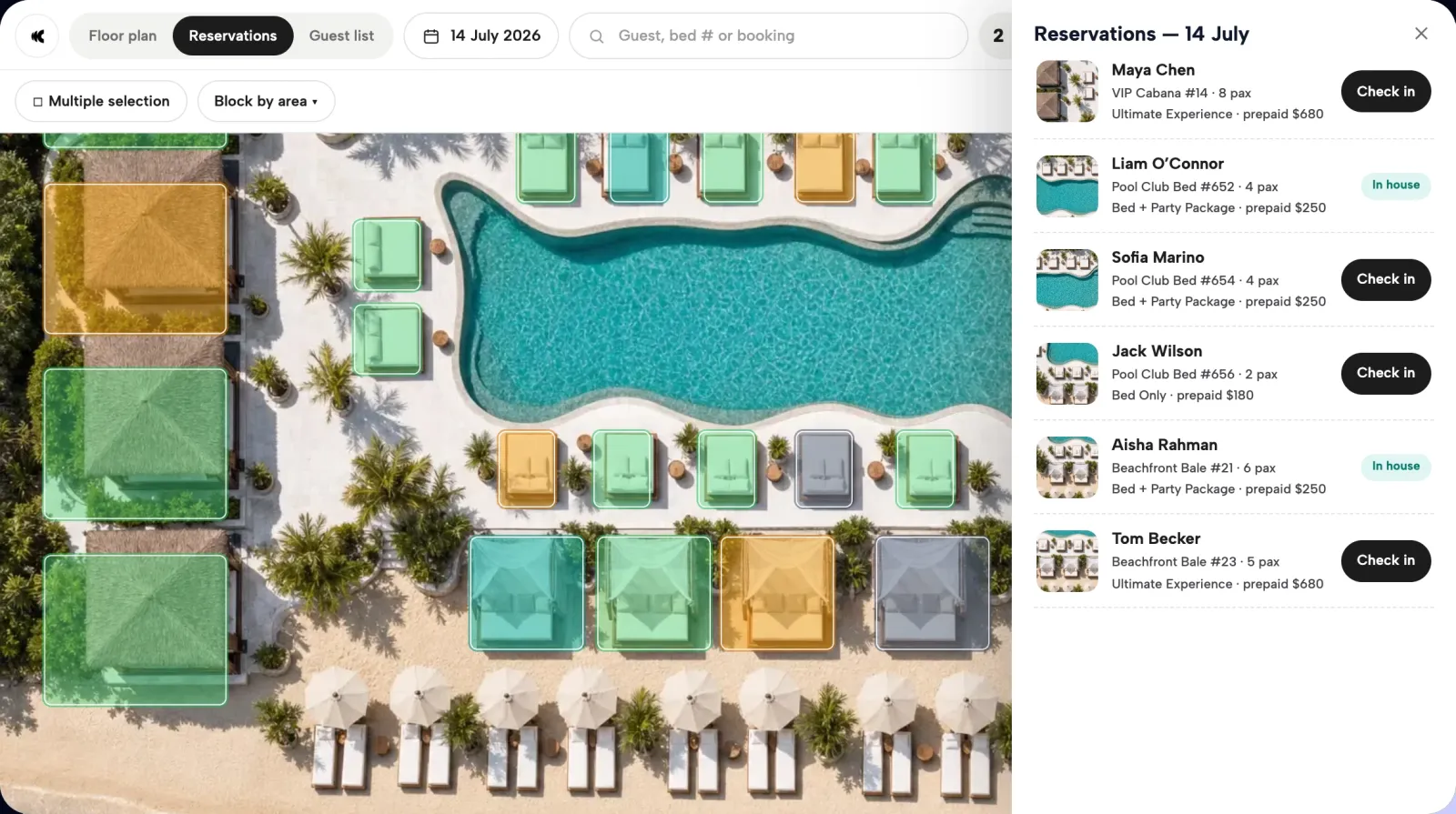
Hotels already run rooms on data; a pre-sold deck gives the pool the same rigor, with more than 20 built-in reports covering booking volume, lead time by zone, average value by furniture type, and repeat share.
- 02Daybeds, cabanas, and zones as real inventory
That's the difference between generic venue booking software and a system that understands the deck as a profit center — the guest intelligence overview owns the reporting detail.
- 03Own the day-pass channel, don't rent it
Marketplaces like ResortPass proved day-pass demand exists, then keep the guest account, the rebooking relationship, and a share of every pass — a direct engine on your own domain keeps the margin and the guest profile, with the marketplace demoted to a discovery layer for soft days.
Operator outcomes
Three revenue layers hiding in one pool deck
The same deck supports three distinct products. Most hotels sell none of them.
- 01Resident reservations
In-house guests book a specific sunbed or daybed before they arrive, ending the dawn towel run and turning premium positions into a paid upgrade instead of a lottery.
- 02Outside-guest day passes
Locals and travelers staying elsewhere already search "hotel day pass" plus a city — a day-pass engine on your own domain captures that demand at full margin, with entry tiers, minimum spends, and packages you control.
- 03Cabana and daybed upsells
The gap between a lounger and a cabana with bottles and food credit is the highest-margin ladder on the property, and sold at booking it's one tap instead of an awkward 11am conversation that mostly doesn't happen.
Where it fits
Resident bookings that fit the property stack
- Existing POS
- Existing PMS
- Meta
- Google Ads
- GA4
- A clean resident-vs-day-guest boundary
Clubtech integrates with Opera PMS and sits on top of the existing property stack rather than replacing it, with the exact posting, payment, and reconciliation behavior scoped with the hotel's IT and finance teams during implementation — never assumed from the integration name alone.
- Charge for scarcity, not access
Keep standard loungers free for residents if you like, and price what's genuinely scarce — front-row daybeds, cabanas, swim-up positions — so everyone gets guaranteed allocation and the furniture that earns a premium is priced like it.
- Every sale feeds your own marketing
Each booking fires to Meta, Google, and GA4 in real time with revenue posted back, so your campaigns build lookalike audiences from your highest-value guests and retarget abandoned bookings within seconds — back to the exact cabana, date, and price.
The proof
The engine, at resort scale
FINNS Beach Club — whose CEO Beau Whittington describes moving from on-the-day bookings with no financial guarantee to millions of dollars in pre-paid bookings each month — runs the same engine at resort scale.
Commercials follow discovery: the property inventory, resident and outside-guest journeys, payments, PMS boundary, integrations, and rollout are scoped before Clubtech returns with a tailored proposal.
Operator questions
Questions operators ask
What software do hotels use for pool and sunbed booking?
Hotels use pool booking software that maps the deck as bookable inventory — guests select a specific lounger, daybed, or cabana online and commit before arrival. Purpose-built platforms like Clubtech add tiered packages, day-pass sales to outside guests, a defined Opera PMS integration boundary, and marketing data, where generic booking tools only manage time slots.
How do hotels sell day passes without a marketplace?
With a day-pass engine on the hotel's own domain. Guests book pool access, daybeds, or cabana packages directly, the hotel keeps full margin and the guest's contact data, and every sale feeds the property's own remarketing. Marketplaces can supplement discovery on soft days, but the direct channel should be the primary one — it's the one you own.
Should hotels charge residents for sunbeds?
Charge for scarcity, not access. Standard loungers can remain part of the resident experience; premium furniture — front-row daybeds, cabanas, swim-up positions — can be sold as a paid upgrade at booking. Residents get guaranteed allocation instead of a 7am towel race, and the hotel gets a new ancillary line with the payment and PMS workflow agreed during implementation.
What does hotel pool booking software cost?
Clubtech scopes the property before proposing commercials. We map the deck, resident and outside-guest journeys, payments, PMS boundary, integrations, and rollout, then return with the recommended build and proposal together. Book a discovery call using your property inventory.
Does Clubtech integrate with Opera PMS?
Opera PMS is on Clubtech's approved integration roster, and Clubtech sits on top of the current PMS and POS stack rather than replacing it. The exact integration depth, data flow, payment behavior, and operating responsibilities are confirmed for the property before launch.
Connected product path
See the capability, the operating fit, and the proof.

Your venue, pre-sold.
Put your venue
inside the demo.
Book a focused walkthrough, configured around a premium venue like yours.
Book a Demo