
The UrVenue alternative for beach clubs, day clubs, and independent venues
Looking for a UrVenue alternative? Where UrVenue fits, where it doesn't, and how Clubtech compares for beach clubs, day clubs, and independent venues.
Choosing a booking platform is choosing who sells your Saturday. Pick one built for a different kind of venue and the cost shows up quietly: checkouts abandoned on the third screen, ad spend you can't attribute to a single booked daybed, premium zones that sell last instead of first. If you're evaluating UrVenue for a beach club or day club — especially outside the US — it's worth being precise about what it was built for, and what you actually run.
What UrVenue is
UrVenue is a Las Vegas-born hospitality booking platform, founded in 2011, that grew from nightclubs, lounges, and pools into what it now calls a property experience management system (PXMS) — software for selling and operating every experience on a resort property: nightclubs, dayclubs, pools and beaches, sportsbooks, mixed-use entertainment, and the hotels that contain them. It grew up inside the world's most industrialized nightlife market, and it shows in the product's DNA: cross-venue portfolios, hotel-integrated operations, and a client roster that includes Caesars Entertainment, MGM Resorts, Wynn, Tao Group, and Zouk Group.
That's a genuine pedigree, and this page won't pretend otherwise. The question isn't whether UrVenue is good software. It's whether it's built for your venue.
Where UrVenue fits well
Be honest about the cases where UrVenue is a strong answer:
- US mega-resorts and casino properties. If your venue is one outlet inside a large American resort with enterprise procurement, an in-house IT team, and a portfolio of nightlife concepts, UrVenue was designed around exactly that world.
- Multi-venue nightlife groups. Operators running several clubs under one corporate umbrella get portfolio-level tooling — cross-venue booking widgets and property-wide inventory through UrVenue's UrResort/PXMS products — that a single-venue platform doesn't need to have.
- Deep US hospitality ecosystem ties. For properties whose stack, agencies, and partners are all US-centric, staying inside that ecosystem has real switching-cost logic.
If that's you, UrVenue deserves a serious look. This page exists for everyone else.
Where operators outgrow the fit
The venues searching for a UrVenue alternative tend to share a profile: independent beach clubs and day clubs, often in Southeast Asia, the Mediterranean, or the Gulf, where the deck itself is the product and marketing runs on Meta and Google, not a casino host's phone book. Four mismatches come up repeatedly.
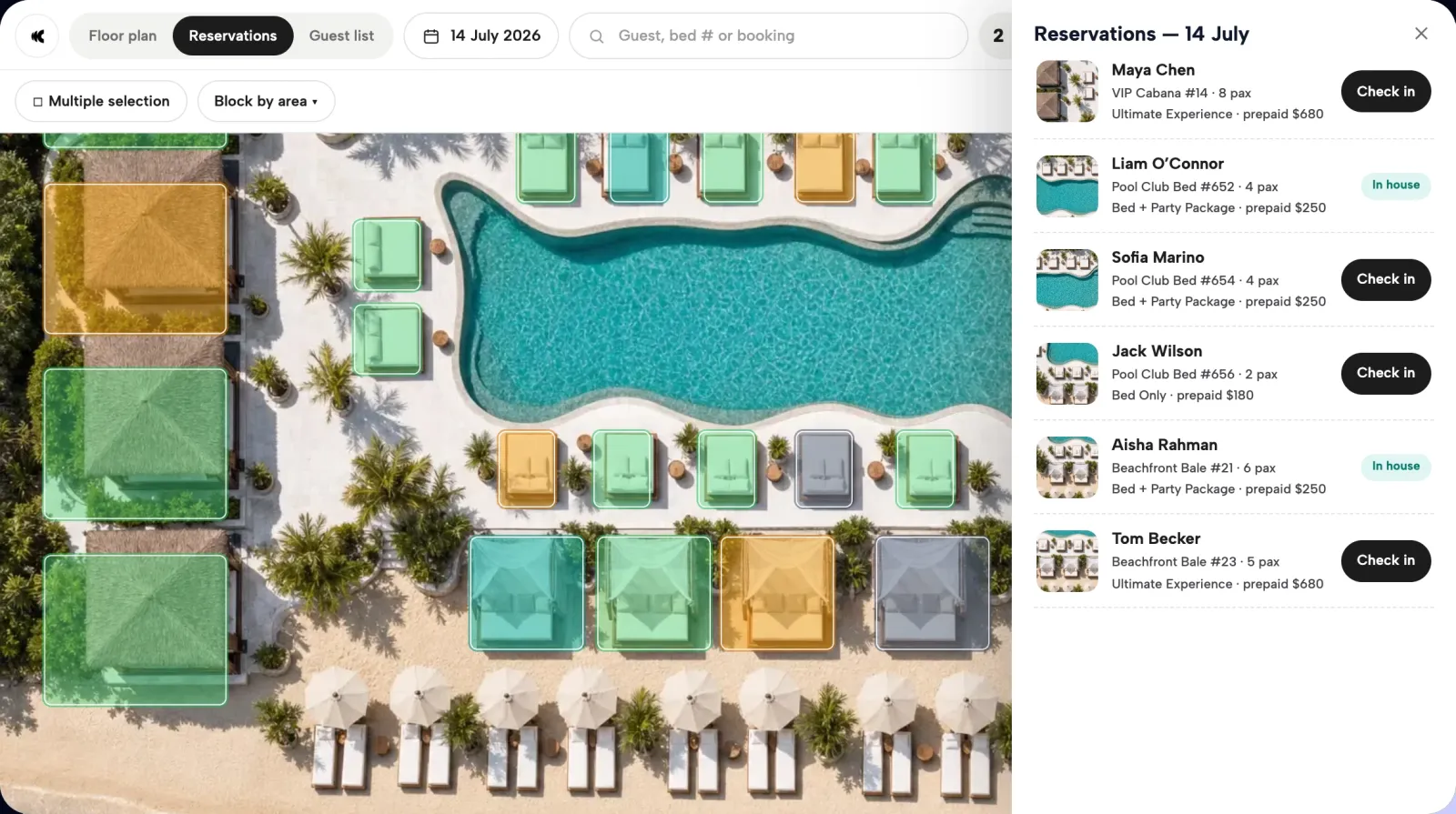
1. The venue isn't Vegas. A beach club in Bali or a day club in Dubai sells furniture, zones, and dayparts to guests who found it on Instagram last night. The buying moment is a phone screen after 10pm — on Clubtech, 82% of bookings happen on a phone after 10pm — not a concierge desk. The booking flow has to close that guest in four taps, or the moment passes.
2. The ads loop is the growth engine. Independent venues live or die on paid social. Clubtech treats the booking as the conversion event and pipes it to Meta, Google, and GA4 in real time: lookalike audiences seeded from your highest-LTV guests, platform-specific retargeting pools, abandoned-cart CAPI events fired within seconds so dynamic ads return a guest to the exact zone, date, and price they left — and revenue posted back for value-based optimization. If your platform can't feed that loop, your media buyer is flying blind. UrVenue's public materials emphasize booking, yield management, and operations rather than ad-platform conversion plumbing — if paid social is your growth engine, make them demo that pipeline specifically.
3. White-label depth. Clubtech runs entirely behind your brand — your domain, your design, your guest data. For a venue whose brand is the asset, sending guests to a checkout that doesn't look and feel like yours leaks trust at the exact moment money changes hands. UrVenue's answer here is its Creative Services offering — a design team that integrates its booking tools into a venue's own branded website — which is a service engagement rather than a self-serve default.
4. Regional payments and market presence. Bookings in Bali need Midtrans; multi-currency venues need Airwallex; everyone needs Apple Pay and Google Pay at checkout, and WhatsApp where guests actually talk. Clubtech operates from Bali, Singapore, and Dubai — the markets where the beach club category is growing fastest — with resident reservations landing on the folio through Opera PMS integration for hotel-attached venues.
Clubtech vs UrVenue, side by side
| Clubtech | UrVenue | |
|---|---|---|
| Built for | Independent beach clubs, day clubs, nightclubs, hotel pools | Nightlife/daylife venues and resort-property portfolios, from Vegas mega-resorts to global groups (Caesars, MGM, Wynn, Tao, Zouk) |
| Booking flow | Interactive venue map with zones, tappable furniture, and 360° walkthroughs; checkout in four taps, no app install | Interactive 3D venue maps with seat/section selection; cross-venue booking widgets and branded event landing pages |
| Pricing mechanics | Tiered packages (bed only → party package → ultimate experience), stackable add-ons, "Book Online & Save" early-commitment pricing | Automated price yielding, table deposits, F&B minimums, custom quotes for special requests |
| Ads & attribution | Bookings as conversion events to Meta, Google, GA4 in real time; abandoned-cart CAPI within seconds; revenue posted back for value-based optimization | Not detailed in public materials |
| Sold-out handling | Priority-entry / free-entry data capture — contact data captured even when furniture is gone | Ticket waitlists — waitlisted guests can buy as availability changes |
| White-label | Your domain, your design, your guest data | Creative Services team integrates booking into a venue's branded website |
| Payments | Airwallex, Midtrans, Apple Pay, Google Pay | Integrated payment processing (pre-payment, deposits, no-show fees, minimums); gateways not listed publicly |
| PMS | Opera PMS | PMS connectivity via the Hapi integrations platform; 30+ POS/PMS/payment partner integrations incl. OpenTable |
| Markets | Bali · Singapore · Dubai | Las Vegas HQ; reports serving organizations in 15 countries |
| Pricing | Quote-based — no public pricing; contact for a tailored quote | |
| Seeing it | 15-minute demo, pre-configured to a venue like yours, no contracts, no credit card | Demo by request through their sales team |
The UrVenue column reflects their public materials as of July 2026; where they don't publish detail — ad-platform attribution, specific payment gateways — we've said so rather than guessed.
What switching actually looks like
Operators overestimate migration pain because they picture rebuilding everything at once. In practice the sequence is simpler: your venue map and zones get built first, packages and pricing tiers are configured to mirror what already sells, payment and PMS integrations connect to the accounts you already hold, and the ads pipeline starts firing conversion events from the first booking. The demo itself starts with the platform pre-configured to a venue like yours, so you're evaluating your deck, not a generic sandbox.
The proof case is FINNS Beach Club in Bali, where CEO Beau Whittington describes growing from on-the-day bookings with no financial guarantee to millions of dollars in pre-paid bookings each month. That transition — walk-up hope to pre-sold certainty — is the actual reason to change platforms, whatever you're changing from.
If you're still mapping the category, our complete guide to beach club booking systems has the full 12-question evaluation checklist, including the questions where other vendors — UrVenue included — genuinely score points. And if your venue runs two dayparts on one inventory, the day club booking system page covers that economics in detail.
Questions operators ask
What is UrVenue?
UrVenue is a Las Vegas-based hospitality booking and venue-management platform, founded in 2011, focused on nightlife, daylife, and resort operations — nightclubs, dayclubs, pools, sportsbooks, and hotel-integrated venues. Its deepest roots are in the US resort and casino ecosystem (clients include Caesars, MGM, Wynn, and Tao Group), and it reports serving organizations in 15 countries with its property experience management system (PXMS).
What does UrVenue cost?
UrVenue does not publish pricing; its own FAQ directs venues to contact its team for a tailored quote based on venue size, features, integrations, and the number of venues onboarded. For comparison, Clubtech demos in 15 minutes with the platform pre-configured to a venue like yours — no contracts and no credit card to see it.
What is the best UrVenue alternative?
It depends on the venue you run. For US casino-resort portfolios, UrVenue's own ecosystem is hard to beat. For independent beach clubs, day clubs, and hotel pools — especially in Southeast Asia, the Mediterranean, and the Gulf — Clubtech is built for exactly that shape: map-first booking, tiered packages, prepayment, and an ads loop that treats every booking as a conversion event.
How is Clubtech different from UrVenue?
Clubtech is built for the independent premium venue rather than the enterprise resort portfolio. Guests book on an interactive map with 360° walkthroughs and check out in four taps; bookings feed Meta, Google, and GA4 in real time with abandoned-cart recovery in seconds; and the whole platform runs white-label on your domain with your guest data. Regional depth — Bali, Singapore, Dubai, Midtrans, Airwallex, Opera PMS — comes standard.
See your venue on Clubtech. 15 minutes, no pitch deck, no contracts — we'll show up with the map already built for a venue like yours. Book a demo