A beach club's inventory expires every day at sunset. A $450 daybed that walks at 2pm is $450 you never see again — not deferred, not discounted, gone. The question isn't how to get more people through the door; it's how to make sure every square meter of deck is sold, at the right price, before the day it exists.
This playbook covers the full revenue stack — what to sell, how to price it, and where the money leaks out.
The beach club revenue stack
Most operators run two or three revenue streams and leave the rest on the deck. There are six, and they stack:
1. Entry and day passes. The base layer. Even a free-entry policy is a revenue decision — it's the top of your funnel and the start of your guest data. Paid entry works when demand outruns capacity; free entry works when your furniture and F&B margins carry the day. Either way, capture the booking, not just the body count.
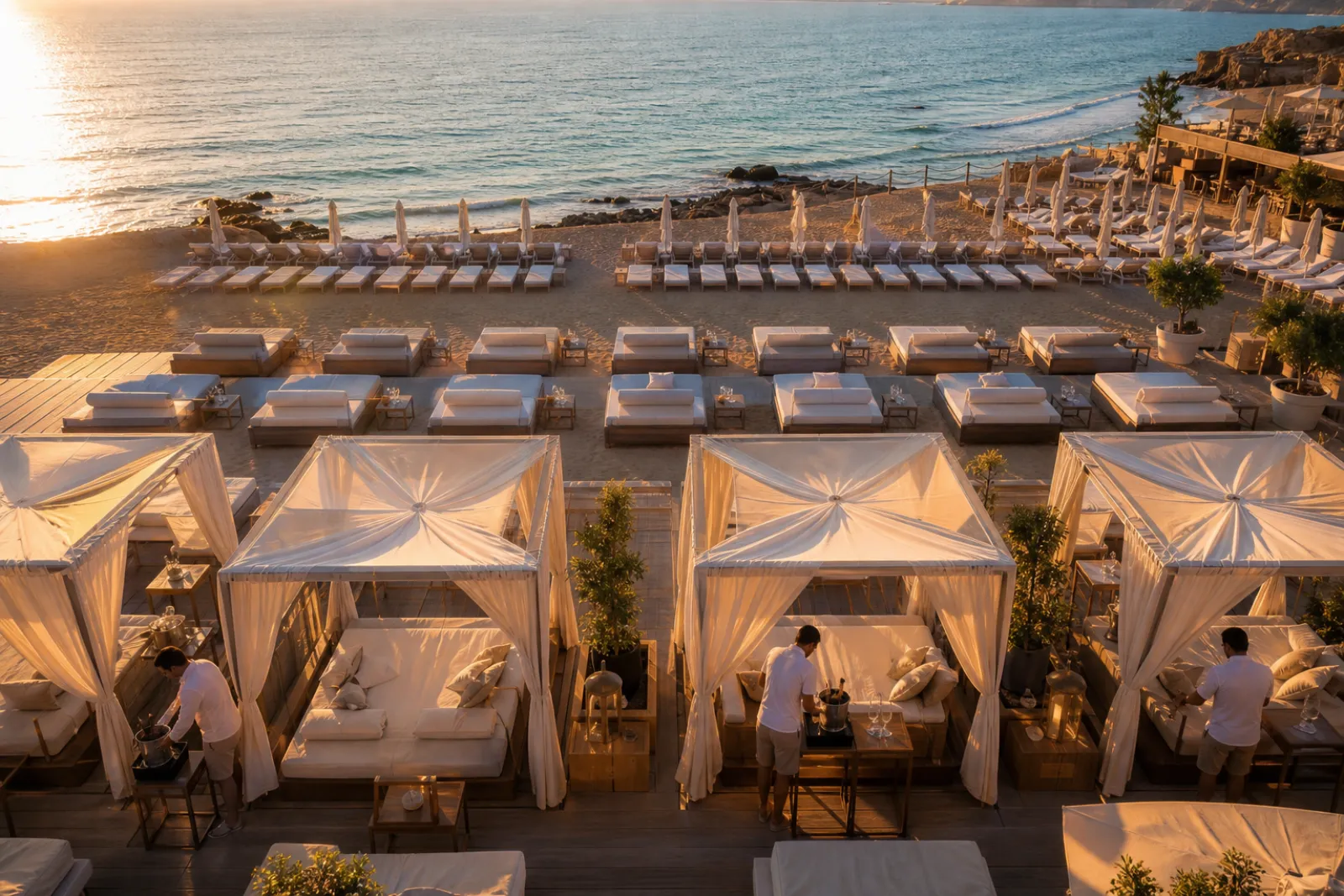
2. Furniture. Sunbeds, daybeds, cabanas, VIP decks. This is your highest-margin physical inventory and the layer most venues underprice, because they price the object instead of the position. Front row is not the same product as fourth row. Swim-up is not the same product as shade line. Zone them, tier them, price them apart.
3. Minimum spends. The bridge between furniture and F&B. A daybed with a minimum spend isn't rented — it's a guaranteed F&B order with a guaranteed seat attached. More on setting these below.
4. Packages. Bed only → party package → ultimate experience. A tier ladder does the upselling for you: guests self-select upward when the next rung is one tap at booking, not a pitch on the deck. On Clubtech, packages are the default selling unit, not an afterthought bolted onto a bed rental.
5. Add-ons. Bottles, cakes, transfers. They create revenue on top of the reservation and give the venue a preparation list before service. Moving those choices into the booking flow, before the guest arrives, is what grew FINNS Beach Club's bottle add-ons 67% year on year and lifted average order value 23%. That is FINNS's mix on FINNS's deck — measure your own attachment against your own baseline rather than importing the percentage.
6. Events. Ticketed nights, takeovers, brand partnerships. Events monetize the same real estate a second time — the economics of one venue, two sellable days per day.
The venues that grow fastest aren't adding streams five and six first. They're moving every stream from walk-up to pre-sold. If you're evaluating the machinery to do that, start with our complete guide to beach club booking systems.
Beach club minimum spend: setting it, tiering it, enforcing it
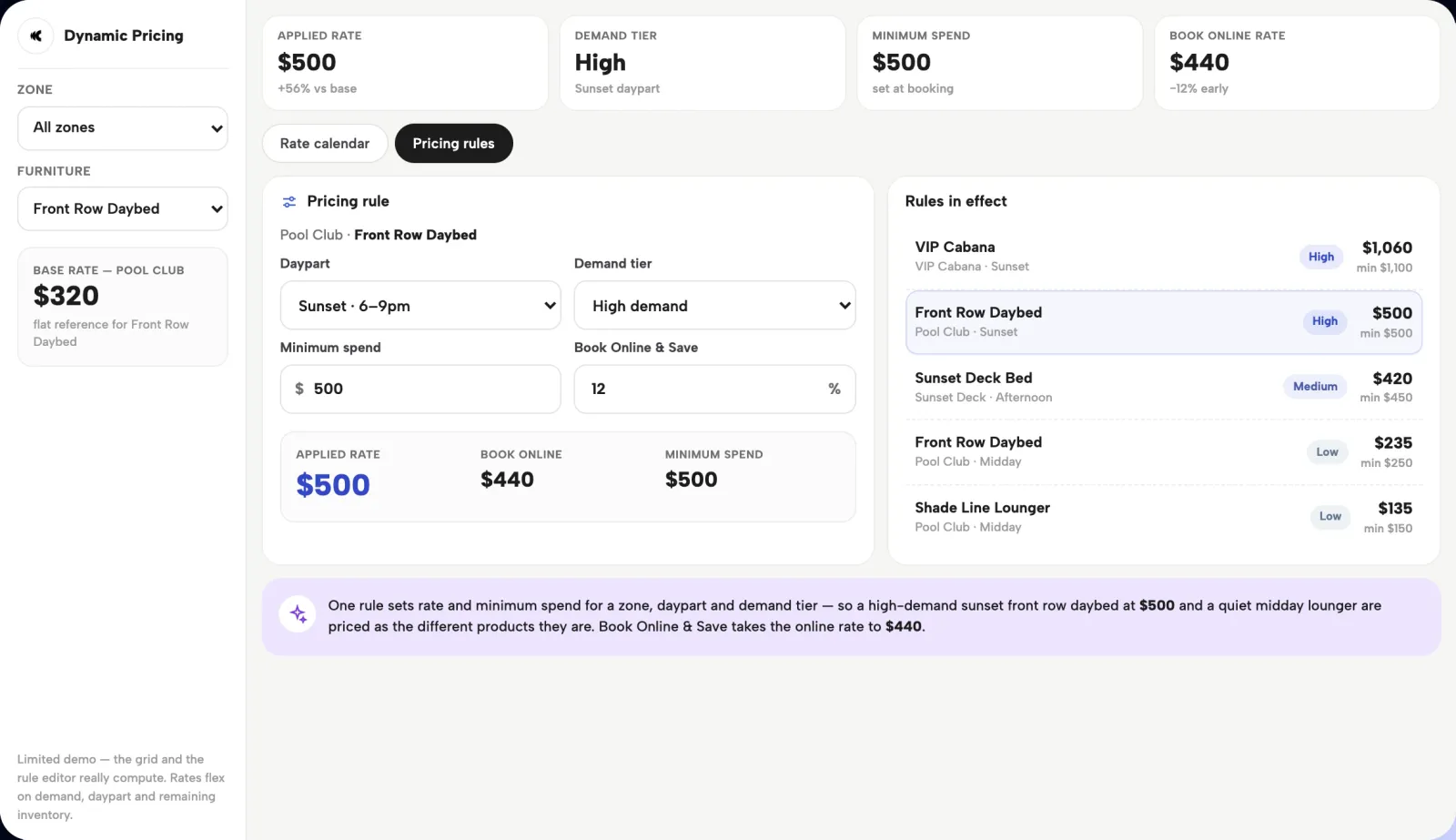
Minimum spend is the most misunderstood number on the deck. Set too low, it's decoration. Set too high without a package attached, it reads as a toll and kills conversion. Done right, it converts your furniture into pre-committed F&B revenue.
The mechanics that work:
- Tier by position, not by furniture type. Two identical daybeds are not worth the same minimum if one fronts the pool and one faces the service corridor. Guests already know this; your pricing should too.
- Anchor the minimum inside a package. "AED 2,000 minimum spend" is friction. "Party package: daybed, two bottles, fruit platter — counts toward your AED 2,000 minimum" is a plan. Same number, entirely different psychology.
- Collect it, or part of it, at booking. A minimum spend enforced by a clipboard at the door gets negotiated. A minimum spend prepaid online gets honored — the guest arrives already invested, and typically spends past it.
- Let the data set the number. When you can see average value by package variant and by zone — segmented, trending, without exporting a CSV — the right minimum stops being a guess. It's last month's actuals plus ambition.
The pre-sold venue: why revenue certainty beats walk-up hope
Walk-up revenue is weather revenue. One gray sky, one competing event, one soft Saturday, and the forecast you staffed against evaporates. Pre-sold revenue is banked before the sky gets a vote.
The mechanic that pulls demand forward is a reason to commit early. Clubtech's "Book Online & Save" spread gives guests a price advantage for booking ahead — and gives you two things walk-up business never will:
- Cash before the day. Prepaid bookings are revenue you hold regardless of what the morning looks like.
- A demand curve you can read. Daily booking volume, lead time by zone, which zones sell out first — days in advance. You staff, stock, and promote against real bookings, not a hunch.
This is the model that transformed FINNS Beach Club in Bali. Beau Whittington, FINNS's CEO, describes the shift from simple on-the-day bookings with no financial guarantee to millions of dollars of pre-paid bookings each month. In the figures FINNS has shared, covering July 2025 to May 2026: over 1 billion Rupiah processed every day — Rp 432.9B, roughly USD 24.2M — with around USD 1.86M in pre-paid bookings every month and 240,251 guest profiles captured and owned by the venue. Same venue, same beach. The revenue moved because the selling window moved.
And a pre-sold venue compounds on the marketing side: every booking is a conversion event, piped to Meta, Google, and GA4 in real time. Your highest-value guests seed lookalike audiences; browsers who didn't book land in retargeting pools; revenue flows back to the ad platforms so the algorithm optimizes for spend, not clicks. The deck sells the ads that sell the deck.
Beach club pricing strategy: the tier ladder and the online-vs-door spread
Most beach club pricing problems aren't level problems — they're architecture problems. A single flat rate leaves money at both ends: too expensive for the guest who just wanted a bed, too cheap for the group buying an occasion.
Build the ladder instead:
- Entry tier — bed only, back rows. Priced to convert the hesitant. This is your volume rung and your data capture rung.
- Core tier — better position plus a minimum spend or a starter package. Where most revenue should land.
- Premium tier — front row, cabanas, party packages with bottles and add-ons. Priced with confidence; on a map-first booking flow the premium zones sell out first, not last, because guests are buying the exact spot they can see, not a category on a dropdown.
- Ceiling tier — the ultimate experience. Even if it rarely sells, it anchors everything below it.
Then put a spread between online and door pricing. "Book Online & Save" is not a discount program — it's dynamic pricing with training wheels. You're charging less for certainty (a prepaid booking three days out) and more for spontaneity (a walk-up on a sold-out Saturday), which is exactly how every mature perishable-inventory business prices. When you're ready to go further — pricing by lead time, time of day, weekday, and season — the demand signals are already in your booking data. That's the next step up, and we've covered it in depth in our guide to dynamic pricing for beach clubs.
One guardrail: never let pricing punish loyalty. The spread should reward commitment, not ambush your regulars at the door.
Plugging the leaks: no-shows, sold-out days, and abandoned carts
Increasing revenue isn't only about selling more. Three leaks quietly drain venues that look busy:
The no-show. An unpaid reservation is a rumor, not revenue. The guest who "booked" by DM and never arrived didn't just cost you their spend — they cost you the paying guest you turned away to hold their bed. Prepayment closes this leak almost entirely: money down means guests arrive, and when they don't, the revenue stays with you. We've broken down the full cost math in our piece on beach club no-shows and the pre-payment fix.
The sold-out goodbye. A full deck feels like winning, but every guest who hits "sold out" and closes the tab is a lost relationship, not just a lost sale. Clubtech's priority-entry capture takes the booking anyway — free-entry or waitlist — so the guest who couldn't get Saturday's front row is a contact you can sell Tuesday's to. Sold out should grow your database, not cap it.
The abandoned cart. A guest who picked a daybed, saw the price, and drifted off at 11pm is not gone — 82% of bookings happen on a phone after 10pm, and drift is what phones do. Abandoned-cart events fire to Meta within seconds, and dynamic ads return the guest to the exact zone, date, and price they left behind. That's found revenue from demand you already paid to acquire.
Close the loop with on-deck economics too: guests who pre-committed to a package upgrade and spend past their minimum more readily than walk-ups — see our earlier post on the power of pre-booked upsells.
The revenue model in a beach club business plan
If you're writing a beach club business plan — for a bank, an investor, or a landlord — the revenue section is where most plans go soft: one blended revenue line multiplied by an occupancy guess. Build it stream by stream instead. Units of furniture by tier and zone, price per unit per booking, occupancy assumptions by season, minimum-spend attach on premium positions, then add-ons and events layered on top.
Two numbers deserve their own line in any plan. Season length, because your inventory only exists on days the deck is open — a 20-week season and a year-round operation are different businesses wearing the same swimwear. And the pre-sold share of revenue: the percentage banked before the day it's earned. The higher that share, the less your projections depend on weather and walk-up luck — and the easier the plan is to defend, because pre-sold bookings are a demand record, not a hope. The same architecture that makes the plan credible on paper is the one that protects profit once the venue is open: profit follows the mix — how much of the deck sells at premium tiers, how much F&B the minimums guarantee, and how little of it walks away as no-shows.
This playbook is the education layer. When you want to see the machinery running on a venue like yours — the map-first booking flow, packages, prepayment, and the reporting behind all of it — start with the Clubtech platform for beach clubs.
Questions operators ask
How do beach clubs make money?
Beach clubs make money from six stacked streams: entry fees or day passes, furniture rental (sunbeds, daybeds, cabanas), minimum spends that guarantee F&B revenue, tiered packages, add-ons like bottles and transfers, and ticketed events. The highest-performing venues pre-sell most of these streams online days in advance rather than relying on walk-up trade.
What are typical beach club revenue streams?
The typical streams are entry/day passes, furniture by zone and tier, food and beverage (usually the largest line), minimum spends attached to premium furniture, pre-booked add-ons such as bottles and celebration extras, and events. Most venues run only two or three of these deliberately; the growth opportunity is usually activating the rest and moving all of them to prepaid booking.
How does minimum spend work at a beach club?
A minimum spend is a committed amount a guest agrees to spend on food and beverage in exchange for reserving premium furniture — the daybed is "free," but the table must ring up, say, $500. Operators tier minimums by zone and position, anchor them inside packages so they read as value rather than a toll, and increasingly collect them (fully or partly) online at booking so they're enforced by prepayment, not a door negotiation.
What should a beach club business plan include on the revenue side?
Model each revenue stream separately rather than one blended line: furniture units by tier and zone, price per booking, seasonal occupancy, minimum-spend attach, add-ons, and events. State your season length and your target pre-sold share of revenue explicitly — those two assumptions drive the whole model, and a plan built on pre-sold bookings is far easier to defend than one built on walk-up hope.
How profitable is a beach club?
Profitability varies with location, season length, cost structure, and revenue mix, so a universal margin range would mislead. The structural drivers an operator can measure directly are the pre-sold share of revenue, furniture tier architecture, minimum-spend enforcement, and which revenue streams are active.
See the four revenue levers working together. Continue to Clubtech Revenue, then book a demo configured around a venue like yours.