Most beach club marketing budgets buy the wrong thing. They buy reach, followers, and a full camera roll — and on Saturday the front row still depends on walk-ups. A follower costs money and might show up; a booking is money and a name and a date. This guide is a beach club marketing strategy built on one premise: the booking is the conversion, and everything else in the funnel exists to produce it.
Why most beach club marketing measures the wrong thing
Search "beach club marketing" and you'll find engagement tactics: post more reels, run a giveaway, partner with a photographer. None of it is wrong. All of it is unaccountable, because it optimizes for a metric — attention — that never touches the P&L.
Invert the funnel. Start from the thing you actually sell: a specific daybed, in a specific zone, on a specific date, at a specific price. A $450 daybed that walks at 2pm is $450 you never see again; a $450 daybed pre-sold on Tuesday is revenue you can plan staffing, stock, and the next campaign around. When bookings are the conversion event, every marketing motion gets a grade: did it produce paid dates on the map, or didn't it?
That framing changes three practical things:
- Your ad accounts optimize toward buyers, not clickers. Meta and Google get fed real booking events, so their algorithms hunt for people who prepay daybeds — not people who like drone shots.
- Your budget conversation gets honest. Spend stops being a "brand" line item and becomes a cost per pre-sold booking, with revenue attributed back against it.
- Your content gets a job. The reel isn't the goal; it's the top of a path that ends on your booking map.
Everything below assumes you can take a booking online, on your own domain, with payment attached. If you can't yet, fix that first — our complete guide to beach club booking systems covers what to look for and the honest build-vs-buy math.
Beach club advertising: the four-motion paid loop
Paid social and search work for beach clubs when they run as a loop, not a series of one-off campaigns. Four motions, each feeding the next.
Motion 1 — prospecting seeded by your best guests
Broad targeting with a good seed beats narrow interest-stacking. The seed that matters is your own booking history: guests ranked by lifetime value, not by follower count. Lookalike audiences built from your highest-LTV bookers point the platform at people who behave like your cabana buyers, not people who once tagged a beach. On Clubtech, those audiences are built from booking data automatically; if you're running your own stack, export your top spenders and seed lookalikes from them — never from your full email list, which is diluted by one-time bargain hunters.
Motion 2 — retargeting the browsers who didn't book
Most guests who open your booking map don't buy on the first visit. They compare venues in a group chat, check flight dates, get distracted. Platform-specific retargeting pools — people who viewed zones, opened packages, started checkout — let you re-enter that group chat with the exact experience they were considering. Retargeting is cheap relative to prospecting because the audience already chose you once; the campaign just has to remove the friction of choosing again.
Motion 3 — abandoned-cart recovery, at booking speed
The highest-intent guest in your entire funnel is the one who picked a daybed, saw the price, and left. Speed decides whether you recover them. Clubtech fires abandoned-cart events to Meta via the Conversions API within seconds, so dynamic ads return the guest to the exact zone, date, and price they walked away from — while the plan is still alive in their head. A generic "come back soon" email three days later is answering a question the group chat already settled. If you're wiring this yourself, our operator's guide to the Meta Conversions API for venue bookings explains what to send and why pixel-only setups leak.
Motion 4 — revenue attribution, closing the loop
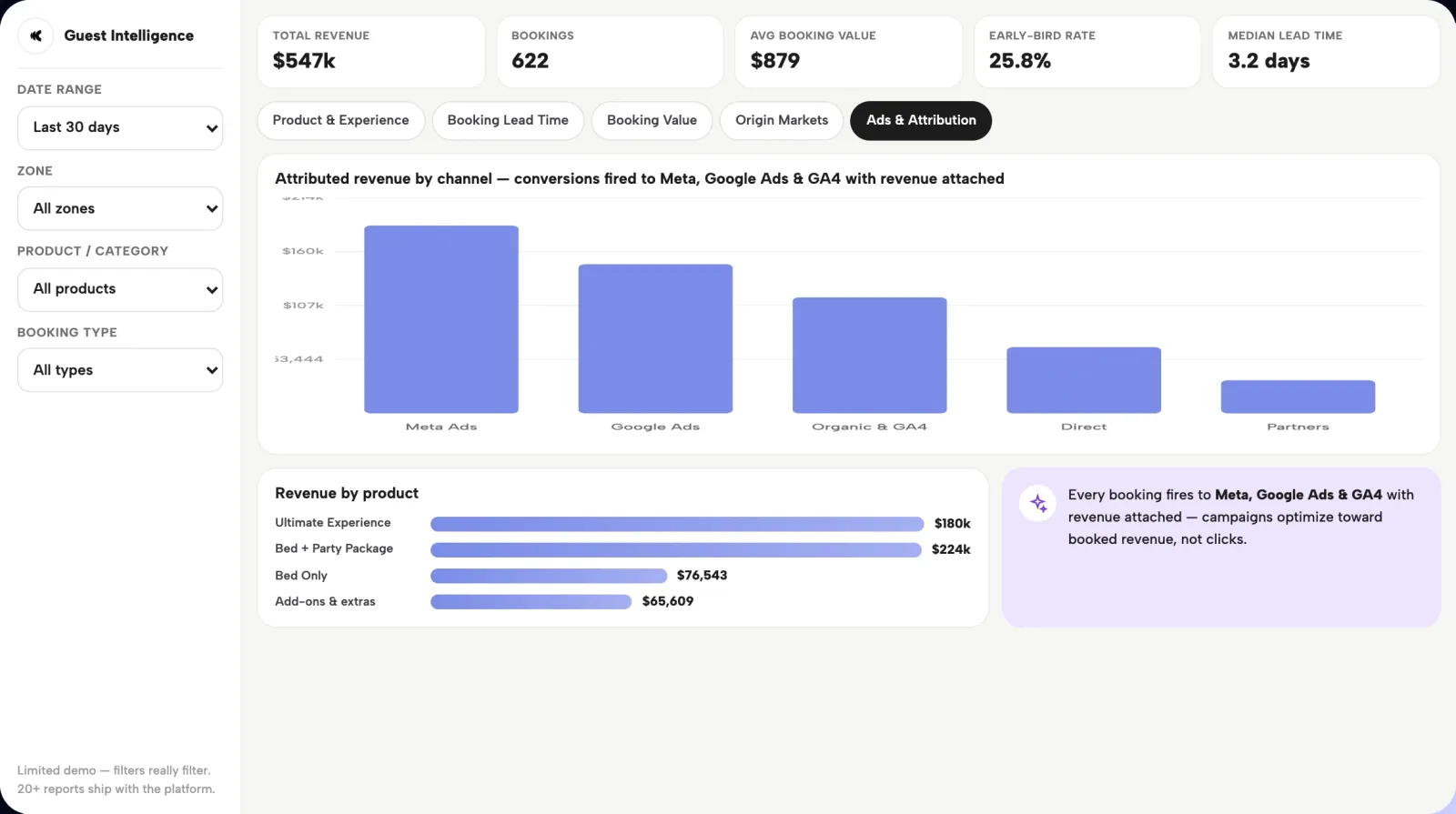
The loop only compounds if revenue flows back into the ad platforms. When actual booking values post back through CAPI and Enhanced Conversions, Meta and Google stop optimizing for "a conversion" and start optimizing for value — bidding harder for the guest pattern that buys the ultimate package, easing off the pattern that books the cheapest bed and no-shows. Value-based optimization is the difference between filling the venue and filling the front row. The same events, mapped properly in GA4, give you source-to-revenue reporting instead of source-to-pageview vanity — covered in our guide to GA4 for venue bookings.
One more mechanical note: your booking flow has to hold up where the demand actually is. 82% of bookings happen on a phone after 10pm — the decision is made in bed, in a group chat, at midnight. If your checkout needs an app install or ten form fields, your ads are paying to fill someone else's Saturday.
Abandoned-cart recovery over WhatsApp
Ad-based recovery works even better with a conversational counterpart. For beach club guests, WhatsApp is usually where the plan is being made — the group chat comparing venues on a Tuesday night is a WhatsApp thread, so a recovery message lands in the same place the decision does.
Three rules keep it effective instead of annoying:
- Same specificity as the ads. The message that converts references the exact zone, date, and price left behind — "your front-row daybed for Saturday the 14th is still open" — not a generic "still thinking it over?"
- Opt-in from the booking flow. A number collected at checkout is high-intent by definition; a number bought from a list is spam waiting to happen. Ask for WhatsApp consent at the point where intent is proven.
- One message, then stop. WhatsApp is a personal channel. One well-timed, specific nudge reads as service; three read as harassment and cost you both the guest and the channel.
Clubtech's integrations include WhatsApp alongside Meta Ads, Google Ads, and GA4 — the same booking context that powers dynamic recovery ads (zone, date, price) is exactly what a WhatsApp recovery message needs to be worth sending.
Retargeting for nightlife venues
Everything above reads like daylight, but the loop runs identically after dark — and nightlife venues need it more, because their traditional sales channel produces no data at all. A table sold through a DM and confirmed by a doorman is unattributed, unguaranteed, and unretargetable: no event fires, no audience builds, no revenue posts back.
Move table and guest-list sales into a real booking flow and nightclub retargeting inherits every motion in this guide, with a few twists:
- The window is compressed. Beach club guests deliberate for days; a Saturday table decision usually happens the same week, in the same after-10pm phone session where most bookings already occur. Retargeting audiences have to refresh in near real time to matter.
- The abandoned table is the week's best audience. A guest who priced a table, saw the minimum spend, and bailed at the deposit is precisely who Friday's retargeting budget should chase — with the exact table, date, and package they left behind.
- Seed lookalikes from table buyers, not followers. A nightclub's Instagram following is full of people who will never buy a table. Lookalikes built from paying bookers point the ad platforms at spenders.
The booking-flow side of this — deposits, minimums, table inventory online — is covered on our nightclub table booking page.
Instagram, influencers, and the organic reality check
Organic social matters for a beach club more than for almost any other business — the product is photogenic and the purchase is social. But be clear about what each channel is for:
- Instagram is your shop window, not your salesperson. Guests who hear about you anywhere check the grid before they book. Its job is proof of atmosphere: real crowds, real sunsets, current events. Judge it on how well it converts the already-curious, not on follower growth.
- Influencers are a reach tool with a settlement problem. Hosted creators can put you in front of the right feeds, but "exposure" is unpriceable until it produces bookings. Give every collaboration a trackable booking link or code and settle the argument with data. If a creator moves paid dates, rebook them; if they move likes, you bought content, not customers.
- The organic-to-paid handoff is where the value is. Your best-performing organic posts are pre-validated ad creative. The reel that organically reached ten times your average is telling you what the market responds to — put budget behind it and point it at the booking map.
The trap is letting organic metrics become the scoreboard. They're the weather report; bookings are the harvest.
First-party data: the marketing asset that compounds
Every motion above gets cheaper and sharper with better guest data — and beach clubs are unusually well positioned to collect it, because guests hand over names, contact details, party sizes, and spend levels as a natural part of booking.
Three practices turn that into a compounding asset:
- Capture the guest even when you can't take the money. Sold-out nights are the biggest data days of your season. Priority-entry and free-entry capture flows mean the guest who found the front row gone still leaves a name and contact details — a warm audience for the next shoulder-season campaign instead of a stranger who bounced.
- Own the relationship on your own domain. Marketplace and aggregator bookings fill beds but the guest belongs to the marketplace. A white-label booking flow — your domain, your design, your guest data — means every booking enriches an asset you keep.
- Segment on booking behavior, not demographics. Repeat-customer share, average value by package variant, lead time by zone — these are marketing segments, not just ops reports. The guest who books cabanas three weeks out gets the pre-season pre-sale email; the guest who books day-of gets the weather-window push.
We've written before about why first-party data is the future of beach club marketing — the short version is that ad platforms rent you targeting, and your booking data is the only targeting you own.
Beach club marketing ideas, season by season
Beach club demand is a wave; the strategy is to sell ahead of it rather than surf it. Every idea below is graded the same way as everything else in this guide: did it produce paid dates on the map.
- Pre-season (8–12 weeks out): sell the season before it starts. Open bookings early and run "book online and save" pricing to pull demand forward. Early commitment gives you deposits in the bank and a demand curve you can read — which zones are selling, at what lead time — before you've turned on a single peak-season ad. Pre-season buyers are also your cheapest lookalike seed for the campaigns that follow.
- Peak season: defend the premium inventory. Prospecting can throttle back when weekends sell themselves; shift budget to retargeting, abandoned-cart recovery, and upsell campaigns that move booked guests up a package tier. Scarcity is your creative — "front row for the 14th is nearly gone" outperforms any lifestyle montage.
- Shoulder season: packages, not discounts. Cutting the daybed price teaches guests to wait for cuts. Holding the price and adding value — bottle inclusions, transfers, late checkout on the bed — protects the rate card while giving the retargeting pool a genuinely new reason to come back. This is where those sold-out-night capture lists earn their keep.
- Off-season: the list-building quarter. Announce next season's opening date, run early-bird windows for last year's top spenders, and let the booking data from the season you just finished redesign the tier ladder for the one ahead.
The five numbers a GM should see every week
A beach club marketing strategy survives contact with reality only if someone is watching the right dashboard. Five numbers, weekly, no CSV exports:
- Booking volume and its trend — total paid bookings this week versus last week and versus the same week last season. The single clearest read on whether marketing is working.
- Lead time by zone — how far ahead guests book your front row versus your lawn. Shrinking lead times are the early warning that a soft weekend is coming while there's still time to promote into it.
- Average booking value by variant — bed-only versus party package versus ultimate experience. If ads are filling the venue but the mix is sliding down-tier, the targeting is drifting toward the wrong guest.
- Repeat-customer share — the percentage of this week's bookings from returning guests. It's the compounding-asset gauge: rising repeat share means the data flywheel is turning and every acquired guest is worth more than their first booking.
- Attributed revenue against ad spend — actual booking revenue posted back per channel, not platform-reported conversions. This is the number that ends the "should we even run ads" debate, in either direction.
This is the model the FINNS Beach Club team runs in Bali. CEO Beau Whittington describes the shift from simple on-the-day bookings with no financial guarantee to millions of dollars of pre-paid bookings each month — a marketing outcome, achieved by making the booking, not the follower, the thing every channel is accountable for.
Questions operators ask
How do you market a beach club?
Make online bookings the conversion event, then build every channel around producing them: paid social prospecting seeded by your highest-value guests, retargeting for map browsers who didn't book, abandoned-cart recovery within seconds, and revenue posted back for value-based optimization. Organic Instagram and influencers feed the top of that funnel — but they're judged on bookings generated, not reach.
How do you promote a beach club on Instagram versus ads?
Use Instagram as proof and ads as distribution. The grid convinces the already-curious that the atmosphere is real; paid campaigns find new guests via lookalikes, bring back browsers via retargeting, and recover abandoned bookings with dynamic ads. Your best organic posts double as pre-validated ad creative — promote what already over-performed and point it at the booking flow.
What is the best marketing strategy for a new beach club?
Open bookings before you open doors. Pre-season "book online and save" pricing converts launch buzz into deposits and gives you real demand data instead of guesses. Seed your first lookalike audiences from those early bookers, invest in one strong walkthrough of the venue map, and let scarcity in the premium zones do the creative work. A new club's biggest asset is that nobody has seen it yet — sell the reveal.
How much should a beach club spend on marketing?
Anchor spend to pre-sold revenue rather than a fixed percentage of turnover. With booking revenue attributed back per channel, you can hold each channel to a payback target and scale spend while attributed return holds — and cut it the week it doesn't. Industry percentage benchmarks vary too widely by market and venue size to be a useful anchor; a venue that can't attribute revenue to spend is guessing at any budget.
What is the most effective advertising for a beach club?
Paid social and search optimized against real booking events. Prospecting seeded by lookalikes of your highest-value bookers, retargeting for guests who browsed the map, and dynamic ads that recover abandoned bookings consistently beat generic awareness campaigns, because the platforms optimize toward people who prepay daybeds. The prerequisite is server-side conversion tracking with revenue attached — without it, every channel gets graded on clicks.
How do you recover abandoned beach club bookings?
Fast, and in two channels. Fire the abandoned-cart event to Meta within seconds so dynamic ads return the guest to the exact zone, date, and price they left, and — where the guest opted in at checkout — send one specific WhatsApp message referencing the same booking. Speed matters because the decision is happening live in a group chat; a follow-up email three days later arrives after the plan is settled.
See the loop running on your venue. Continue to the Clubtech attribution workflow, then book a demo.