A nightclub business plan sets out the concept, the market, the site and licenses, the opening budget, a bottom-up revenue model for door, bar and tables, the team and the funding ask. The building and fit-out drive most of the opening cost. Once open, Clubtech takes your table bookings online and runs the guest list at the door.
This guide follows the structure lenders and investors expect, then spends its time on the two sections that decide whether the plan survives a real year: what it costs to open, and how the money comes in.
The direct answer: what a nightclub business plan must contain
Most business plans follow seven parts. In a nightclub plan, each one has a specific job:
- Executive summary. The concept, the site, the money needed and when it pays back, on one page.
- Concept and market. The music, the crowd, the nights you will open and the clubs competing for the same group on the same night.
- Site, licenses and fit-out. The building, its capacity, the licenses it needs and what it takes to make it a club: sound, lighting, bars, tables, toilets and acoustic work.
- Opening budget. Every one-off cost before the first night, plus a reserve for the first months of trading.
- Revenue model. Door, bar and tables, built bottom-up per night, as below.
- Operations and team. Managers, hosts, bar staff, bottle servers, security and DJs, plus the systems they work in.
- Financials and funding. Monthly profit and loss, cash flow, the break-even point and the funding ask.
How much does it cost to open a nightclub?
It depends on the city and, above all, on the building. A published US breakdown gives a sense of scale. Wexford Insurance's guide to nightclub opening costs, checked on 2 Nov 2026, lists these ranges (Source: wexfordins.com):
| Cost line | Published range (US) | Type |
|---|---|---|
| Renovation and interior design | $50,000 to $250,000 or more | One-off |
| Equipment and supplies | $20,000 to $100,000 | One-off |
| Licensing and permits | $1,000 to $20,000 | One-off |
| Staffing and training | $10,000 to $50,000 in initial expenses | One-off |
| Venue rent | $5,000 to $20,000 a month | Monthly |
| Staff salaries | $30,000 to $100,000 a month | Monthly |
| General liability insurance | $500 to $2,000 a year | Yearly |
| Property insurance | $1,000 to $10,000 a year | Yearly |
| Workers' compensation insurance | $2,000 to $10,000 a year | Yearly |
Added together, the one-off lines in that breakdown come to roughly $81,000 to $420,000 or more, before the first month's rent and payroll. The guide does not cite sources for its ranges, and costs outside the US differ widely, so treat it as a sense of scale. Price your own site with local quotes from builders, sound engineers and licensing advisors.
Model revenue bottom-up: door, bar and tables
A nightclub sells three things, and each needs its own line in the model:
- Door. Paid entries per night times the average ticket or door price, after guest-list and free entries. Model each night of the week separately, not one weekly average.
- Bar. Guests who are not at a table times their average spend. The bar follows the door, so a soft door means a soft bar.
- Tables. Tables per night times the share you sell times the average spend per table, which the minimum spend and your packages set. Bottle service usually brings the highest spend per group, so the table plan deserves its own page.
Tables and tickets are the lines you can sell before the night, which makes them the lines you can forecast with evidence rather than hope. Then stress-test the model: run it with fewer nights open, a softer door and fewer tables sold than your base case. If it only works with a full room every weekend, it is not a plan yet.
The cost lines plans forget
Rent, fit-out and payroll make it into every plan. These lines often do not:
- Security and the door team. Licensed security on every open night, and the staff who check IDs and the guest list.
- Sound and neighbors. Acoustic treatment, sound limiters and the cost of complaints you did not plan for.
- Music licensing. Public performance licenses for recorded music, separate from what you pay DJs.
- Talent. DJ and artist fees, travel and hospitality, often committed weeks before the night earns anything.
- Opening stock and breakage. The first bar order, glassware, and the breakage that follows.
- Payment and channel costs. Card fees on every transaction, and any fees third-party ticket or table apps charge.
- Marketing that never stops. Every night is new inventory to fill, so marketing is a monthly line, not a launch budget.
Each one is small next to the fit-out. Together they decide whether the first year's cash flow holds.
Is it hard to open a club?
Yes. Most of the capital goes in before a single ticket sells. Licenses can take months and come with conditions on hours, capacity and sound. Demand is concentrated on a few nights a week, so the plan has to show how the club fills its quieter nights as well as the weekend.
The other hard part is evidence. A lender reading the plan wants to know why the tables will sell, not just that they exist. Pre-opening table sales, a guest list built before launch and a clear booking channel are the closest thing a new club has to a track record.
The booking channel belongs in the plan
How tables are sold changes the plan. If tables are sold by DM and confirmed on the night, the table line is a guess, and the guest data leaves with whoever took the message. If guests book and pay ahead on your own site, the plan can show tables committed per night. Deposits and prepayments put cash in the account before the night, and every booking leaves a guest record you own.
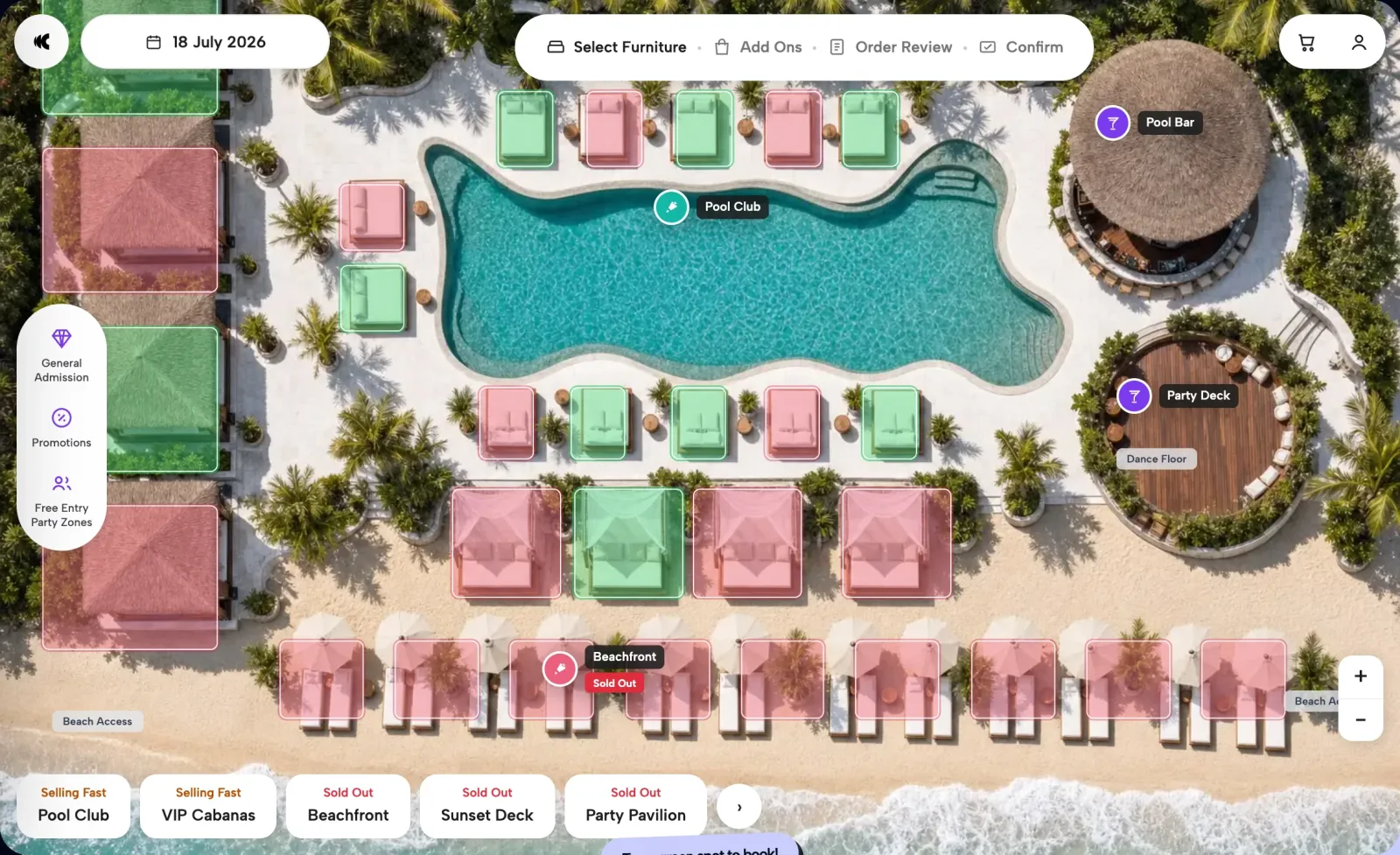
Clubtech is nightclub management software built for that model. Guests pick the exact table on a 3D birds-eye map of your floor, choose a package, add bottles and pay the deposit or prepayment you set, in four taps on a phone. Bookings land on your floor plan in real time, the guest list sits beside the tables, and each booking reaches Meta, Google, TikTok and GA4 with its revenue value, so the marketing line in the plan can be measured against bookings. Sol Rooftop, a rooftop venue in Canggu, Bali, recorded 4,022 bookings, 1,301 of them online, in its first two months on Clubtech.
Planning a day venue as well? Our beach club business plan covers furniture, zones and season.
Questions operators ask
How much would it cost to start a nightclub?
It depends most on the building and the city. The fit-out, sound and lighting, licenses, insurance, opening stock and the team you hire before opening make up the one-off budget, and rent and payroll start before the first night earns anything. Price each line with local quotes, and hold a reserve for the first months of trading.
Is it hard to open up a club?
Yes. Most of the capital goes in before a single ticket sells, licenses can take months and come with conditions on hours, capacity and sound, and demand is concentrated on a few nights a week. A credible plan shows how the club fills its quieter nights as well as the weekend, and how it sells tables before the night.
What should a nightclub business plan include?
It should include an executive summary, the concept and market, the site with its licenses and fit-out, the opening budget, a bottom-up revenue model for door, bar and tables, the operations and team, and the financials with the funding ask. Build the revenue model per night of the week rather than as one weekly average.
Do you need a license to run a nightclub?
Yes. Nearly every market requires a liquor license and a business license, and most add conditions or permits for late-night entertainment, capacity, fire safety and music. Requirements and timelines differ by city, so confirm them with the local licensing authority before signing a lease, because the license often decides whether a building can work as a club at all.
How do nightclubs make money?
Nightclubs make money from three lines: the door, the bar and tables. Door entries and tickets fill the room, the bar earns from guests who are not at a table, and tables sold with a minimum spend or a package usually bring the highest spend per group. Private events and brand partnerships can add a fourth line on quieter nights.
Planning a nightclub? See how Clubtech sells tables before the night and runs the guest list at the door. Book a 30-minute demo