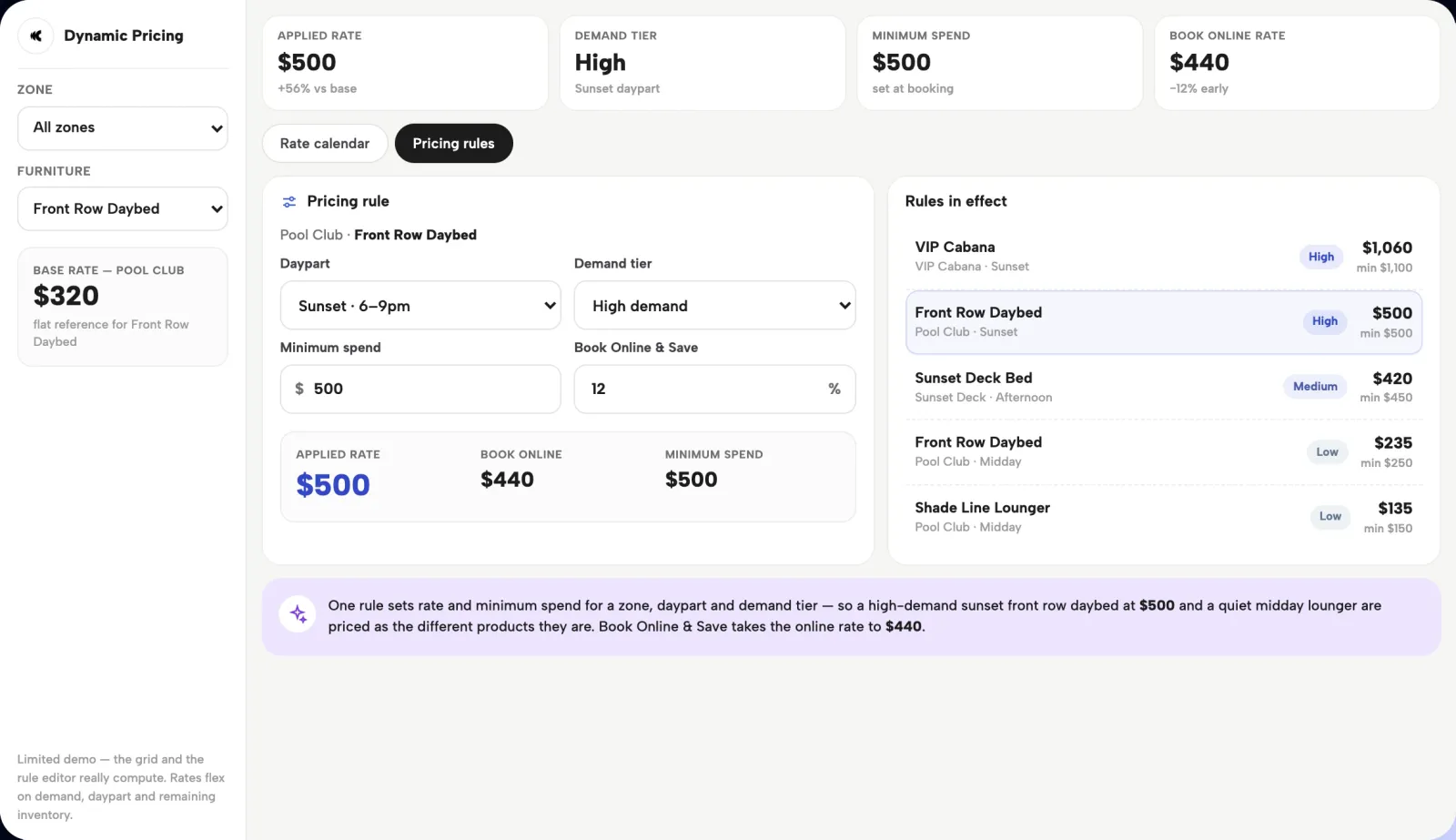
A minimum spend is the most misunderstood number in venue pricing. Set too low, it costs nothing and protects nothing. Set too high with no explanation, it reads as a cover charge with extra steps and the group books elsewhere. Set well — anchored to what the furniture actually earns, varied by date, and stated clearly at booking — it is the quietest revenue instrument a venue runs: guests self-select, commit money before arriving, and the operator knows what the room is worth before doors.
The direct answer: what a minimum spend is for
A minimum spend does one job a ticket price cannot: it guarantees the productivity of a piece of furniture without inflating the entry price. The guest commits to consuming a set value at the table or daybed; the venue trades exclusivity of the spot for certainty of revenue. Alongside prepayments and deposits, minimum spends are one of the commitment mechanics that kill no-shows — a group with money attached to a specific table on a specific night shows up.
Minimum spend, deposit, or prepaid package — pick the right instrument
The three get conflated, and they do different jobs.
A deposit protects against absence. It is the smallest commitment that changes behavior, and it belongs on inventory where the real risk is the no-show, not underspend — a weekday daybed, a standard booth.
A minimum spend protects productivity. It belongs on furniture whose value is what gets consumed at it: prime tables on a Saturday, front-row daybeds on an event date. The guest keeps flexibility over what they order; the venue keeps a floor under the revenue.
A prepaid package removes ambiguity entirely — bed-only through party package to ultimate, paid upfront with add-ons stacked at booking. Packages suit dates where demand is deep enough that guests will commit fully in advance, and they front-load the revenue as working float before service day.
Most venues run all three at once across different zones and dates. The strategy is the mapping, not the choice.
Set the number from the furniture, not from fear
The defensible minimum is the one the furniture already earns from an average group on that date — as a worked example, a table that seats eight and typically turns two bottles and mixers is a table whose history names its own minimum; rounding that history to a clean number is a floor, not a stretch. The failure mode in both directions comes from ignoring the history: a minimum far below the furniture's normal take is decoration, and a minimum set at the best night the table ever had will hold the spot empty on ordinary ones.
An empty prime table with a proud minimum is not a pricing win. The arithmetic every operator should run: the daybed that walks away unsold at 2pm earns zero, and zero is the number the minimum exists to prevent — which argues for softening minimums late, not lowering them early.
Vary it like you vary price — because it is price
A flat minimum across the calendar leaves money on the table twice: it under-charges the date everyone wants and over-charges the Tuesday you need bodies on. Minimums should move with demand the way rates do — higher on event dates and weekends, lower or absent midweek, differentiated by zone the same way the furniture itself is tiered. That is dynamic pricing logic applied to commitment rather than entry price, and the same demand signals drive both. Where the wider rate architecture is covered in the beach club pricing strategy, the minimum is the piece of it that guests agree to explicitly.
Say the number at booking, not at the door
Every minimum-spend dispute traces to the same root: the guest learned the number too late. The fix is structural, not scripted — the minimum belongs inside the booking flow, attached to the specific table or daybed, agreed before payment. On Clubtech, guests book the exact spot from the 3D venue map inside the selling flow with the commitment stated up front, confirm the full order at the review step, and pay inside the same journey. A guest who tapped through the number four times does not argue it at the door.
Stating it early also lets the minimum do its quiet second job: qualification. The group for whom the number is wrong self-selects out at booking — on their sofa, days ahead — instead of at the velvet rope in front of a line.
Enforce with hospitality, not a calculator
On the night, the minimum is a service target, not a tab audit. The teams that keep guests and hit the number treat it the same way: the server knows each table's commitment and remaining balance, steers the shortfall into another round or a bottle upgrade before close, and never presents the gap as a fine. Where the venue sells stackable add-ons — bottles, cakes, experiences — the path from "short of minimum" to "over it happily" is an offer, not a confrontation.
Measure whether the strategy is working
A minimum spend strategy is testable. The reads that matter: average value by variant (is the committed furniture out-earning the uncommitted equivalent), lead time (are higher-commitment dates booking further out), repeat share (are minimum-spend guests returning, which is the burn test), and product mix (is the spend landing in bottles and add-ons or scraping by on entry-level orders). Clubtech ships 20+ reports that read exactly this from the venue's own bookings, segmented and trending without CSV exports — so next season's minimums are set from evidence, not last season's argument.
Questions operators ask
What is a minimum spend at a venue?
It is a committed consumption value attached to a table, daybed, or cabana: the guest guarantees to spend at least that amount at the spot, and the venue guarantees the spot. It protects the productivity of premium furniture without raising entry prices, and alongside deposits and prepayment it materially reduces no-shows.
How should a venue set minimum spend amounts?
Anchor each piece of furniture to what it historically earns from a typical group on that kind of date, and round to a clean number. A minimum far below the furniture's normal take protects nothing, and one set to the best night on record holds the spot empty on ordinary nights. Review against actuals each season.
Should minimum spends change by date?
Yes. A minimum is a price, and flat prices across a demand curve lose money at both ends. Raise minimums on event dates and peak weekends, lower or drop them midweek, and differentiate by zone the same way the furniture is tiered. The same demand signals that drive dynamic pricing drive the minimum.
Minimum spend or deposit — which is better?
They solve different problems. A deposit is the smallest commitment that stops no-shows and suits inventory where absence is the main risk. A minimum spend guarantees what premium furniture earns while leaving the guest free to choose what they order. Most venues run deposits on standard inventory and minimums on prime spots.
How do you enforce a minimum spend without upsetting guests?
State it at booking, attached to the specific table, agreed before payment — disputes almost always trace to a number learned too late. On the night, treat it as a service target: the team tracks each table's balance and closes gaps with an offer, a round, or an upgrade, never by presenting the shortfall as a penalty.
Want your minimums stated at booking instead of argued at the door? Bring your floor plan and current numbers and we will walk how commitment pricing runs in the booking flow. Book a 30-minute demo — no contracts, no credit card.