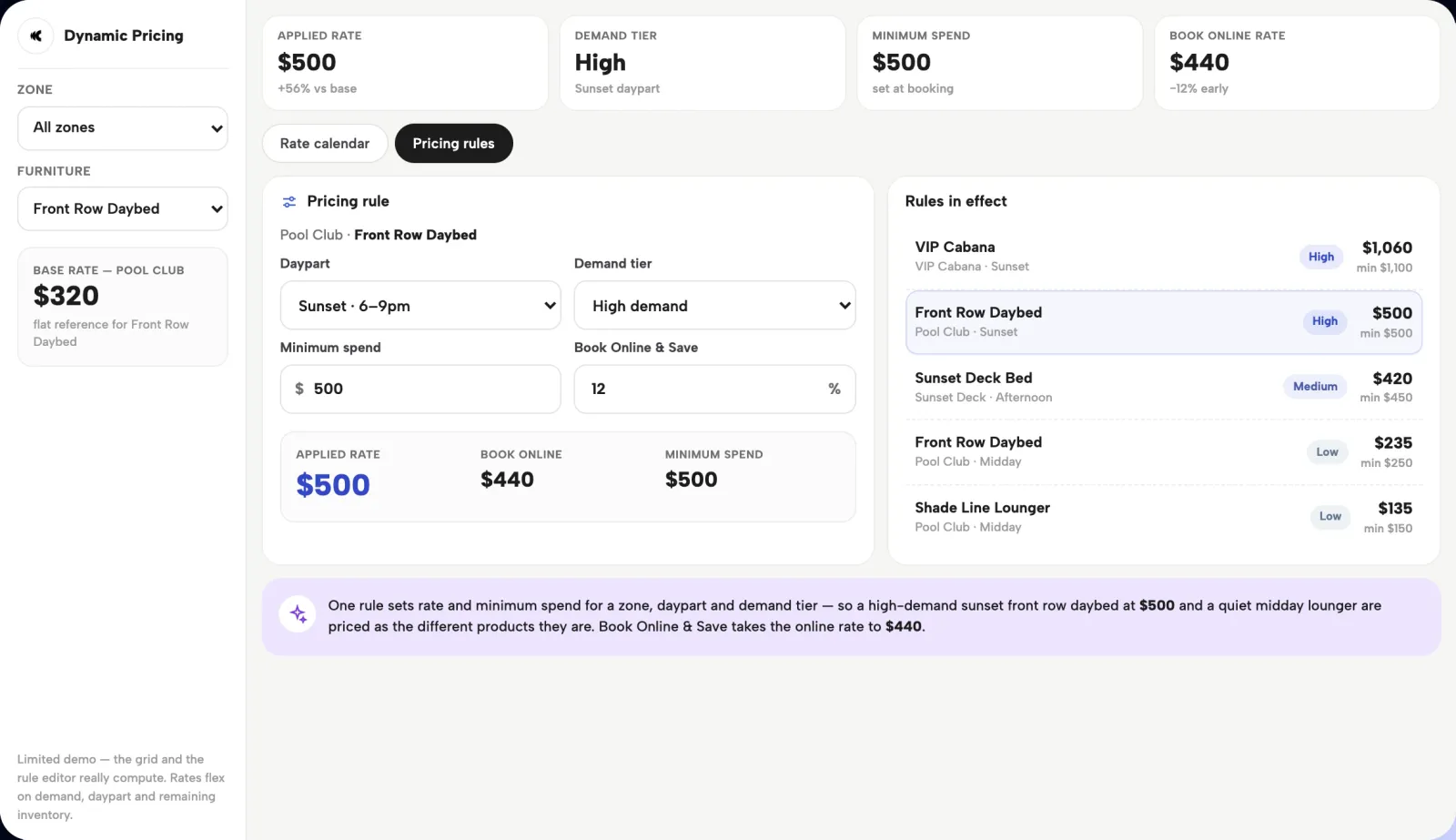
Most beach club pricing problems are not level problems — the rate isn't too high or too low, it's alone. One flat price on a deck full of unequal positions overcharges the guest who wanted the back lawn and undercharges the group buying the front row for a birthday. The money leaks at both ends, every day, in amounts that never show up as a line item.
Pricing strategy is architecture: where the rates sit relative to each other, what earns a premium, and what protects the rate card when demand goes soft. This post builds that architecture in five moves.
The direct answer: how should a beach club price?
Price the position, not the furniture: anchor rates by zone, then build a tier ladder within each zone — bed only, party package, ultimate — so guests upgrade themselves. Put a spread between online and walk-up prices to reward early commitment, layer peak-day pricing on top using lead-time data, attach minimum spends to premium furniture instead of gating everything with entry fees, and defend soft days with packages rather than discounts.
Anchor by zone: the deck is a map of prices
Two identical daybeds are not the same product if one fronts the pool and one faces the service corridor. Guests already know this; a pricing strategy just makes the knowledge official.
Start by zoning the deck — front row, swim-up, shade line, lawn — and give each zone its own anchor rate. Premium zones do double duty: they earn their own margin, and a front-row cabana at the top of the range is why the mid-tier daybed reads as sensible rather than expensive.
Zone anchoring works best when guests can see what they're paying for. On a map-first booking flow, where the guest picks the exact sunbed or daybed, the price difference justifies itself visually — front row costs double because the guest is looking at why.
Build the tier ladder: bed only → party → ultimate
Within each zone, a flat rate forces a yes-or-no decision. A ladder turns it into which:
- Bed only — the entry rung. Converts the hesitant, captures the guest record.
- Party package — the bed plus bottles, platters, or credit that counts toward the spend. This is where most revenue should land.
- Ultimate experience — the ceiling rung, stacked with add-ons: bottles, cakes, transfers. Even when it sells rarely, it anchors the rungs below.
Keep the rungs meaningfully apart — tiers 15% apart blur into one price — and let guests self-select upward at booking, when they're planning an occasion and add-ons are one tap, not a pitch on a crowded deck. The ladder is the upsell program; nobody on the floor has to sell anything.
Price the commitment: Book Online & Save
The next layer prices when the guest commits, not just where they sit. A spread between the online price and the walk-up price — Book Online & Save — charges less for certainty and more for spontaneity, which is how every mature perishable-inventory business prices.
The guest reads the spread as a reward. The venue banks the real benefits: cash collected before the weather gets a vote, capacity data days in advance to staff and stock against, and a prepaid booking that cannot no-show. That operational payoff is the subject of venue operations every night; pricing is what makes it possible.
This early-commitment spread is also the on-ramp to real dynamic pricing. Once lead-time and sell-out data accumulate, the next moves are increments: widen the spread on peak Saturdays, hold it midweek, and reprice the dates that consistently sell out early. The full method — demand signals, price states, guardrails — is in dynamic pricing for beach clubs.
Minimum spends vs entry fees: gate with commitment, not tolls
Both price access; confusing them costs conversion.
Entry fees price the venue as a whole. They work when demand outruns capacity — and when it doesn't, every dollar of blanket entry fee filters out guests who would have paid you more once inside.
Minimum spends price the premium positions. Attached to a daybed or cabana, a minimum isn't a toll — it's a guaranteed F&B order with a seat included, and the furniture reads as "free." Anchored inside a package ("party package — counts toward your minimum"), the same number converts instead of repelling.
The working pattern for most venues: keep entry light or free to feed the funnel, and put the pricing power in furniture minimums, tiered by zone. Collect the minimum — fully or partly — at booking, so it's enforced by prepayment rather than a door negotiation. Where the streams themselves are the question (day passes, events, add-on economics), see beach club revenue streams.
Discounting is the last resort: packages protect the rate card
Every soft Tuesday whispers the same suggestion: cut the price. Resist it — a public discount damages every future sale. Guests who see the daybed at 30% off learn to wait for 30% off, and premium positioning — once discounted — is expensive to rebuild.
The rate card survives soft demand through value, not price:
- Fill soft days with packages, not markdowns. Hold the bed price and add a bottle, a platter, or credit. The invoice value holds; the guest still feels the win.
- Absorb peak surges the same way. Rather than doubling the daybed on a festival weekend, require package tiers for premium zones — the base rate card stays familiar while average booking value climbs.
- Aim offers, don't broadcast them. An early-commitment spread and targeted offers to your own guest list move demand without teaching the whole market to wait.
- Never reprice a booked guest. The price at booking is the price — prepaid means that transaction closed days ago.
This is the discipline behind venues that scale on the pre-sold model — FINNS Beach Club grew to millions of dollars of pre-paid bookings each month on package-led, early-commitment selling, not on discounting the deck. Rate integrity compounds; markdowns don't.
Questions operators ask
How do you price a beach club daybed?
Anchor by zone first: front row, swim-up, shade, and lawn each carry their own base rate, because position is the product. Then ladder each zone — bed only, party package, ultimate — so guests upgrade themselves at booking. Premium zones usually carry a minimum spend rather than a higher rental fee, converting the position premium into guaranteed F&B revenue.
Should a beach club charge an entry fee or a minimum spend?
Usually both, doing different jobs: light or free entry to feed the funnel and capture guest data, minimum spends on premium furniture to carry the pricing power. A blanket entry fee suppresses volume at the top of the funnel; a tiered minimum monetizes exactly the guests with the most intent. Collect minimums at booking so prepayment enforces them.
What is Book Online & Save pricing?
It's a deliberate spread between the online price and the walk-up price: guests who commit and pay in advance pay less than guests who turn up on the day. Guests read it as a reward for planning. The venue gains prepaid revenue that can't no-show, capacity data days ahead for staffing and stock, and demand signals that feed later dynamic pricing.
When should a beach club discount?
As the last move, after packages, added value, and targeted offers have been tried — and ideally never publicly. Broad discounts train guests to wait and erode the premium positioning the rest of the rate card depends on. Fill soft days by holding the bed price and adding value inside a package.
How many price tiers should a beach club have?
Per zone, three or four: an entry rung that converts the hesitant, a core package where most revenue should land, and a premium or ultimate rung that anchors the ladder even if it rarely sells. Keep rungs far enough apart to be genuinely different decisions; narrow gaps blur together and the ladder stops upselling.
Walk your rate card on Clubtech. Zones, ladders, and spreads on a platform pre-configured for a venue like yours. Book a 30-minute demo