Bookings are day one. Operations are every night. A $450 daybed sold ten days out is not revenue yet — it's a promise your floor has to keep on a specific Saturday, at a specific hour, with the right staff on shift and the right bottles in the fridge. Venues lose more money keeping promises badly than they ever lose making them.
This is the operations pillar of the pre-sold model. Our revenue playbook covers what to sell and how to price it. This guide covers the other half: how a venue that sells its deck days in advance actually runs — the nightly read of tomorrow's bookings, staffing and stock against real demand, the door, the floor reset, the rain plan, and the five numbers a GM should look at every week.
What beach club operations means when the venue is pre-sold
Beach club operations for a pre-sold venue is a nightly cycle: read tomorrow's confirmed bookings by zone, set staffing and stock against that real demand, run check-in from one live list instead of spreadsheets, reset the floor zone by zone between the day and the night, and recover revenue when weather intervenes. The forecast comes from bookings already paid for — not from the sky, the season, or a hunch.
That is the structural difference. A walk-up venue operates on guesses and absorbs the variance in wasted payroll, dead stock, and door chaos. A pre-sold venue operates on a manifest. Every section below is one loop of that cycle.
Reading tomorrow from tonight's bookings
The most valuable fifteen minutes of a GM's day happen the night before, looking at what has already sold.
The key signal is lead time by zone. Guests do not book a full-day cabana the way they book a sunset daybed. Full-day premium furniture tends to commit days out; sunset and evening bookings fill closer to the date. Once you know your venue's normal curve — how full each zone usually is at T-3, T-2, T-1 — tonight's numbers stop being trivia and become a forecast:
- Tomorrow's sunset cabanas are at their usual T-1 level. Staff them normally.
- Saturday's front row sold out on Wednesday. That's not just a full zone — it's a pricing signal (covered in dynamic pricing for beach clubs) and an early warning to load the premium zones with your strongest servers.
- The lawn is soft for Sunday. You have 48 hours to do something about it — a package push to your list, an ads nudge — instead of finding out at noon on the day.
This read only works if bookings live in one system. When Saturday exists partly in a booking platform, partly in an Instagram inbox, and partly in a doorman's head, there is no curve to read. Clubtech's guest intelligence shows daily booking volume and lead time by zone, segmented and trending, without anyone exporting a CSV.
Staffing and stock against real demand
Walk-up venues staff against the weather forecast. Pre-sold venues staff against the manifest.
The difference shows up as money in both directions. Overstaffing a soft Tuesday burns payroll on servers polishing glasses. Understaffing a Saturday that quietly pre-sold to 90% burns something worse: the service quality that justified the premium prices, on the exact day your highest-paying guests showed up. Pre-paid guests who waited 40 minutes for their included bottle do not rebook.
The nightly booking read converts directly into rosters and orders:
- Roster by zone load, not by headcount. If the VIP deck is pre-sold full and the lawn is half-booked, tomorrow's floor plan should look asymmetric. Put seniority where the minimum spends are.
- Order against pre-sold packages. Every party and ultimate package sold is a known bottle, a known cake, a known transfer. Stack the confirmed add-ons for the week and your order sheet writes itself — celebration cakes ordered against actual bookings, not an average.
- Prep the peaks you can already see. Event dates, holiday weekends, and any date where lead time is running ahead of normal are visible days out. Kitchen prep, ice, towels, and float all scale off the same manifest.
None of this requires new instincts. It requires that the instincts your best GM already has get fed real numbers the night before instead of a weather app on the morning.
The door: check-in without spreadsheets
The door is where pre-sold operations most often fall apart. The guest did everything right — booked, prepaid, arrived — and then stood in line while a host cross-referenced a printout against a WhatsApp thread.
The fix is structural, not heroic: the door works off the same live booking record as everything else.
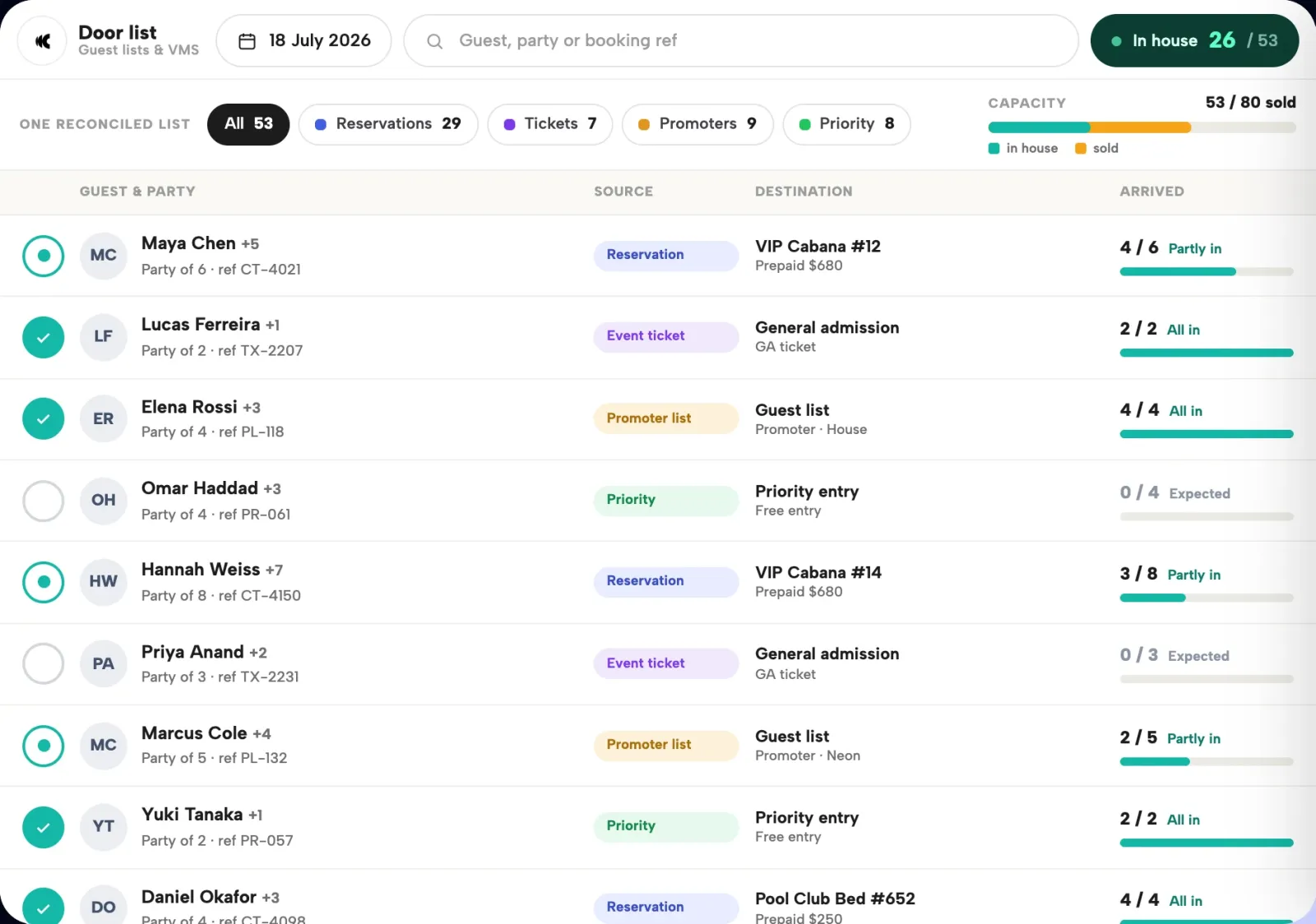
- One list, live. The reservation created online is the record the host sees — name, zone, furniture, package, prepaid amount, add-ons. No reconciling the doorman's spreadsheet against the inbox, no "let me check with my manager."
- Fast verification. The confirmation the guest carries should get them through the door in seconds.
- Arrival visibility for the floor. When check-in marks the booking arrived, the floor knows the party for cabana 12 is walking in — the bottle moves to ice before they sit down. That 90-second head start is what a prepaid premium is supposed to buy.
This matters most where volume and status collide. Nightclubs run the same problem at higher stakes — a VIP table sold by DM with no deposit and no record is a door argument waiting to happen, which is why nightclub table booking starts with putting the table, the minimum spend, and the guest identity in one system before anyone reaches the rope.
The floor reset, zone by zone
Between the day and the night, a beach club briefly becomes a stage crew. The daytime loungers empty, the sunset cabanas are due, and every piece of furniture has to be turned — cleared, cleaned, re-dressed, re-set for the incoming package.
Running this by zone, off the booking map, beats running it by walking the deck:
- Turn the zones in sell-out order. The zones that sold out first are the ones with incoming guests soonest. Reset the front row before the back lawn, not left to right.
- Dress to the booking, not the default. The manifest says daybed 14 is a party package with two bottles and a cake at 5pm. The reset puts the ice bucket and the reserved setup there — not a generic towel roll.
- Release what didn't sell. Zones still open for the evening are walk-up and upsell inventory. The floor manager should know which beds are sellable tonight without radioing anyone.
Venues that sell specific sunbeds and daybeds on an interactive map get this discipline almost free: the map that sold the furniture is the map that resets it. Day clubs that sell the same furniture twice a day live and die on this turn — selling the same daybeds twice only works if the reset is systematic.
When it rains: service recovery as a revenue function
Weather is the tax on outdoor revenue, and walk-up venues pay it in full: gray sky, empty deck, zero recourse. A pre-sold venue holds a different hand — the revenue is already banked, and the question becomes service recovery: what you do for the guest whose prepaid Saturday got rained on.
Handled as a revenue function rather than a refund queue, a rain day is salvageable:
- Hold the relationship, not just the money. Offer a prepaid guest a move to another date rather than a refund — the plan was the beach day, not the specific Tuesday.
- Have the policy before the cloud. Deposit, cancellation, and weather terms shown at booking prevent the door-side argument later. What Clubtech venues state publicly on refunds and weather is a policy decision each operator owns.
- Use the manifest to triage. On a marginal-weather morning you can see exactly who is booked, in which zones, at what value — and contact the day's highest-value bookings first instead of waiting for the walkouts.
The no-show problem is the same economics in reverse — an empty bed you held for someone who never came — and prepayment is the fix for both. The full cost math is in our piece on beach club no-shows.
The five numbers a GM should watch weekly
Daily operations run off the manifest. The venue itself runs off five weekly numbers — segmented and trending, not buried in CSV exports:
- Booking volume trend. Is demand building or fading, week over week? This is the earliest read on whether the season is tracking.
- Lead time by zone. Shrinking lead times mean softening demand; stretching lead times mean you can staff earlier, order tighter, and probably price higher.
- Average booking value by variant. Which packages actually carry the revenue. If the party package outsells bed-only three to one in the front zones, your floor plan and your menu should reflect it.
- Repeat-customer share. The health metric walk-up venues can't even measure. A rising repeat share means service is keeping the promises sales made.
- Attributed revenue vs ad spend. What the marketing dollar returned in bookings — the number that ends the "is Instagram working" debate at the weekly meeting.
These five turn the weekly management meeting from anecdotes into decisions. On Clubtech they come built in as guest intelligence; the point stands on any stack — if your GM cannot produce these five in under a minute, the operation is running on memory.
Season transitions: opening pre-sold, closing with data
Operations has a yearly rhythm on top of the nightly one, and the venues that handle it best treat the transition as part of operations, not a pause in it.
Before the season. The buying and setup window is before opening day — Mediterranean venues set up in the winter for a May opening; Dubai venues rebuild in late summer for the October restart. A venue that installs its booking system and puts early-commitment pricing live before the season opens starts day one with pre-sold revenue and a staffing forecast, instead of spending the first six weeks generating the data it should have been collecting already. Book Online & Save works hardest here: the spread gives guests a reason to commit before your doors open.
During the season. Peak season is proof-harvest season. The numbers, the sell-out patterns, and the service wins you log now are next winter's pricing decisions and next season's marketing material.
Closing and re-opening. End-of-season data — which zones earned their rates, which nights underfilled, where lead times ran long — is the blueprint for next season's map, tiers, and rate card. That analysis feeds directly back into the revenue playbook: operations generates the evidence; pricing spends it.
The through-line of this entire guide is one sentence: the booking system is not a sales tool that operations tolerates — it is the operating system the venue runs on every night.
Questions operators ask
What does beach club operations involve day to day?
Day to day, beach club operations is a repeating cycle: read tomorrow's confirmed bookings by zone the night before, set the roster and stock orders against that demand, run check-in from one live booking list, reset the floor zone by zone between the day and the night, and handle weather and no-show recovery. In a pre-sold venue every step works from the booking manifest rather than guesswork.
How do you staff a beach club efficiently?
Staff against confirmed bookings, not the weather forecast. Pre-sold venues can see occupancy by zone days ahead, so rosters follow real demand — senior servers on the pre-sold premium zones, lighter coverage where the lawn is soft. Lead-time data tells you how much tomorrow can still change. Walk-up venues can't do this; they pay for the uncertainty in overstaffed Tuesdays and understaffed Saturdays.
How should a beach club handle rainy days?
Hold the revenue and save the relationship. If bookings are prepaid, a rain day is a service-recovery exercise rather than a write-off: contact booked guests early, lead with a move to another date, and apply a weather policy that was already stated at booking. Venues that depend on walk-up trade simply lose the day.
What KPIs should a beach club GM track?
Five weekly numbers cover the operation: booking volume trend, lead time by zone, average booking value by package variant, repeat-customer share, and attributed revenue versus ad spend. Together they answer whether demand is building, how far ahead the venue can plan, which products carry the revenue, whether service is bringing guests back, and what marketing actually returned.
Why do beach clubs still use spreadsheets, and what replaces them?
Spreadsheets persist because they're free and familiar — bookings arrive by DM, email, and phone, and someone consolidates them by hand. What replaces them is a single booking system that sales, floor, and door all read from: the reservation created online is the record at check-in, the floor reset, and the weekly report. The spreadsheet's real cost is reconciliation errors, door disputes, and unusable data.
When should a new venue set up its operations stack?
Before the season opens, not after. A venue that installs its booking platform pre-season opens with prepaid revenue on the books, a staffing forecast from real lead-time data, and early-commitment pricing already working. Setting up mid-season means running the busiest weeks on guesswork while learning a system. The buying window is the off-season — the payoff is opening day one pre-sold.
See your nightly operation on Clubtech. One system for sales, floor, and door — pre-configured for a venue like yours. Book a 30-minute demo