Ask an operator where the money comes from and you'll usually hear two answers: beds and bar. That's a deck running at a fraction of its earning surface. The same square meters support six distinct revenue streams — and the gap between a busy club and a profitable one is rarely more guests. It's how many of the six are switched on, and how many are sold in advance instead of hoped for at the gate.
This post walks the full stack, stream by stream, with the same lens on each: what it earns, and how pre-selling changes it.
The direct answer: what are a beach club's revenue streams?
A beach club has six core revenue streams: furniture rental across zones and price tiers, food and beverage anchored by minimum spends, tiered packages with stackable add-ons, ticketed events, day passes and entry (including data capture when furniture sells out), and repeat-guest revenue. Each stream earns more pre-sold than walk-up — prepayment removes no-show risk, pulls the buying decision to when guests spend more, and creates guest data the venue owns.
For how these streams interlock into a growth plan, the beach club revenue playbook is the parent guide; this post goes deeper on the streams themselves.
1. Daybeds, cabanas and tables — a grid, not one product
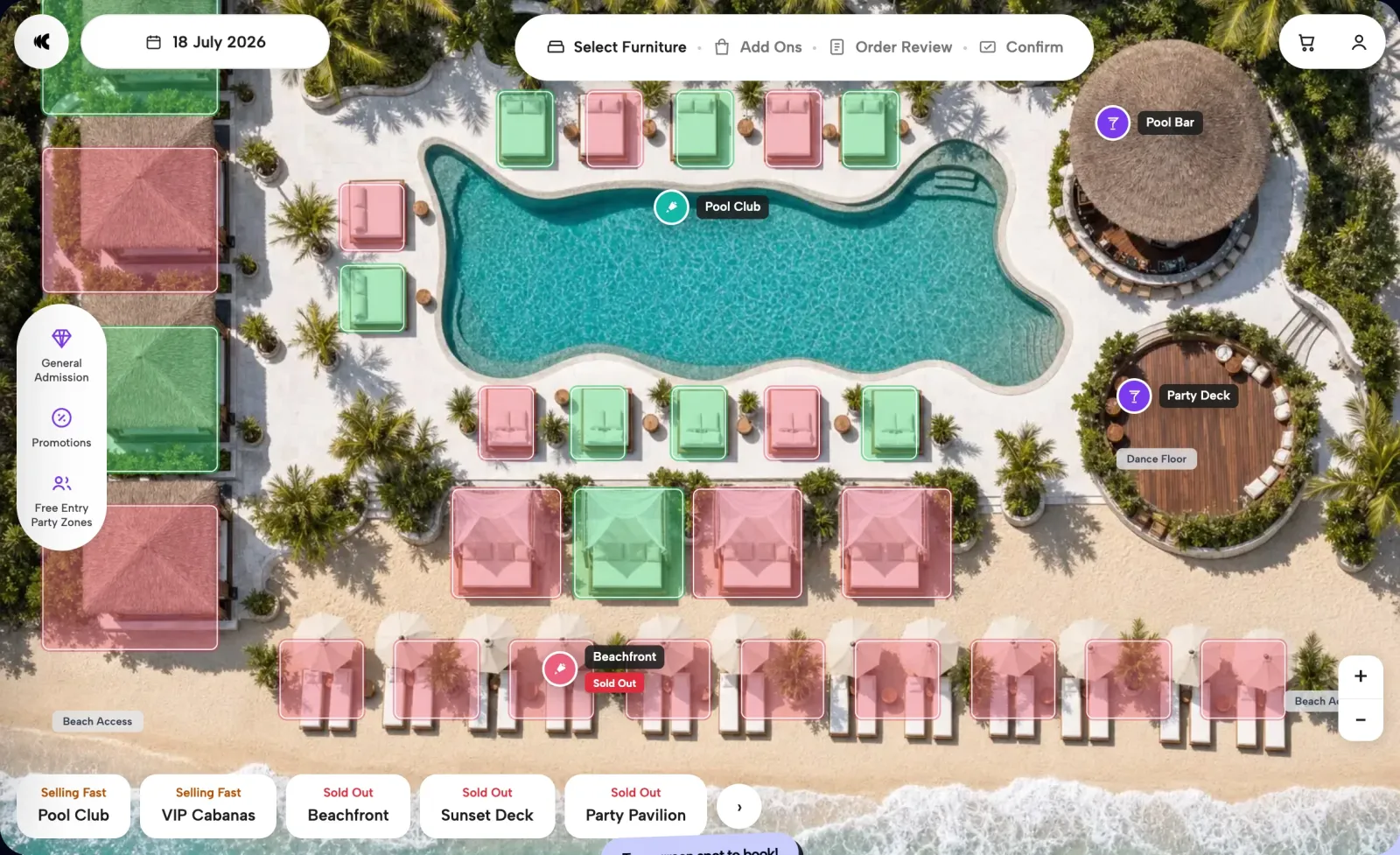
Furniture is the anchor stream and the most commonly undersold, because most venues sell it as one product at one price for the whole day. It's actually a grid: zone × tier × time of day.
Front row, swim-up, shade line, and lawn are different products at different rates. And a daybed sold for a full day is one sale, while the same daybed sold once for the day and again for sunset is two — same furniture, same payroll shift underneath it. Whether your concept can sell the same daybeds twice is one of the highest-leverage revenue decisions available, and it's an operations decision as much as a pricing one: the floor reset in between has to be systematic, which is exactly the rhythm covered in venue operations every night.
Pre-selling changes this stream first and hardest. A pre-paid daybed cannot no-show, and the booking data — lead time by furniture type, sell-out order by zone — becomes the demand signal that sets next month's rates.
2. F&B, anchored by minimum spends
F&B is usually the largest line, and the minimum spend is what connects it to the furniture grid. A premium daybed with a minimum attached isn't rented — it's a guaranteed F&B order with a seat included.
Pre-selling upgrades the minimum from a door-side negotiation to a collected commitment. A minimum enforced by a clipboard gets argued down; a minimum paid, in full or part, at booking gets honored — and guests who arrive already committed spend past it more readily than walk-ups deciding line by line. Set the numbers with the tiering logic in beach club pricing strategy.
3. Packages and add-ons
Packages are the upsell that doesn't need a pitch. A tier ladder — bed only, party package, ultimate experience — lets guests select their own upgrade at booking, when they're planning an occasion, rather than on the deck, when they're already settled. Stackable add-ons ride along: bottles, cakes, transfers, each individually small and collectively meaningful.
The pre-sold effect here is about timing. The guest booking a Saturday celebration ten days out says yes to the bottle and the cake far more readily than the same guest flagging a server at 3pm. FINNS Beach Club in Bali — the reference case for the pre-sold model, now taking millions of dollars of pre-paid bookings each month — sells exactly this way: the package is the default unit of sale, not an afterthought on a bed rental.
4. Events and ticketing
Events monetize the same real estate a second time: a ticketed sunset party, a takeover, a brand night earns on top of the daytime deck. For nightclub-style programming the mechanics converge with table-based selling — tables, minimums, and tickets in one flow.
Pre-selling is native to this stream — nobody runs walk-up-only events — but the upgrade is running tickets through the same system as furniture, so the event buyer and the daybed buyer land in one guest database instead of a ticketing silo you rent. Clubtech supports event ticketing and multi-currency checkout.
5. Day passes and the sold-out capture
Entry is the base layer — and even free entry is a revenue decision, because it's the top of the funnel and the start of the guest record.
The overlooked half of this stream is what happens when furniture sells out. On a walk-up model, "sold out" means turning away demand you paid marketing dollars to attract. Pre-sold venues capture it instead: priority-entry or free-entry registration takes the guest's details even when there's no bed left to sell. The guest who missed Saturday's front row becomes the contact who gets Tuesday's availability. Sold out should grow the database, not cap it.
6. Repeat-guest revenue
The quietest stream is the guest who comes back — and it's the one walk-up venues can't even measure, because a walk-up who returns is indistinguishable from a stranger.
Direct pre-sold booking makes repeat revenue visible and workable. Every booking builds a guest record the venue owns: repeat-customer share becomes a number you track, your highest-value guests seed lookalike audiences for acquisition, and the marketing loop runs on bookings rather than followers. This is also the stream marketplaces quietly confiscate — commission models keep the guest relationship, so the repeat visit gets re-sold to you as new demand. Owning the channel means owning stream six.
Reading the stack as one system
The six streams share one multiplier: the earlier the sale, the more each is worth. Prepayment kills the no-show, booking-time buying lifts package and add-on attach, sold-out days convert to future demand, and every transaction compounds the guest database. Activating a dormant stream usually beats squeezing an active one — and moving any stream from walk-up to pre-sold beats both.
Questions operators ask
What are the main revenue streams for a beach club?
Six: furniture rental across zones and price tiers, food and beverage anchored by minimum spends, tiered packages with add-ons like bottles and transfers, ticketed events, day passes and entry (including contact capture when furniture sells out), and repeat-guest revenue. Most venues deliberately run only two or three; the growth opportunity is usually activating the rest and moving all of them to prepaid booking.
What is the biggest revenue stream for beach clubs?
F&B is typically the largest line, but it's downstream of furniture: minimum spends and packages attached to beds are what guarantee the F&B revenue arrives. That's why high-performing venues treat furniture, minimums, and packages as one connected system rather than three separate prices — the bed sale is what locks the bar sale in.
How do beach clubs make money when they're sold out?
By capturing the demand instead of turning it away. Priority-entry or free-entry registration takes contact details from guests who wanted furniture that's gone, so a sold-out Saturday builds the audience for a soft Tuesday. Venues that just show "sold out" convert their best marketing days into dead ends; capture turns them into database growth.
Do day passes cannibalize furniture revenue?
Not when they're tiered correctly. A day pass is the funnel's base layer — it converts guests who wouldn't buy a daybed today into guests on your property and in your database. Cannibalization happens when the pass includes too much; kept lean, it upsells naturally toward furniture and packages on the next visit.
Why does pre-selling change revenue stream economics?
Three mechanisms. Prepayment removes no-show risk, so reserved furniture is revenue rather than a rumor. Booking-time decisions carry higher attach — guests planning an occasion add packages and bottles more readily than guests already on the deck. And every pre-sold transaction creates owned guest data, which powers repeat revenue and value-based ad optimization.
See all six streams running on one platform. Pre-configured for a venue like yours, no contracts. Book a 30-minute demo