Most beach club business plans model costs to the dollar and revenue to a wish. The fit-out budget runs to two decimal places; the income line says "capacity × average spend × 70% occupancy" and hopes nobody asks where the 70% came from. Investors ask. And the venues that struggle in year one usually aren't the ones that overspent on furniture — they're the ones that overestimated how much of that furniture would sell, and had no mechanism to sell it in advance.
This post covers the three parts that determine whether the spreadsheet survives contact with a real season: the bottom-up revenue model, the cost lines that routinely go missing, and why the booking channel is a plan-stage decision, not a post-opening one.
The direct answer: what a beach club business plan must contain
A credible beach club business plan models revenue bottom-up — each furniture type, times its price tier, times how often it sells in a day, times realistic occupancy across the season curve — instead of one blended average. It costs the forgotten lines: furniture refurbishment, seasonal payroll ramp, payment fees, weather variance. And it names the booking channel, because whether revenue arrives pre-paid or walk-up changes the cash flow, the risk, and the marketing math on every other page.
Model revenue bottom-up: furniture × zones × season
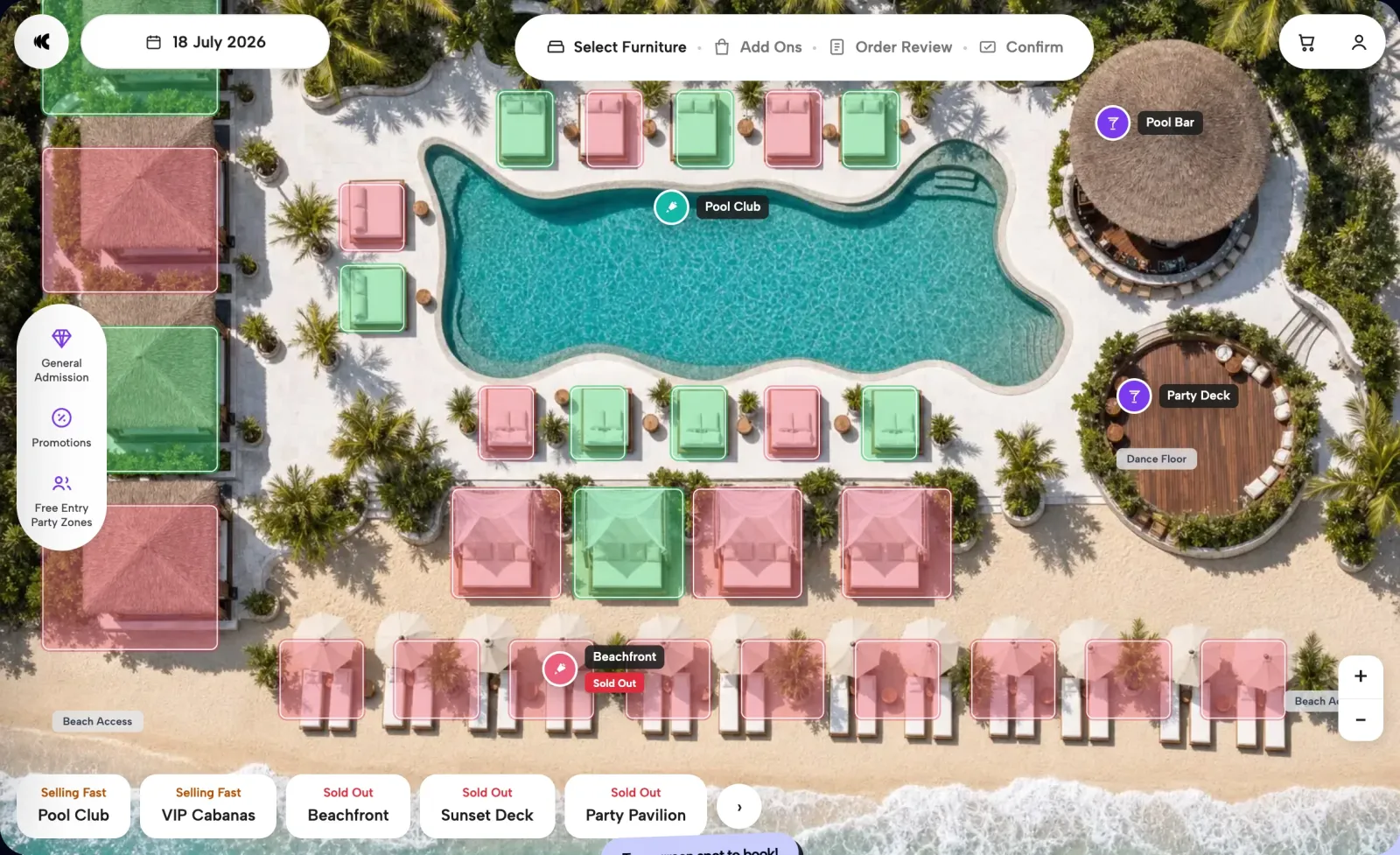
The blended-average model fails because a beach club is not one product. It's an inventory grid, and every cell prices differently:
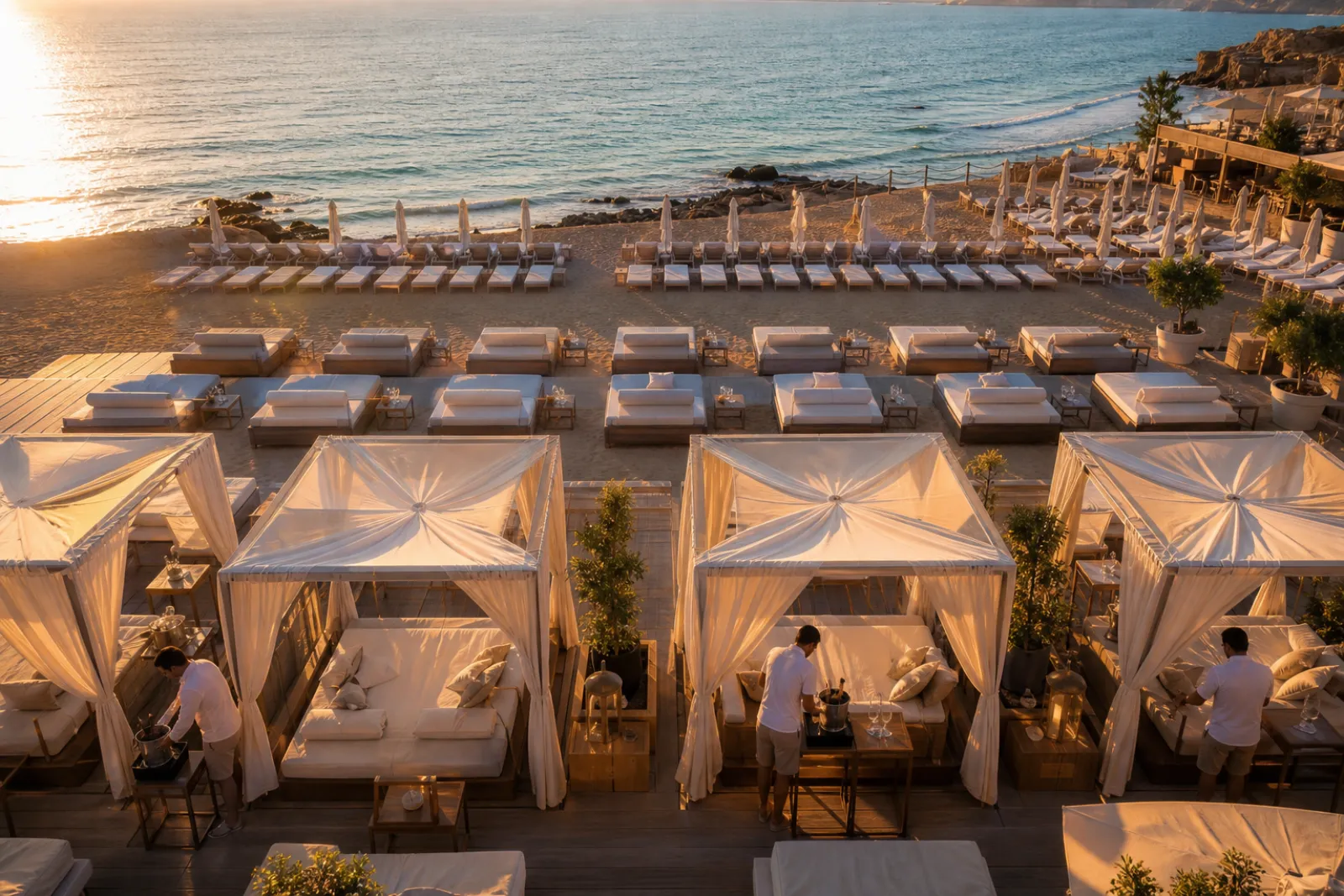
- Furniture, by zone and tier. Sunbeds on the lawn, daybeds in the middle, front-row daybeds, cabanas, VIP decks. Price the position, not the object — front row and fourth row are different products, as our revenue playbook covers in depth.
- Day and night. If the deck sells one full-day booking only, that's one sellable day. If the same daybeds and cabanas sell again for sunset or the evening, the furniture earns twice. Whether your concept supports that second sell-through is a plan-level decision that roughly scales the revenue ceiling — and the staffing model with it.
- Season shape. No venue runs one occupancy number. Model the curve: peak months, shoulder months, and — for seasonal markets — zero months. A Mediterranean club earning for five months must carry twelve months of fixed costs; a year-round market like Bali peaks twice. Occupancy assumptions belong per month, per zone.
Then stress-test it. What does the P&L look like at meaningfully lower occupancy than your base case? If the plan only works at optimistic occupancy, it isn't a plan — it's the wish with formatting. Do not borrow benchmark occupancy or margin numbers from generic hospitality sources.
The full menu of what can sit on top of furniture revenue — minimum spends, packages, add-ons, events, day passes — is its own topic; see beach club revenue streams and price the ladder using beach club pricing strategy.
The cost lines plans forget
Fit-out, rent, and payroll make it into every plan. These lines frequently don't, and they bite in season two:
- Furniture refurbishment and replacement. Salt, sun, and sunscreen destroy premium furniture faster than founders expect. Cushions, canopies, and teak need a standing annual budget, not an emergency one.
- Seasonal payroll ramp and wind-down. Hiring, training, and (in seasonal markets) releasing a full floor team every year is a real recurring cost, including onboarding weeks at full pay before full revenue.
- Payment and channel costs. Card fees on every transaction; commission if you sell through marketplaces or agencies. A percentage of revenue is still a cost line even when no invoice arrives.
- Licensing, permits, and beach concessions. Annual, rising, and renegotiated exactly when you have no leverage.
- Weather and variance. Rain days, wind days, and soft weeks are not exceptions — they're a predictable percentage of any outdoor season. A plan with no variance allowance treats the best case as the base case.
- Marketing as a permanent line. Not a launch budget that tapers to zero, but an ongoing cost of filling perishable inventory that expires every sunset.
None of these should sink the plan — but their absence is the first thing an experienced investor notices.
The booking channel is a plan decision, not an afterthought
Here's the section most templates skip entirely: how revenue arrives. Two venues with identical decks and prices can be completely different businesses depending on the answer.
Walk-up and DM-based selling means revenue lands on the day, so the venue carries all the variance: weather risk, no-shows, staffing set against guesses, and no guest data to remarket to. This is the default a venue inherits by not deciding.
Pre-sold, direct booking means guests commit and pay days in advance. Cash arrives before the cost of serving it. Occupancy is visible early enough to staff and stock against — the daily operating rhythm we cover in venue operations every night. No-shows stop being a revenue event because the revenue is already collected. And every booking creates a guest record you own.
Marketplace distribution brings demand but takes commission and keeps the guest relationship — you never learn who booked your own deck. As a launch supplement it can make sense; as the plan's primary channel it means building an audience you'll never own.
The channel choice also changes the plan's marketing math. When bookings are the conversion event — fired to Meta, Google, and GA4 with revenue attached — the plan can state customer acquisition cost as a measurable number instead of a branding hope. FINNS Beach Club in Bali is the reference case for what the pre-sold model looks like at scale: its CEO describes growing from on-the-day bookings with no financial guarantee to millions of dollars of pre-paid bookings each month.
Write the channel into the plan the way you'd write in the POS or the kitchen: infrastructure, decided before opening — retrofitting mid-season means running your most fragile season on the walk-up default.
Questions operators ask
How do I write a beach club business plan?
Build it in three layers: a bottom-up revenue model (each furniture zone × its rate × how often it sells in a day × monthly occupancy across the season curve), a complete cost stack including the forgotten lines (furniture refurbishment, seasonal payroll ramp, payment fees, weather variance), and the operating decisions — booking channel, pricing architecture, staffing model — that determine whether the revenue model is achievable.
How much revenue can a beach club make?
It depends on furniture count, price tiers, zones, and season length — which is exactly why the plan must model those variables instead of quoting an industry average. A useful plan states revenue as a range across occupancy scenarios, not a single number. Be suspicious of benchmark figures; credible beach-club-specific data is scarce.
Are beach clubs profitable?
They can be, but margin follows structure: season length versus twelve months of fixed costs, the share of revenue that is pre-sold rather than weather-dependent, F&B attach through minimum spends and packages, and how many revenue streams are actually running. A walk-up-dependent club and a pre-sold club with the same deck are different businesses on margin.
What startup costs do beach club founders underestimate?
The recurring ones. Furniture refurbishment against salt and sun, the annual cost of hiring and training a seasonal floor team, payment and marketplace fees that scale with revenue, license and concession renewals, and a weather-variance allowance. Launch budgets usually survive scrutiny; it's year-two operating reality that most plans haven't priced.
When should a new beach club choose its booking system?
At the plan stage, alongside the POS and the kitchen — before opening, not after. The booking channel determines whether revenue arrives pre-paid or on the day, which changes cash flow, no-show exposure, staffing accuracy, and whether marketing spend is measurable. Opening on walk-up and retrofitting a booking system mid-season means running your most fragile months on the least forgiving model.
Planning a venue? See what the pre-sold model looks like before you commit the spreadsheet — on a platform pre-configured for a venue like yours. Book a 30-minute demo