Most venues can state their ad spend to the dollar. Very few can state what it returned. The spend sits in one system, the revenue sits in another, and between them is a "conversion" defined as a click, a form fill, or a tap on a WhatsApp button. None of those is money, so next month's budget ends up set on instinct.
That is a definition problem before it is a reporting problem, and the definition is the part you control.
The direct answer: the conversion is the paid booking, with its value attached
Marketing ROI for a venue is booked revenue divided by what you spent to get it. So the conversion you report to every platform has to be the completed, paid booking — not the inquiry, not the landing-page view — and it has to carry a value: amount paid, currency, a stable transaction ID, and enough detail to tell a two-person sunbed from an eight-person cabana.
After that it is arithmetic. Meta, Google, TikTok, and GA4 each hold a version of which channel produced which booking. Your booking system holds the number none of them can argue with: what was actually sold.
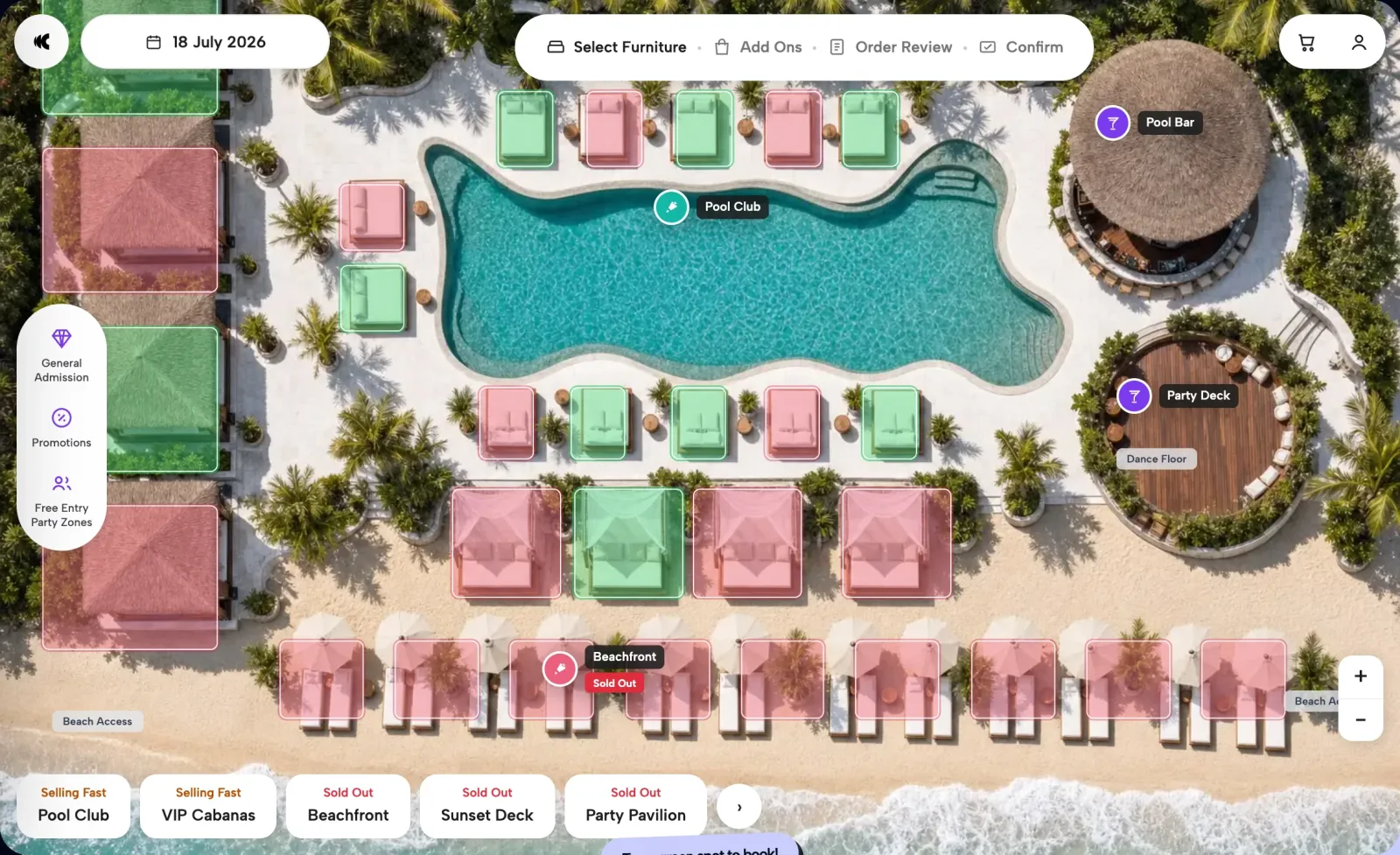
On Clubtech you do not build that plumbing. Bookings fire to Meta, Google, TikTok, and GA4 in real time with revenue values posted back — value-based optimization, not a count of conversions. The implementation sits in two companion pieces: GA4 for venue bookings for the event model, and the Meta Conversions API for venue bookings for server-side delivery.
A conversion without a value teaches the platform the wrong thing
Ad platforms optimize toward whatever you told them success looks like. If every booking reports as one conversion with no value, the algorithm buys the cheapest possible booking: the midweek lounger, the two-top, the discount hunter. Volume climbs, booked revenue does not, and the dashboard looks better than the deck.
Attach the value and the target changes. The bidding starts hunting for people who resemble the guests who spent the most, and audiences can be seeded from your highest-value bookers rather than follower counts. Same budget, different guest.
Two rules keep it honest. Fire on payment, not on request — an unpaid booking is a forecast. And send one event per booking with a stable ID, because a duplicate inflates your ROI and the platform's confidence at once.
The three numbers that decide next month's budget
Not thirty. Three.
1. Booked revenue by channel, against spend by channel. Not sessions, not leads, not cost per click. If a channel cannot be stated as dollars booked over dollars spent, it is not being measured. It lives in the ad platforms and GA4, where the booking event lands with its value attached.
2. Cost per booking and average booking value, per channel, side by side. Neither means anything alone. An expensive cost per booking is fine if that channel brings the large group bookings; a cheap one that only sells single loungers can be the worse buy.
3. The reconciliation delta. What the platforms report, against what your booking system says was actually sold. There will be a gap; its size matters far less than its steadiness. A delta that jumps means the measurement moved, not the market — and every number above it is fiction until you know which.
One and two are modeled. Three is the only fact.
Clubtech ships 20+ reports — booking volume, lead time by zone, average value by variant, product mix, repeat share, origin markets — so the revenue side of that arithmetic is on a screen rather than in a CSV export. The channel split is not in those reports. The weekly operating version of these numbers is the five-number read in the beach club marketing strategy guide.
Where attribution genuinely breaks in a venue business
Three cases the model cannot see. Pretending otherwise is how a working budget gets cut.
The walk-in who saw the ad. Someone watches a reel on Tuesday, arrives on Saturday, pays at the door. The ad did the work. There is no click, no session, no event, no credit. It is structurally invisible, and it is why brand spend should never be judged on last click.
The group booked by one person. Eight guests arrive, one paid. The platforms see a single conversion — a large one, if you sent the value. The other seven are the part worth chasing. On Clubtech the booker invites the party and each ancillary guest supplies their own details, so the marketable audience grows with every reservation — even where attribution shows a single buyer.
The guest who books far ahead. The bigger the date, the earlier it gets committed, while default click windows in the ad platforms are measured in days. When the decision and the payment sit that far apart, the first click has aged out, the booking lands as direct traffic, and the channel that created the demand gets underfunded.
Add consent gaps, blocked tracking, and the guest who researches on a laptop and books on a phone at night, and reported booked revenue is a floor, not a total.
How to be honest about it instead of pretending the model is clean
Pick one attribution model, write its rules down, and leave it alone for the quarter. Consistency beats accuracy: you are comparing this week to last week, and a changing model cannot.
Keep a blended number beside the modeled one: total booked revenue over total marketing spend. It needs no attribution and cannot be gamed by a platform grading its own homework. When the two disagree for more than a few weeks, trust the blended one.
For anything you need to prove, turn it off. Pause a channel for two weeks, or hold it out of one market, and watch total booked revenue rather than the dashboard.
What to change when the number is bad
Cheapest fixes first.
Check the measurement before the marketing. Is the event firing on payment, once per booking, with a value and a currency? Much of "our ads don't work" is an ads account that was never told what a booking is worth.
Check the flow, not the ad. If cost per click is normal and cost per booking is not, the ad worked and the booking flow lost the guest. On Clubtech, abandoned-cart events fire within seconds, and WhatsApp and email recovery return the guest to the exact zone, date, and price they left — demand you have already bought, finished rather than abandoned.
Check what you are selling. Average booking value is a marketing number. Add-ons inside the flow, tiered packages, and pricing that flexes with demand raise the numerator on traffic you already paid for.
Then move money between channels — on booked revenue over several weeks, not on one bad Monday.
Questions operators ask
What should a venue count as a marketing conversion?
The completed, paid booking. An inquiry, a form fill, or a landing-page view tells you someone was interested, not that they bought. Reporting the paid booking as the conversion, with the amount paid attached, is what lets an ad platform optimize toward revenue instead of toward whoever is cheapest to persuade.
How do I calculate marketing ROI for a venue?
Divide booked revenue attributed to a channel by what you spent on that channel over the same period, then keep a blended figure beside it: total booked revenue over total marketing spend. The blended number needs no attribution model, so it is the honest backstop when the two disagree.
Why do my ad platform numbers not match my booking system?
Because they count different things. Platforms count conversions they believe they caused, inside their own attribution windows, and more than one will claim the same booking. Your booking system counts what was sold. Expect a permanent gap, track it weekly, and treat a sudden change in it as a measurement failure rather than a result.
Can I attribute a walk-in to an ad?
Not directly. A guest who sees an ad and pays at the door leaves no click and no event, so no model will credit it. What you can do is capture that guest at the door, judge brand spend against total booked revenue across the market rather than last-click results, and use hold-out periods.
How much does Clubtech cost?
Commercials follow discovery. Every venue has a different mix of inventory, zones, payments, integrations, teams, and rollout work, so a list price would be fiction. We map the operation on a call and come back with a proposal built around the real scope.
Bring one month of ad spend and one month of bookings to the call. We will walk the booking event on your own setup — what fires, what value travels with it, and where it lands in Meta, Google, TikTok and GA4. Book a 30-minute demo