Most premium venues have already won Instagram. The grid looks expensive, the video travels, the comments fill with people tagging friends. Then Saturday comes and the front row is still being sold in DMs at 9pm by whoever is holding the phone.
A large following alongside thin direct revenue is the normal condition, not the exception, and posting more rarely fixes it. What closes the distance is the path from feed to checkout — and that path usually has three breaks nobody owns.
The short answer
A follower becomes a booking when three things are true. The profile link points at bookable inventory, not a homepage. The landing moment shows the exact furniture and date the guest pictured in the video. And the checkout survives being finished one-handed on a phone, late, on hotel wifi — because that is when it happens: 82% of bookings happen on a phone after 10pm.
A fourth makes it repeatable: the booking is recorded as revenue against the channel that produced it, so social is judged on money, not reach.
The follower count is a denominator nobody pays you for
Follower growth is the easiest number in the building to move and the hardest to bank. One video outruns your audience and the count jumps, with no bearing on whether anyone can buy a cabana for the 14th.
The operator version is narrower: of the people who reached the profile this week, how many landed somewhere they could buy something, and how many did. That gives social a conversion rate instead of a scoreboard — the same premise the wider beach club marketing strategy runs on.
Break one: the link points at a brochure
The most common failure is a homepage. The link opens the front door, the guest hunts for a reservations tab, and the form behind it promises a reply during business hours — three hops and a wait, for someone who was ready thirty seconds ago.
Point the link at inventory instead. On Clubtech the booking flow runs white-label on the venue's own domain, so the tap lands inside your brand rather than at a marketplace that keeps the guest. Campaign links should land as close to the post as the site allows — the sunset-cabana video pointed at the cabanas and the weekend it was shot for, not at the top of the site.
Break two: the landing moment sells the venue instead of the Saturday
The guest arrives holding a specific picture: that table, that view, that night. A page that answers with a hero image and an about paragraph asks them to start again, and most will not.
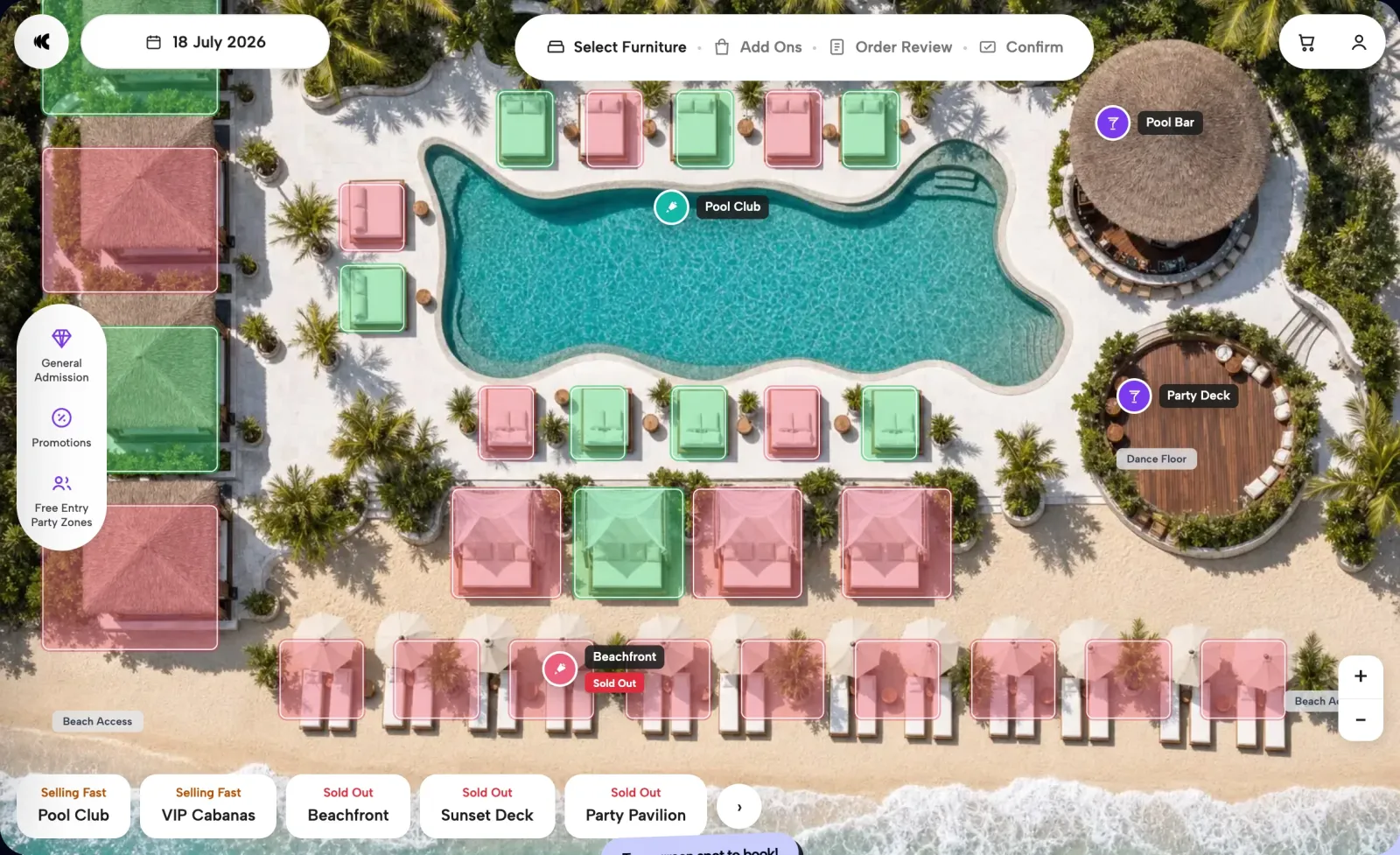
This is the argument for a map-first flow. The 3D birds-eye view puts the guest above the venue, tapping the daybed or booth they saw in the post, watching the 360° walkthrough, choosing a package before price is the subject. They buy the spot, not "a sunbed." The content did the wanting; the page only has to let them act.
Break three: checkout gives up on a phone at 11pm
Late-night phone traffic is impatient and often on a poor connection; a slow page, an account step, or an app install is a lost booking, not a delayed one.
Clubtech's flow is built for that moment: sub-second load, four taps to a complete booking, one-tap wallet authorization with Apple Pay or Google Pay, no app to install. Guests who leave mid-flow trigger abandoned-booking events within seconds, and WhatsApp or email returns them to the exact zone, date, and price they left. When the furniture is gone, priority capture still takes their details — sold out should not mean anonymous.
What converts versus what performs
Reach and revenue rarely come from the same post. The one that travels is a crowd at golden hour. The one that sells is duller: the corner booth and its view, what a package includes, what is left for Saturday. Atmosphere content recruits the audience; inventory content sells to it.
Keep both, and pair them. Every strong atmosphere post deserves a booking-shaped sibling the same week, aimed at the same furniture, captioned to hand off to the link. Scarcity works when it is dated and true — "the front row for the 14th is nearly gone" is a claim your booking map can confirm.
Treat the profile as a booking surface, not a portfolio
The profile is the most visited page you do not control, and it is usually built like a gallery. Build it like a storefront: a bio that names what you sell and when it can be booked, highlights that work as a small sales page — zones, packages, events — and stories carrying the bookable link on the nights that need selling, not only the ones that sold out.
Close the loop so social gets credit for revenue
Social loses budget arguments because it turns up holding reach with nothing attached. That is a plumbing problem, not a reporting one.
When a booking completes it fires to Meta, Google, TikTok, and GA4 in real time with the revenue value posted back, so platforms optimize toward booked dollars rather than clicks, and organic sits in the same ledger as paid. The data belongs to the venue and compounds: lookalikes seed from your highest-LTV bookers rather than follower counts, and every-guest capture puts the booker's whole party in the database, not just the payer. The measurement side is covered in GA4 for venue bookings.
What social should show the owner each week
Five lines. The channel split comes from GA4 and the ad platforms the bookings fire into; the profile and link numbers come from Instagram's own insights; the value and zone numbers come from the venue's own booking reports.
- Bookings attributed to social, and what they were worth. Revenue is the headline, not reach.
- Profile taps into the booking flow, and the share that reached checkout. A drop here is a link or landing problem.
- Average booking value from social against the house average. Whether the content attracts the guest you want.
- Lead time by zone for social-sourced bookings. How far ahead this audience commits sets when next week's posts run.
- New guest profiles captured, party included. The asset the channel builds in a quiet week.
Then one line of interpretation: what sold, what stalled, what next week is pointed at.
Questions operators ask
How do you turn Instagram followers into bookings?
Shorten the path. Point the profile link at bookable inventory instead of a homepage, land the guest on the exact furniture and date they saw in the post, and keep checkout to a few taps on a phone. Then record each completed booking as revenue against the channel, so content decisions get made on money.
Should the link in bio go to the homepage or the booking page?
The booking page, and where possible the specific zone the content is about. Every hop between the tap and the inventory loses people who were ready. Keep the destination on your own domain with campaign parameters attached, rather than a third-party link tool sitting between the venue and both the guest and the data.
What kind of Instagram content actually produces bookings?
Content that shows what is being sold: the specific booth and its view, what a package includes, which furniture is left for the weekend. Atmosphere content builds the audience and should keep running, but it converts best when paired the same week with a post aimed at real, dated, bookable inventory.
How do I know which bookings came from Instagram?
Make the booking itself the event you measure. Completed bookings fire to Meta, Google, TikTok, and GA4 in real time with revenue values posted back, so social sits in the same ledger as paid campaigns and search. Clubtech's own reporting covers the booking side: volume, value, product mix, and lead time by zone.
How much does it cost?
Commercials follow discovery. Every venue has a different mix of inventory, zones, payments, integrations, teams, and rollout work. We map the operation on a call and come back with a proposal built around the real scope.
Bring your grid and one real Saturday to the call. We will show the path from a post to a paid booking on your own furniture, and the report that puts revenue beside it. Book a 30-minute demo