An operator wants to "make a guest list online," so they reach for the first generic RSVP tool that ranks. A form, a shareable link, a running count of who said yes. For a lot of events, that is the right answer. For a working venue on a Saturday night, it falls apart at the door.
The gap is not about features. It is about what the tool is built to protect. An RSVP form protects a headcount. A venue needs to protect inventory, capture every guest, and turn the night into data it can sell against next week. Here is how to tell which problem you have.
For guests looking for Bali nightlife, venue reviews, and a list to join, start with Guest List Now. The comparison below is for operators deciding how the list should run once it reaches the door.
When a generic RSVP form is genuinely the right tool
Plenty of gatherings do not need a booking system, and it would be dishonest to pretend otherwise. If your event looks like one of these, use the free form:
- A one-off private party. You know most of the guests, there is no revenue at the door, and you just need a rough count for catering.
- A wedding or family celebration. The organiser already owns the relationship with every guest. Meal choices and a plus-one count are the whole job.
- A free community event. No payment, no minimum spend, no inventory to lose. If ten fewer people show up, nothing breaks.
The common thread: nobody is paying, no spot is held against revenue, and no campaign depends on knowing who came. A generic RSVP tool does that fine, and Clubtech is not the right fit for it. If that is your event, you can stop reading here.
When "guest list" quietly means "booking system"
A venue's guest list looks like an RSVP list and behaves nothing like one. The moment there is a door, a minimum spend, or a Saturday that sells out, the requirements change: guests are paying rather than promising, the door becomes a control point, and every name is someone you want to reach for the next event.
When any of those are true, a generic RSVP tool is the wrong shape. You need a system built for how a venue makes money. That is what our guest-list and visitor management software is for, and it is why venue guest lists usually sit alongside table and furniture booking.
Four things a venue needs that a form cannot do
Door check-in that runs at door speed
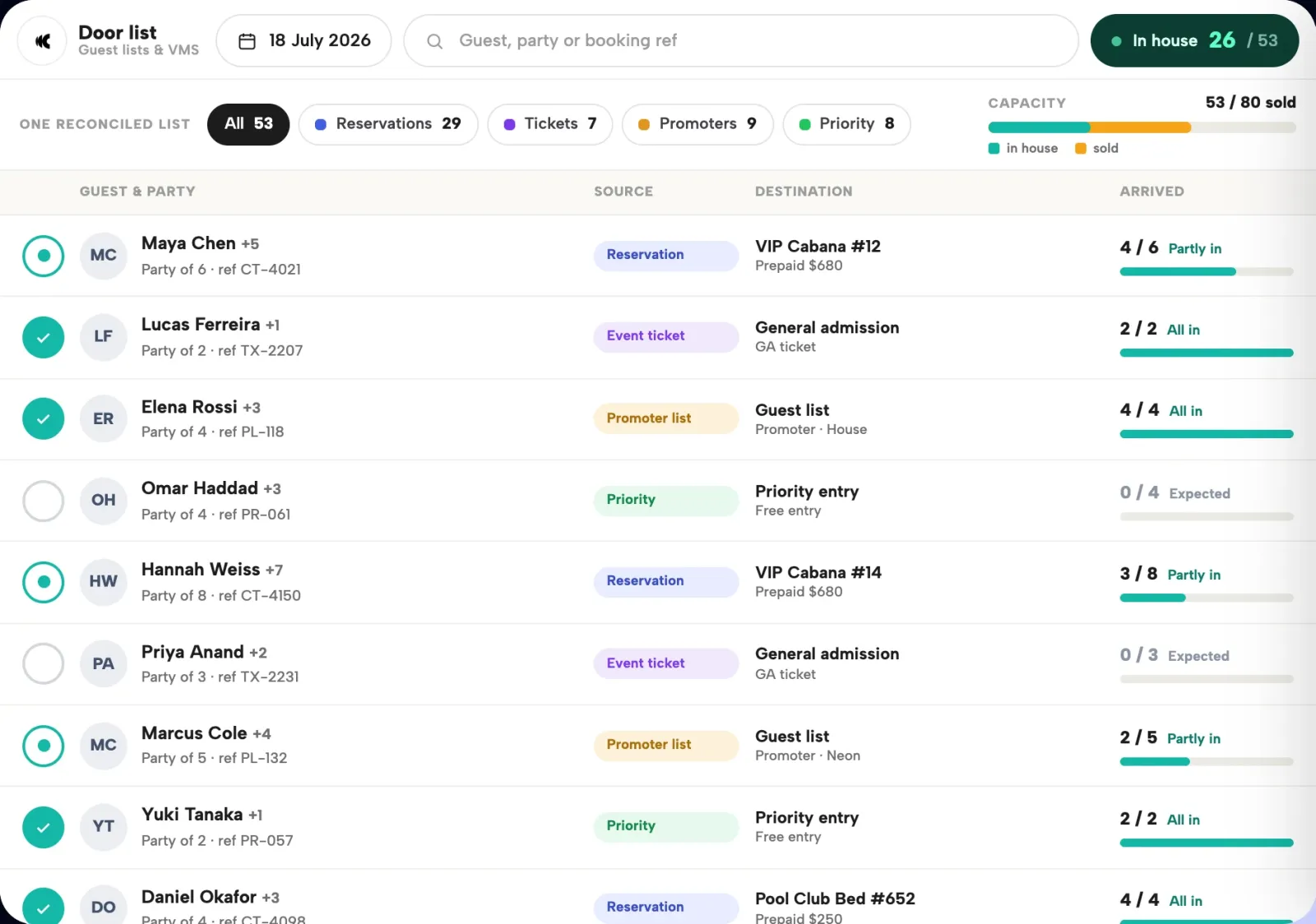
An RSVP export is a static list. A venue needs a live door. Clubtech pairs the guest list with visitor management and QR-code check-in for ticketed entry, so the host works against real-time status, not a printout that went stale the moment the last name was added. Check-in is an operations job, not a spreadsheet lookup.
Every-guest data capture, not just the organiser
This is the failure most operators miss until it is too late. A generic form captures the one person who submitted it. Everyone else in that party is invisible to you. Clubtech flips it: the booker invites their group, and each invited guest supplies their own details. You capture the whole party, not just the payer. Fifty guests through the door become fifty contacts you own, on your own domain, instead of one email address and a headcount.
Prepayment and minimum spend to protect inventory
A form counts intentions. A booking system protects the spot. Prepayments, deposits, and minimum spends turn a promised table into a guaranteed one — the single biggest lever against no-shows. When a name on your list has money behind it, the Saturday you were holding is revenue, not a gamble.
A list that becomes a marketable database
The point of capturing guests is what happens after they leave. Clubtech's guest data feeds 20-plus built-in reports — booking volume, lead time by zone, average value by package, repeat-customer share — with no CSV exports to stitch together. The same first-party data seeds your ads: bookings post back to Meta, Google, and GA4 in real time with revenue values. A dead RSVP list cannot do any of that.
The commercials are built after discovery. Clubtech maps the venue, guest-list operation, payments, POS/PMS boundary, integrations, and rollout before returning with a tailored proposal. It sits on top of the existing stack rather than replacing it. FINNS Beach Club runs on it — CEO Beau Whittington: "We have grown from simple on-the-day bookings with no financial guarantee to now having millions of dollars worth of pre-paid bookings each month."
If you are deciding between a form and a real system, the fastest way to know is to see your own floor plan in it. Book a 15-minute demo — no contracts, no credit card.
Questions operators ask
Can I make a guest list online without a full booking system?
Yes, and for a free or private one-off event you probably should — a generic RSVP form handles it. The line to watch is money and the door. The moment guests are paying, a spot is held against revenue, or you need fast check-in, an RSVP form stops being enough.
What is the difference between RSVP management and guest-list management for a venue?
RSVP management protects a headcount: who said they are coming. Guest-list management for a venue protects inventory and the door — live check-in, prepayment against no-shows, and capturing every guest rather than just the organiser. One counts intentions; the other guarantees revenue and builds a database.
Does an online guest list capture every guest or just the person who books?
A generic form captures only the submitter. Clubtech captures the whole party: the booker invites their group, and each guest supplies their own details, so a fifty-person list becomes fifty contacts you own.
How does a guest list stop no-shows?
A name on a form is a promise, and promises do not always show up. Attaching prepayments, deposits, or a minimum spend turns a promised table into a guaranteed one. When the booking has money behind it, the held inventory is revenue you can bank.
Can I keep using a free RSVP tool alongside Clubtech?
For genuinely free, private, or community events, keep the free tool — that is the honest fit. Use Clubtech for the nights that carry revenue: paid entry, table bookings, minimum spends, and any event where the guest data should feed your reporting and ads.
See it on your own floor plan. 15 minutes, no contracts, no credit card. Book a demo