It is 11:40pm on a Friday and there are two lists at your door. One is a shared spreadsheet somebody is refreshing on a cracked phone. The other lives in a promoter's DMs, and the promoter is not answering. A group of eight is at the rope insisting they are on it, the line is backing up, and the only person who can confirm the booking is inside dancing.
That is what most venues call guest list management. It is not software. It is a set of habits held together by memory and goodwill, and it fails at the moment volume is highest and mistakes cost the most.
Guest List Now covers the guest-facing side: discovering Bali nightlife, reading venue reviews, and finding guest-list bookings. This guide stays on the operator side — running the list, the door, and the guest data after the name is added.
What guest list management actually means for a venue
A generic RSVP or event tool answers one question: is this person coming, yes or no. That is fine for a conference. It is not enough for a premium venue, where the guest list is tied to furniture, entry priority, spend, and a service day that runs on a clock.
Guest list management for a venue means running the door as an operational system, not a checklist:
- Every name is attached to a booking, a host, or a reason for entry — not floating in a message thread.
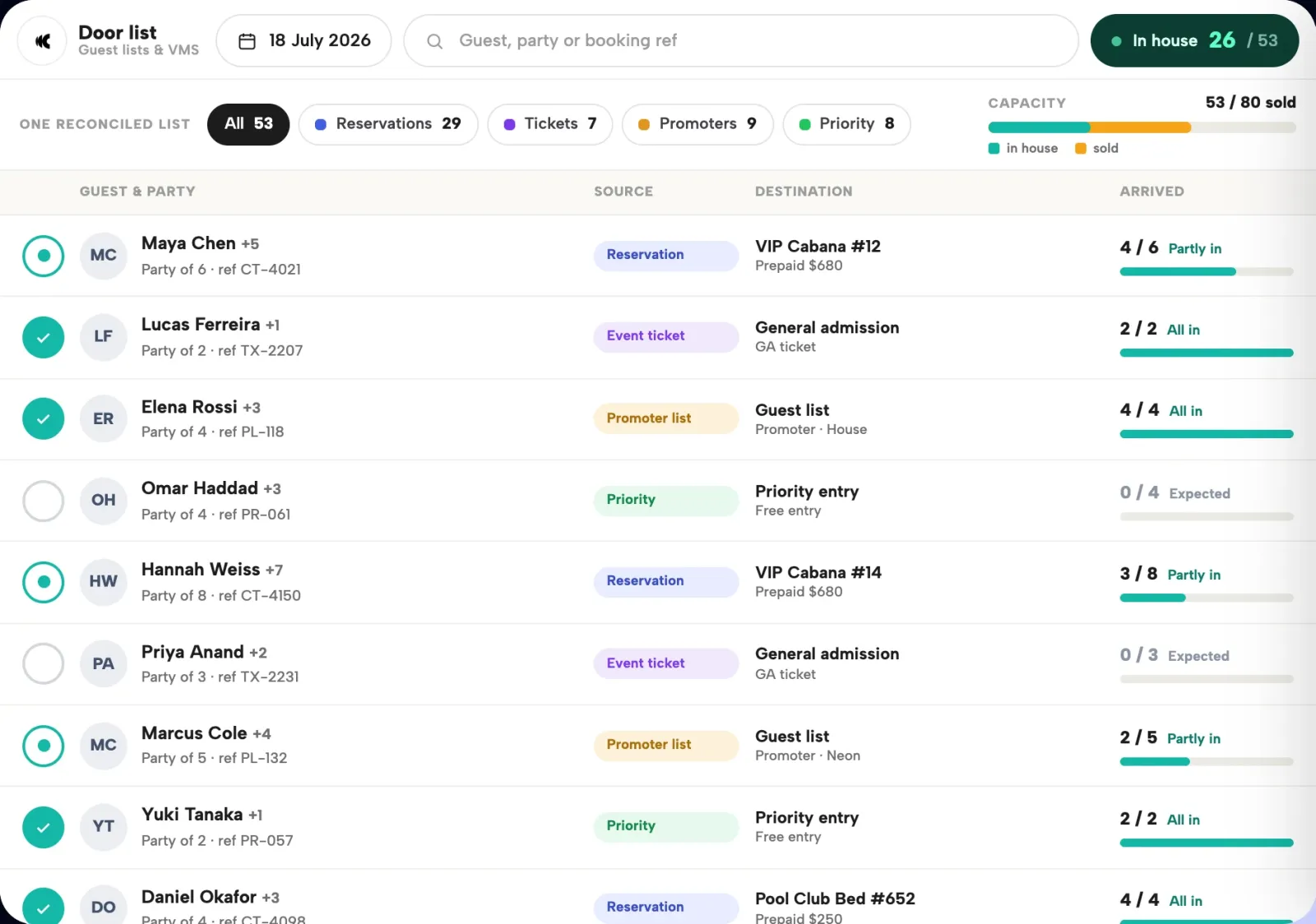
- The door knows, in real time, who has arrived and who is still expected.
- Comps, priority entry, and paid entry are visible in one place, so nobody argues at the rope.
- Your floor team, reservations team, and promoters all see the same list.
Generic tools treat the RSVP as the end of the job. For an operator it is the start of it — the list has to connect to the door, the floor plan, and the marketing database. That is where most tools stop and Clubtech keeps going. Our guest-list and visitor management sits inside the same platform as reservations, front-of-house operations, and marketing, so the name at the door is the same record everywhere else.
The door workflow: check-in that keeps the line moving
The door is where a guest list either works or embarrasses you. A visitor management system (VMS) at the entrance turns a scroll-and-squint search into a single scan.
- QR-code check-in. The guest presents a code, the host scans it, and the record confirms instantly — the same QR check-in Clubtech uses for events and tickets.
- Live arrival status. As guests scan in, the list updates for everyone, so your floor team can hold seats and nobody releases a spot too early.
- One list, not three. The door host, the operator console, and the promoter's names all resolve to one source of truth.
Behind the door, the operator console and floor plan tie the guest list to the room. You know what is booked before doors open, seating is allocated automatically, and inventory stays in sync as people arrive.
Capture the whole party, not just the booker
Here is the leak almost every venue lives with. One person books a table for six. You collect one name, one email, one phone number. The other five walk in, spend money, and leave no trace. You paid to acquire the whole group and captured a sixth of it.
Clubtech closes that leak by design. The booker invites their group, and each invited guest supplies their own details as part of joining the reservation. The venue captures the whole party for marketing, not just the payer. Six guests in the door becomes six records you own — names you can bring back for the next big night, not anonymous walk-ins.
Priority and free-entry capture when you sell out
Selling out is a good problem that most systems handle badly. The furniture is gone and the honest answer to the next enquiry is "sorry." That guest closes the tab and you never hear from them again. Sold out became lost.
It should not. When furniture sells out, Clubtech captures priority and free-entry data instead of turning the guest away empty-handed. The guest who could not get a table joins a priority or free-entry list, so you keep the relationship and the contact, and you have a warm audience to convert the next time capacity opens. Sold out is a data capture opportunity, not a dead end.
From a list to a marketable database
A spreadsheet remembers who came on Saturday. It does not tell you anything useful about them. The whole point of running the door as a system is that the list becomes a database you can market to and reason about.
Clubtech turns the guest list into guest intelligence with 20+ built-in reports — booking volume, lead time by zone, average value by variant and package, repeat-customer share — read inside the platform, with no CSV exports to wrangle. You do not just have a list of who is coming tonight. You have the shape of your demand and the value of your regulars.
Because the venue owns its guest data on its own white-label platform, that database is yours and it feeds your marketing directly. It is why FINNS Beach Club CEO Beau Whittington describes the shift plainly: "We have grown from simple on-the-day bookings with no financial guarantee… to now having millions of dollars worth of pre-paid bookings each month."
Where the spreadsheet and the promoter's phone stop working
A shared list works for a launch party. It breaks the night you actually need it. The signs are familiar:
- Two people editing the same list, and nobody trusts which version is live.
- A promoter who owns names in their phone — and takes them when they leave.
- No way to know at 1am how many of tonight's list actually showed.
- A door argument that only ends when someone walks inside to check.
- A month of guest lists that leaves you with no usable database.
The moment any of these is costing you real revenue or real time is the moment guest list software earns its place. And it does not require replacing your stack — Clubtech sits on top of your existing POS and PMS with no major IT changes.
Commercials follow discovery. We map the guest-list workflow, floor, payments, integrations, teams, and rollout, then return with a proposal built around the confirmed operation. See it running on a floor plan like yours in a focused discovery call.
Questions operators ask
What is guest list management software for a venue?
It is a system that runs your door as an operational tool rather than a shared spreadsheet. It attaches every name to a booking, host, or entry reason, tracks arrivals in real time via check-in, and turns the list into a guest database you own. For a venue it connects the door to the floor plan and to marketing, which a generic RSVP tool does not.
How is an online guest list different from a spreadsheet or a promoter's phone?
A spreadsheet has no live arrival status, no single source of truth, and no data after the night ends. A promoter's phone means the contacts leave when the promoter does. An online guest list keeps one live list that the door, reservations, and floor teams all see, and captures every guest as a record the venue owns.
Can I capture details for the whole group, not just the person who booked?
Yes. With Clubtech the booker invites their group and each invited guest supplies their own details when they join the reservation. The venue captures the whole party for marketing rather than only the payer, so six guests at a table become six contacts you own.
What happens to guests when we sell out?
Sold out does not have to mean a lost guest. When furniture sells out, Clubtech captures priority and free-entry data so the guest who missed out joins a warm list you can convert next time capacity opens, instead of closing the tab and disappearing.
Do I have to replace my POS or PMS to use guest list software?
No. Clubtech sits on top of your existing POS and PMS with no major IT changes and integrates with the tools you already run. Switching cost is low because it does not replace your stack — it adds the booking, door, and marketing layer on top of it.
See your guest list turn into a database. Start with the guest-list workflow, then book a demo.