In most cities a hotel pool is an amenity with a towel desk. In Dubai it is a product. From October to May the deck is sold to people who are not staying: day passes, cabanas, packages and minimum spends, bought by people who live in the city and by visitors staying elsewhere. The hotel competes for that guest with every beach club along the coast, and the booking page is where the sale is won or lost.
The direct answer: what a Dubai hotel pool booking system has to do
Four jobs, through the October to May season. Keep the residents' allocation separate from what goes on sale. Sell the rest to outside guests as specific furniture, in packages with minimum spends. Take payment from an international booker in a few taps. Price a peak weekend apart from a quiet weekday. All four run on the hotel's own domain, under its brand.
Residents and outside guests on one deck
The first decision is not about software. It is which part of the deck belongs to residents, and on which days. That line is the operator's allocation, and in Dubai it moves with occupancy. On a full peak-season weekend the resident zones need more of the deck. On a lower-occupancy weekday, more of it can go on public sale.
On Clubtech that allocation lives on the interactive internal floor plan. Area-blocking and all-day blocking hold resident zones back from sale on the days the hotel needs them, and what is left is sold to outside guests. Online bookings sync to the same floor plan in real time, with automatic seating allocation, so the pool team works from one view of both groups. Nobody has to cross-check the day-guest list against the resident list at 10am.
The front office is the other half of the boundary. Opera PMS is an integration row for the hotel vertical, and its scope is confirmed property by property. What the connection does at your hotel is agreed with your IT and finance teams before launch, not assumed from the integration name. The product model for hotel decks, including how the resident line is drawn, is on the hotel pool booking page.
Selling the day to non-residents: packages, cabanas and minimum spends on the map
An outside guest is not buying access to a pool. They are choosing between your deck and a beach club down the coast, and they choose on the spot itself: the shaded cabana by the water, the lounger row with the view. A pass count cannot win that comparison. A map of the actual deck can.
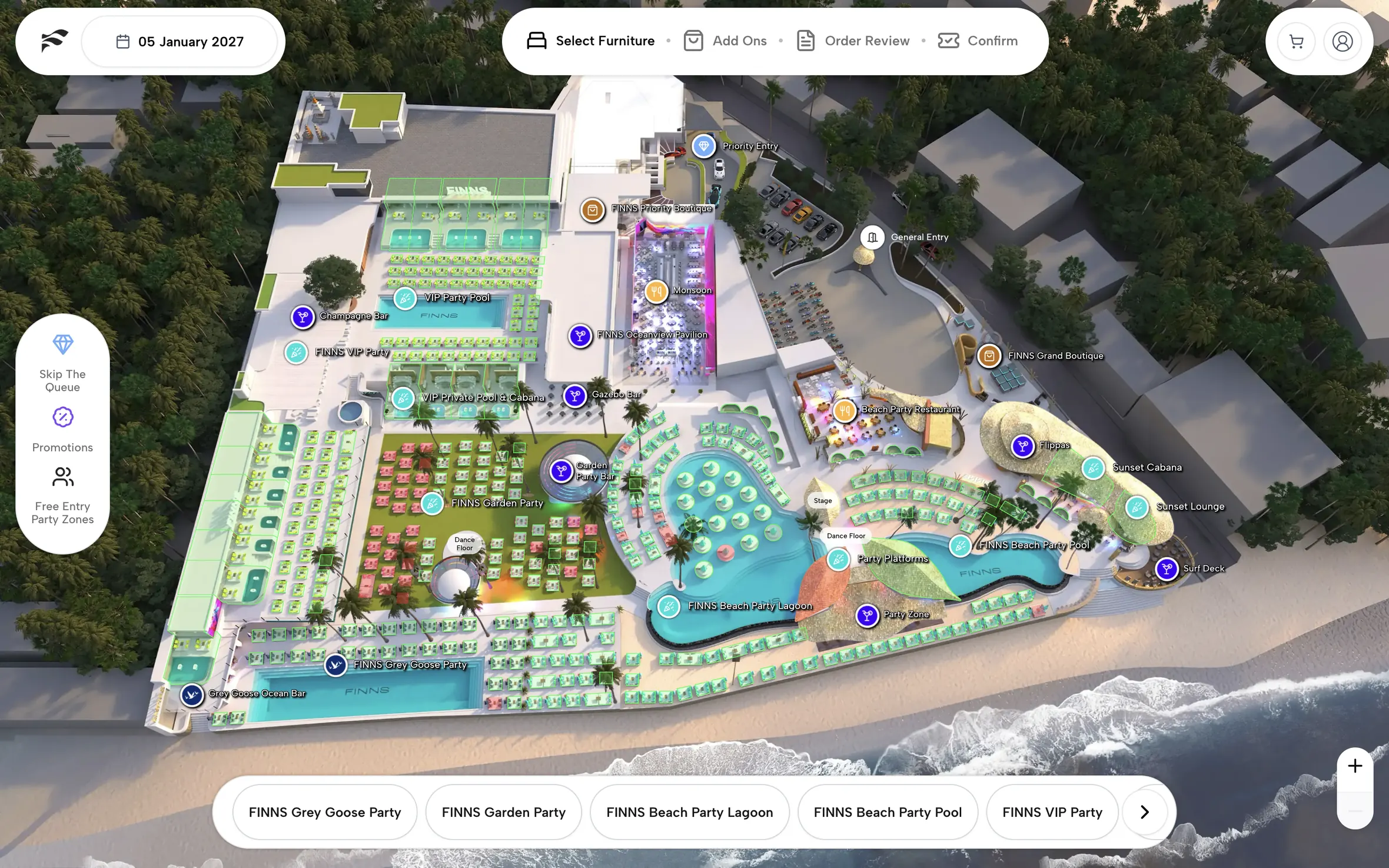
On Clubtech's 3D birds-eye booking map the guest explores the deck from above, watches the 360° walkthroughs and taps the exact cabana before paying. For the Dubai outside guest, the add-ons do specific work: a transfer for the visitor staying across the city, a cake for the birthday group, bottles for the cabana. A minimum spend on the cabanas puts a floor under the furniture that earns the most, while the entry tier sells from the same map. How to structure the pass tiers themselves is covered in how to sell hotel day passes.
On the best peak-season Saturdays the cabanas sell out. Priority and free-entry data capture takes the late guest's details anyway, so a sold-out deck still adds to next weekend's audience.
The international booker: multi-currency checkout and wallet payment
A pool day is often decided the night before: 82% of bookings happen on a phone after 10pm, and in Dubai the card may well be sterling, euro or dollar. Checkout stays inside the flow, multi-currency, in four taps with wallet authorization in one. The payment layer works the same way for the city's tables, covered in the Dubai nightclub table booking guide.
What differs for a hotel is who the campaigns are for. The pool's ads are aimed at people who are not staying, so they need a signal of their own. Every booking fires to Meta, Google, TikTok and GA4 in real time with revenue values posted back, so day-pass campaigns learn from paid cabanas, not from clicks.
Pricing peak weekends against quiet weekdays
A Dubai pool deck in December and the same deck on an April weekday are different products. A hotel also has an input the beach club down the road does not: its own occupancy. On a full weekend the resident allocation grows, fewer units go on public sale, and the ones that do are scarcer.
Dynamic pricing lets rates flex by demand, time of day and inventory, so the outside-guest price can follow both the calendar and the resident line instead of holding from October to May. "Book Online & Save" early-commitment pricing works alongside it, bringing commitment and capacity data in days before the date, while there is still time to staff and stock the weekend.
Ramadan and the season edges
Ramadan 2027 is expected to fall around 8 February to 8 March, inside peak season. A party package built for January will not suit those weeks at the pool, so what is on sale should change with them. The first weeks of October and the last weeks of May sell differently from January too. Clubtech's content management system gives the venue self-service control of its products, promos and variants, plus conditional dates, so the team can change what is on sale for those weeks without rebuilding the map.
Group-run properties: one brand per hotel, one platform behind them
Many Dubai hotels belong to groups, and each property keeps its own brand standards. Clubtech is white-label, so each hotel's pool booking page runs on that hotel's own domain, in its own design, with its own map, packages and prices, and the guest data stays with the property that earned it. For a standalone beach club in the same market, the fit is covered on the Dubai beach club booking page.
Questions operators ask
What is a hotel pool booking system?
Software that sells a hotel's pool deck as bookable inventory. Guests choose a specific lounger, daybed or cabana on a map of the deck, add a package and extras, and pay before they arrive. For a Dubai hotel it also has to hold resident allocation apart from what is on sale, and take payment from international guests in their own currency.
Can outside guests book the pool without affecting hotel residents?
Yes, provided the hotel decides the allocation first. Resident zones are held back from sale with area-blocking or all-day blocking on the days the hotel needs them, and outside guests book from what remains. Online bookings sync to the internal floor plan in real time, so the pool team works from one view of both residents and day guests.
Does it integrate with Opera PMS?
Opera PMS is an integration row for the hotel vertical, and its scope is confirmed property by property. What the connection does at your hotel is agreed with your IT and finance teams during discovery, rather than assumed from the integration name. Clubtech sits on top of the existing PMS and POS rather than replacing them.
Can guests pay in their own currency?
Clubtech supports multi-currency payment, with Stripe, Airwallex, Apple Pay and Google Pay on the integration list. Payment stays inside the booking flow, the full booking completes in four taps, and wallet authorization takes one. That matters in Dubai, where the guest base is heavily international. The exact methods are confirmed for your property during setup.
Can we sell cabanas and day passes on the same page?
Yes. The entry tier and the premium furniture sit on one 3D map of the deck, each with its own package ladder, from bed only up to the ultimate package, plus add-ons such as bottles, cakes and transfers. Minimum spends can sit on the cabanas. When the cabanas sell out, priority data capture still takes the guest's details.
How much does it cost?
Commercials follow discovery. Every venue has a different mix of inventory, zones, payments, integrations, teams, and rollout work. Book a discovery call. We map the operation, including the resident boundary and your PMS, and return with a commercial proposal built around the real scope.
Bring your deck plan to the call. We will show your pool as a booking map, with resident zones held back and the rest priced for outside guests, on a demo pre-configured to a property like yours. Book a 15-minute demo — no contracts, no credit card.