On a Tuesday in low season, your pool is heated, staffed, towel-stocked, and 40% full. Every empty sunbed is fixed cost with no revenue against it — lifeguard, pool bar, and maintenance get paid whether the deck earns or not. Day passes turn that idle capacity into cash, plus the F&B spend of a guest who plans to stay six hours. The question isn't whether to sell them — it's through which channel, and on whose terms.
To sell hotel day passes, decide the channel first. List on a marketplace like ResortPass and you get instant demand discovery, in exchange for a commission and the guest relationship. Sell through your own booking engine and you keep pricing control, full margin, and the guest data. Most hotels should run a hybrid — marketplace for first-time discovery, owned channel for peak days and every repeat visit — and package passes as tiers with F&B credit so average value climbs.
The revenue case for day passes
A day guest is not a discounted room guest; they're a separate business line with near-zero marginal cost. The pool, spa, and deck already exist. What a day pass adds is a guest who arrives hungry, orders drinks all afternoon, upgrades to a daybed when the sun hits, and — handled well — comes back monthly. Locals become a weekday base that doesn't depend on flight schedules; travelers at cheaper properties nearby buy into yours for the day.
Operators who get this wrong treat day passes as distressed-inventory clearance. The ones who get it right treat them as a product with its own pricing, packaging, and — critically — its own guest database.
The marketplace route: what ResortPass genuinely delivers
Credit where due: ResortPass built this category. It taught travelers that hotel pools and spas are bookable without a room night, and as of July 2026 it lists 2,700+ hotel and spa partners across the US, Mexico, and the Caribbean, with a May 2026 agreement expanding it across the Marriott portfolio. When a guest searches "hotel day pass" in a covered city, ResortPass usually owns that search result before the hotel's own site does. If your midweek deck is empty and you're in its footprint, that discovery is real.
Understand what the trade costs, though:
- Commission on every booking — set per property agreement rather than published; a per-transaction tax that hits hardest on peak days that would have sold out anyway.
- The guest belongs to the marketplace. You get reservation details for check-in; ResortPass keeps the account, payment method, and rebooking relationship — and markets neighboring properties to the same guest.
- A pass is a pass. The marketplace checkout sells entry, not experiences — no daybed tiers, bottle packages, or add-ons — so average booking value is capped at the pass price.
- Geography. As of July 2026 there is no comparable marketplace presence in Southeast Asia or the Mediterranean — a Bali or Ibiza property can't take this route even if it wanted to.
The fuller comparison lives at ResortPass alternative.
The owned channel: your domain, your pricing, your guest
Selling day passes through your own booking engine inverts those trades. The pass sells on your domain, in your design, at prices you change whenever demand says so — no rate agreements, no commission, full margin on peak days. The guest account, payment method, and rebooking relationship are yours — the second visit costs nothing to acquire.
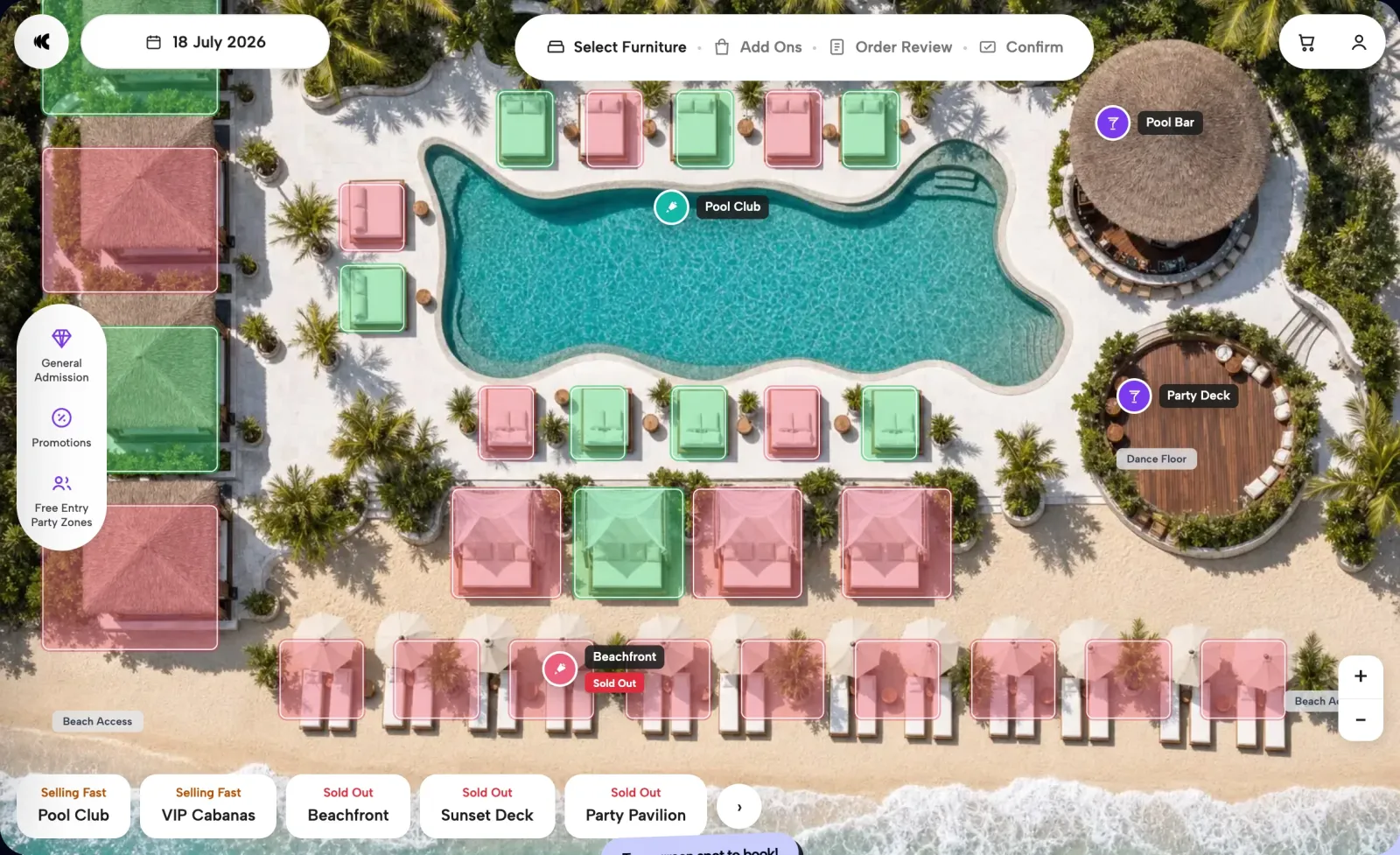
It also changes what a "pass" can be. An owned checkout can present the deck as a map — this daybed, that cabana, front row or shade — with tiered packages and stackable add-ons, so the guest buys a specific experience, not generic entry. Because the booking runs through your own system, it is also a marketing asset: bookings fire to Meta, Google, and GA4 in real time with revenue attached, abandoned checkouts become recoverable events, and your best day-pass guests seed lookalikes that find more of them. None of that is possible when a marketplace owns the checkout. This is what Clubtech's hotel pool booking engine is built for.
The honest cost of the owned route: you have to generate the demand. Which is why the answer for most properties is not either-or.
The hybrid strategy: discovery there, relationship here
Run both channels, but give each a job:
- Marketplace for discovery and soft days. Let ResortPass introduce you to out-of-town guests and fill the Tuesdays. Treat the commission as a customer-acquisition cost.
- Owned channel for peak and repeat. Weekends and high season sell direct, where sell-out days carry no commission. Every marketplace guest who walks in is a conversion opportunity: capture details at check-in and make the direct booking link — with better packages than the marketplace can show — the obvious way back.
- Keep the upsell direct. Even when a marketplace brings the guest, daybed upgrades, cabanas, and bottle service sell through your own system on-site at full margin.
Paid once for discovery, owned forever after — that's the shape of a healthy day-pass business.
Packaging: tiers with F&B credit, not a ticket
A flat entry fee is the weakest version of the product, whatever the channel. Structure passes the way premium venues structure everything else — as a ladder:
- Base pass — pool and deck access with a partial F&B credit, so the pass feels recoverable ("$50 entry, $25 back at the bar") and the guest arrives already spending.
- Daybed or cabana tier — reserved furniture, larger F&B credit, what couples and small groups actually want on a weekend.
- Ultimate tier — cabana, bottle or premium F&B package, and extras like spa access or transfers.
Add-ons — bottles, celebration cakes, airport transfers — stack on any tier, which is how a $50 pass becomes a $400 booking. Early-commitment pricing ("Book Online & Save") pulls decisions forward, giving you capacity data days in advance instead of a walk-up guess at 11am. When a tier sells out, capture the guest with a priority list — sold out is not a lost guest, it's a captured one for next weekend. The wider architecture — pricing ladders, zone yield, the full revenue stack — is covered in the beach club revenue playbook; the mechanics translate to hotel decks directly.
Questions operators ask
How should a hotel price day passes?
Price to real demand, not to a single number: weekends and high season carry a premium, midweek runs lower or leans on F&B credit to protect the headline rate. Structure the price as tiers — base entry, daybed, cabana — rather than one flat fee, and use early-booking pricing to pull commitments forward. There is no universal benchmark; your own sell-out pattern by day and zone is the pricing signal that matters.
Is ResortPass worth it for hotels?
For discovery, often yes — as of July 2026 it has 2,700+ hotel and spa partners and taught travelers the category exists — demand your own channels would take seasons to build. The costs are per-booking commission, a capped booking value, and a guest relationship the marketplace keeps. It's worth it as an acquisition channel for soft days; it's expensive as your only channel, especially on days that would sell out anyway.
What should a hotel day pass include?
At minimum, pool and deck access plus a partial F&B credit — the credit converts entry price into on-property spend and makes the pass feel recoverable. Higher tiers add reserved daybeds or cabanas, larger credits, and premium extras such as spa access or bottle packages. Stackable add-ons matter more than the base inclusion list, because they're what turn a $50 entry into a $400 booking.
Do day passes hurt the experience for room guests?
Not if capacity is controlled. Cap day-pass inventory by day and zone so hotel guests always have space, price weekends high enough that day guests are additive, and release more passes only when occupancy forecasts justify it. A booking system that pre-sells day passes gives you exact counts days ahead — which is precisely the visibility a walk-up policy never provides.
See a day-pass engine running on a property like yours. Map, tiers, add-ons, and the guest data staying with the hotel. Book a 30-minute demo