Dubai runs on tables. The city's premium nightlife sells booths, minimums, and bottle service to groups who decide in a WhatsApp thread, arrive from a hotel, and pay with a card issued somewhere else. Most of that inventory is still held on a promise — a promoter's reply, a host's pencil mark, a screenshot of a price list — and confirmed properly somewhere around 11:30pm.
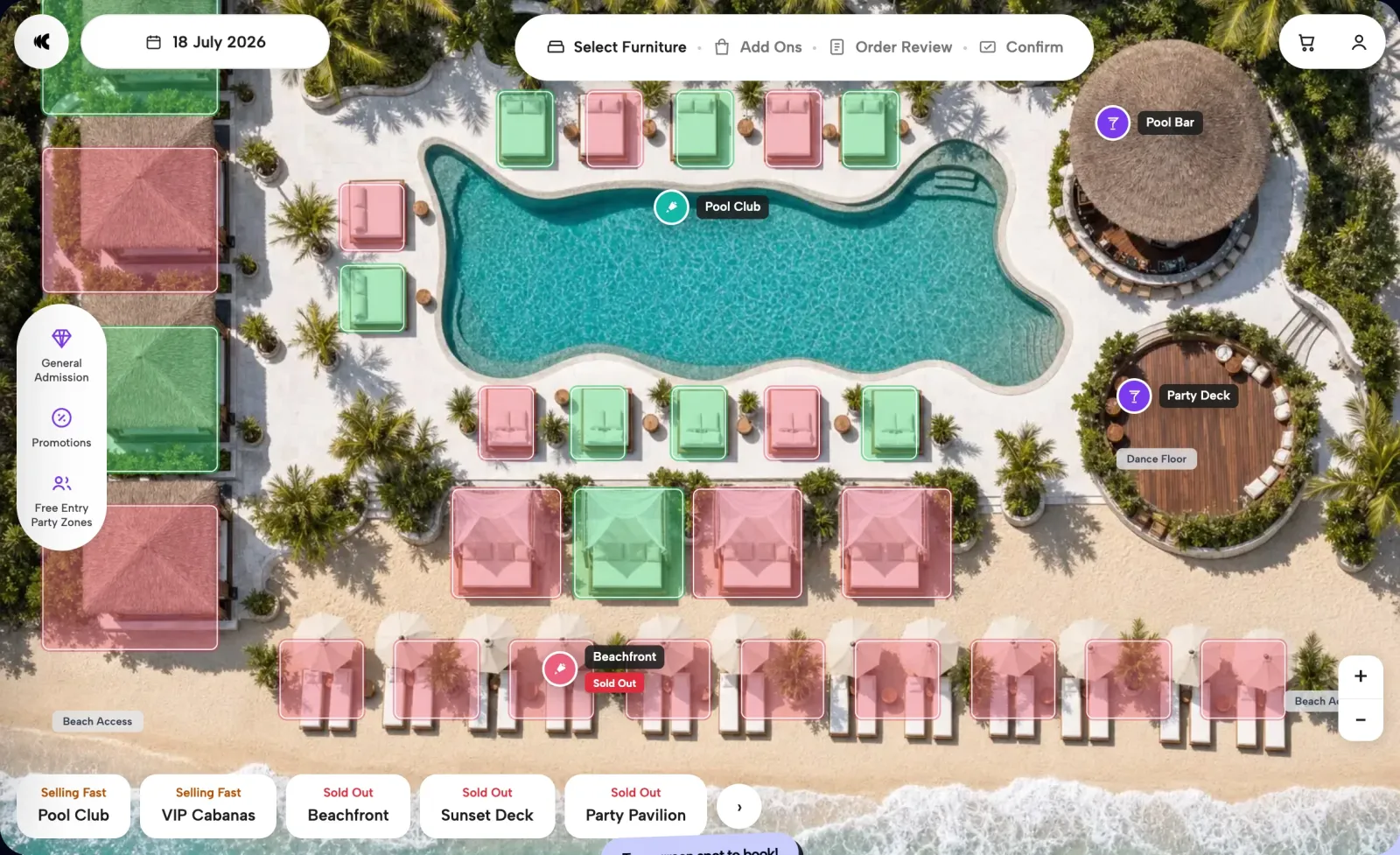
A nightclub table booking system replaces the promise with a transaction. The group picks the exact table on a map of your floor, chooses a package, and pays before the night. Everything downstream — door, floor, reporting, ads — gets easier because the commitment landed first.
The direct answer: what the system does
Four things, in order. It sells the specific table from an interactive 3D map of your venue, in tiered packages with stackable add-ons — the mechanics are covered on the nightclub table booking page. It takes payment before the service day, so the booking is money rather than a maybe. It runs the night from an internal floor plan sharing inventory with the booking map in real time, alongside guest-list and visitor management at the door. And it reports back — who booked, how far ahead, at what value, from which campaign.
Clubtech does those four on one platform, white-label on the venue's own domain, processing over $1M USD in weekly GMV for venue partners in more than 7 countries.
Dubai's calendar decides what you are selling
The outdoor season runs roughly October to May, peaking November to March. Venues that stay open through the summer move inside and move later — club nights, indoor pool days, ladies' days. The practical consequence for tooling: the sunbed is seasonal, but the table sells all year. If you only instrument the daytime furniture — the Dubai beach club side of the operation — you have automated your shorter half.
Two more timing facts worth building around. August to October is when Dubai venues buy — teams re-staff, rebuild programming, and choose tooling before reopening, so a system adopted in season is one adopted mid-service. And Ramadan sits inside peak season: daytime entertainment scales back and programming shifts to the evening, so table inventory and evening-led packages carry those weeks.
The booker is international, the card is not local
Dubai's guest base is heavily international, and the person paying is often booking from another country days before they land. That puts the payment layer on the critical path. Clubtech keeps checkout inside the booking flow with multi-currency payment through Stripe, Airwallex, Apple Pay, and Google Pay — wallet authorization is one tap, the full booking four. A group choosing between two venues from a hotel room in another timezone does not abandon over a payment redirect.
Because the flow is white-label, it runs on your domain under your brand. There is no marketplace between the venue and the guest, and the guest data belongs to the venue — which matters here, because the same group will be back for another property in the same portfolio.
Group operators, not single rooms
Dubai's premium venues are typically attached to hotels or run by licensed hospitality groups, and those groups run portfolios. One decision covers several venues, and the buying committee is real — an ops director and a group revenue owner alongside the venue GM.
That shapes what to ask of a platform. Each venue needs its own brand, map, and price ladder; the group needs one place to read all of them. Clubtech integrates with the POS and PMS already in the building — Opera PMS among them — rather than replacing the stack, so a portfolio rollout is not an IT program.
What the night looks like on the operator side
Selling early only pays off if the floor can act on it. Online inventory syncs to an interactive internal floor plan in real time, automatic seating allocation places parties, and the operator console shows the service day before it starts — which booths are prepaid, what each table ordered, who is on the list. Guest-list and visitor management replaces the clipboard at the rope.
Prepayment changes the economics, not just the admin. A booth that no-shows at midnight is inventory that expired worthless, plus the group you turned away to protect it. Prepayments, deposits, and minimum spends kill no-shows, and the deposits are working float in the account before doors open. When the floor sells out, priority capture still takes the guest's details — sold out is the easiest sell for next Saturday.
What the night tells you afterwards
Every booking fires to Meta, Google, TikTok, and GA4 in real time with revenue values posted back, so campaigns optimize toward booked dollars instead of clicks, and lookalike audiences are seeded from your highest-value bookers rather than your followers. Abandoned bookings trigger recovery within seconds — WhatsApp and email return the group to the exact table, date, and price they left.
Then 20-plus built-in reports read the night back: booking volume, lead time by zone, average value by package variant, product mix, repeat share, origin markets. That last one is the Dubai-specific one — knowing which countries book your Friday, and how far ahead, makes next season's programming and ad spend a decision rather than a guess.
What you are probably replacing
Most Dubai venues are not starting from nothing. The common incumbent is a regional guest-management platform — ServMe shows up most often, with a substantial MENA roster and real hotel depth, handling deposits, event ticketing, and POS/PMS sync competently.
The distinction is not quality, it is what the system is pointed at. That category is operator-facing table management: the team organizes the floor and the covers. Clubtech is guest-facing furniture commerce: the guest picks the booth on a map, ladders up through packages, and pays. If your problem is organizing what your team already sold, the incumbent is fine. If too much of the room is still being sold by hand at 11pm, the model has to change. The full comparison goes deeper.
Proof, stated honestly
There is no published Dubai proof point yet, so we will not manufacture one. The strongest evidence is from Bali, at FINNS Beach Club, whose CEO Beau Whittington describes going from "simple on-the-day bookings with no financial guarantee… to now having millions of dollars worth of pre-paid bookings each month."
Different market, same physics: guaranteed inventory behaves differently from promised inventory. The Dubai variables — the international card, the hotel attachment, the group structure, the season shape — change the configuration, not the mechanic.
Questions operators ask
What is a nightclub table booking system?
Software that lets guests reserve and pay for a specific table before the night, rather than requesting one. The group selects the table on an interactive map of the venue, chooses a package with add-ons, and prepays. The venue gets guaranteed revenue days ahead, and the host team works from confirmed parties instead of a list of maybes.
Can international guests pay in their own currency?
Checkout supports multi-currency payment through Stripe, Airwallex, Apple Pay, and Google Pay, kept inside the booking flow rather than handed off to a redirect. That matters for Dubai specifically, where a large share of bookings are made from abroad before the guest arrives. Exact currency configuration for your venue is set up during onboarding.
When should a Dubai venue implement a booking system?
Between August and October, ahead of the outdoor season. That is when teams re-staff and rebuild programming, so configuration, pricing, and staff training land before service volume does. Implementing mid-season is possible but you are training a team during peak trade.
Does it handle the guest list as well as tables?
Yes. Guest-list and visitor management runs alongside table bookings on the same platform, so the door works from one system rather than a clipboard plus several promoters' phones. Free-entry and priority registrations capture contact details too, which turns the guest list into a marketable database instead of paper that gets binned at close.
How much does it cost?
Commercials follow discovery. Every venue has a different mix of inventory, zones, payments, integrations, teams, and rollout work, so a list price would be fiction. We map the operation on a call and come back with a proposal built around the real scope.
Bring one real Saturday to the call. We will show your floor as a booking map, priced in packages, with the door and the reporting attached. Book a 30-minute demo