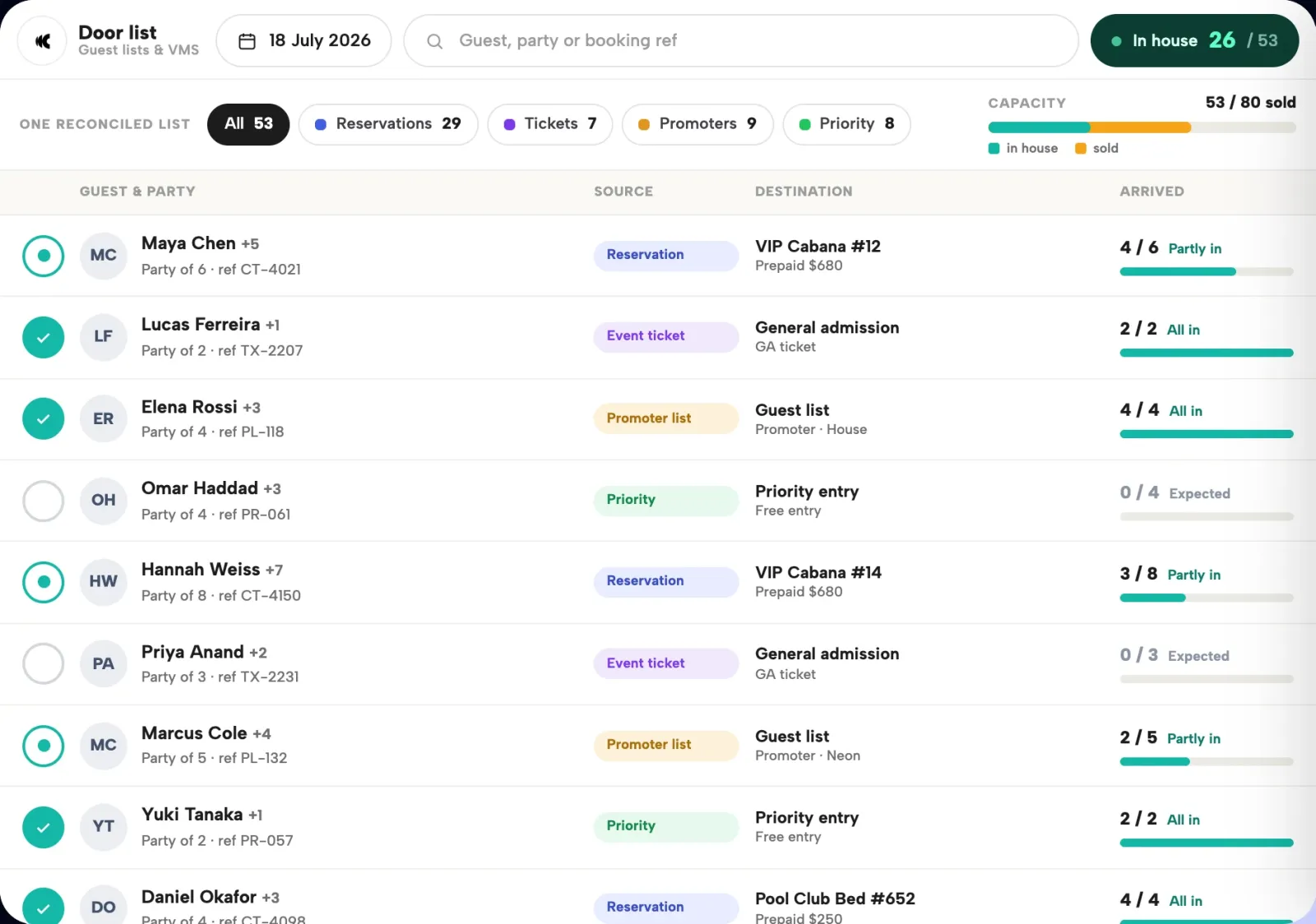
A guest list counter does one job: it keeps a running total of who's inside so the door doesn't blow past capacity. Clicker in hand, tally on a phone, a number that goes up as guests come in and down as they leave. For a fire-code headcount, that's the tool. The problem is that most venues treat the count as the whole point of the door — and the count is the least valuable thing the door produces.
A guest list counter answers "how many." A venue also needs "who" and "what are they worth" — and it needs all three captured while the line is still moving. This is a short guide to counting the door properly: keeping the headcount honest, and turning every count into a guest record you actually own.
What a guest list counter is good for
The count itself matters. Used well, a counter keeps the night legal and comfortable:
- Capacity control. Know how many are inside against your licensed limit, in real time, without guessing.
- Room balance. Track a VIP section or a terrace separately so one area doesn't overfill while another sits empty.
- In-and-out flow. A count that moves both ways tells you whether the room is filling, holding, or emptying — useful for staffing the bar and the door.
If all you need is a number, a clicker or a counter app is enough. Most venues need more than a number.
Why the number alone isn't enough
Here's the gap. A counter says 240 people are in. It can't say which 240, what they booked, or whether they'll come back. So the busiest data moment of the week — every guest walking past the door — produces a total and nothing else. Three things get lost:
- Who they are. A headcount captures no names, no contacts, nothing to market to. The room fills and the database doesn't.
- What they're worth. The count doesn't tie to a booking or a spend, so you can't tell a full room of walk-ups from a full room of prepaid tables.
- Whether it's accurate. A manual counter drifts. A clicker misses re-entries; a tally on a phone gets abandoned by the third rush. The number you're steering by is a guess by 1am.
Count the door, capture the guest
The fix is to make the count a by-product of check-in rather than a separate task. When guests are checked in against a live list, the headcount takes care of itself — and every count is also a captured guest.
- The count is automatic. QR door check-in marks each guest off the live list with a tap, so the running total is exact without anyone working a clicker.
- Every count is a record. Because the booker invites their group and each guest supplies their own details, the people you're counting are the people you're capturing — a table of eight is eight records, not one line on a tally.
- The count knows its value. The live list ties each guest to their booking, so the door total distinguishes prepaid tables from priority walk-ups instead of lumping everyone into one number.
- Capacity stays visible. Because the booking map and the internal floor plan are the same object, the operator sees the count against real inventory — which zones are full, which have room — not just a grand total.
That's the shift a guest list management system makes: the door stops producing a disposable number and starts producing an owned audience. You still get the count — you just also keep everyone you counted.
Questions operators ask
What is a guest list counter?
It's a tool that keeps a running total of how many guests are inside a venue, usually for capacity control. It can be as simple as a clicker or a counter app, or a feature inside a check-in system. On its own it tracks a number; it doesn't record who the guests are or what they booked.
How do you count guests at the door accurately?
Manual counting drifts over a busy night — clickers miss re-entries and tallies get abandoned. The accurate method is to make the count a by-product of check-in: when each guest is scanned in by QR against a live list, the running total is exact automatically, and it stays right even during a rush.
Can a guest list counter tell me who came, not just how many?
A standalone counter can't — it only holds a number. A guest list system can, because each guest is checked in against a record. When every guest supplies their own details, the count and the captured audience are the same thing, so you know who came and can market to them later.
Does the headcount connect to venue capacity?
In a proper system, yes. When the booking map and the floor plan are the same object, the count shows against real inventory — you see which zones are full and which have room, not just a total against a single licensed limit.
Is a headcount enough for a busy venue?
For fire-code compliance, a count is the minimum. For running the business, it isn't — a number can't be marketed to and doesn't separate prepaid guests from walk-ups. A venue is better served by check-in that produces the count and the guest data together.
Move from a count to an owned guest record. Read the guest-list management guide, then book a demo.