Doors open at 9pm. By 9:15 there is a line, a host with a clipboard, and a manager answering the same question forty times: are they on the list. Each name that gets checked is a name that gets forgotten. The clipboard tells you nobody argued at the rope. It tells you nothing else.
That is the mistake most venues make about the door. They treat it as a gate. The door is the last point in your funnel where a guest is standing in front of you, phone in hand, willing to hand over a detail. It is the final revenue and data moment before the night swallows them. A clipboard throws that away.
A note on intent, because search mixes two things. This is about venue door check-in — beach clubs, day clubs, nightclubs, and hotel pools running a service day on a clock. It is not conference or corporate attendee-management SaaS.
Event check-in that starts as a QR code, not a clipboard
For events and ticketed nights, check-in should begin the moment the guest buys, not the moment they arrive. Clubtech's events and ticketing issues a QR code with every ticket, and that code carries the booking into service-day check-in.
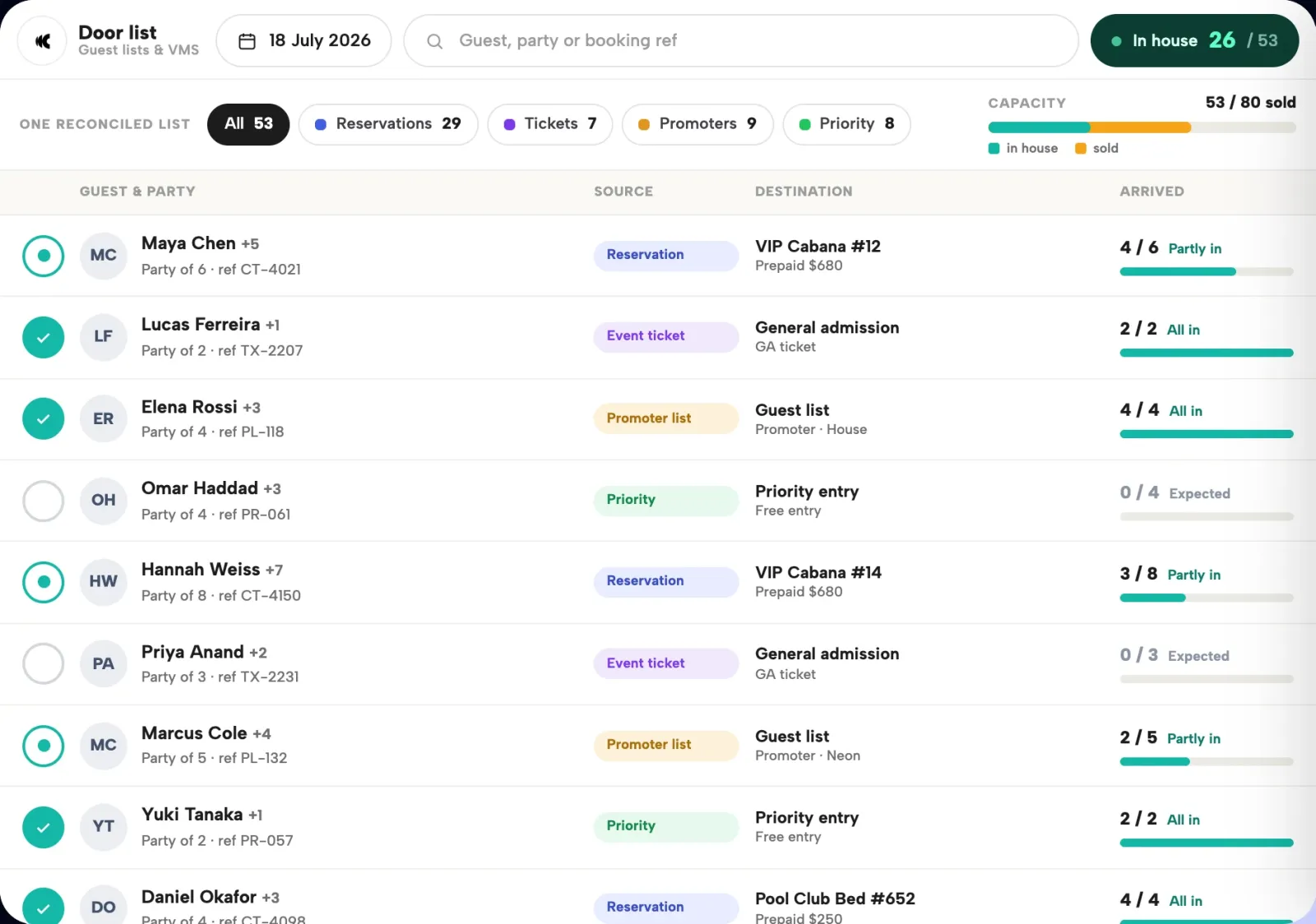
- QR-code check-in. The guest presents the code, the host scans it, and the record confirms instantly. No name search, no scroll-and-squint, no line backing up while someone spells their surname twice.
- Tiered tickets, one scan. General, priority, and package tickets all resolve through the same scan, so the door knows which tier walked in without a separate list for each.
- Live arrival status. As guests scan in, the count updates for everyone — the door, the floor team, the operator. You see a night filling in real time instead of guessing from the queue.
The QR code is the difference between a door that captures who actually attended and a door that only remembers the ones who caused a problem.
Guest check-in and visitor management at the rope
Not every guest arrives on a ticket. Comps, promoter names, table hosts, and walk-ins all hit the same door, and a guest list held in a spreadsheet or a promoter's DMs falls apart when volume is highest.
Clubtech's guest-list and visitor management runs the door as one system, not three habits held together by memory:
- Every name is attached to a booking, a host, or a reason for entry — not floating in a message thread.
- Comps, priority entry, and paid entry are all visible in one place, so the door host is not arbitrating disputes at the rope.
- The list the door sees is the same list the floor team, the reservations team, and the promoters see. One source of truth, no side spreadsheet.
A visitor management system at the entrance turns the door from a bottleneck into a clean, fast checkpoint — and every scan writes a record you keep.
When you sell out, the door still has a job
Sold out is not the end of the funnel. It is a room full of guests who wanted to give you money and could not.
Clubtech's priority and free-entry data capture treats a sold-out night as a data event. When the furniture is gone, the guest still supplies their details for priority or free entry — so a sold-out Saturday becomes a list of high-intent names for the next one. Sold out does not mean lost guest. The guest you could not seat tonight is the one you seat first next weekend, because the door remembered them.
The operator console: know what is booked before doors open
The door does not start when the first guest arrives. It starts hours earlier, when the operator can see the whole service day laid out. The operator console and floor plan show what is booked before doors open — every table, package, and ticketed arrival — against an interactive internal floor map.
- Seating is allocated automatically, so the floor team is not solving a puzzle at 9pm.
- Real-time inventory stays in sync as guests scan in, so a held table is not double-booked against a no-show too early.
- The console and the door are the same platform, so what the host scans and what the operator sees never drift apart.
You walk into the night knowing the shape of it. The door confirms the plan instead of improvising against it.
Booking to door to database: one connected record
Here is what a clipboard can never do. Every scan at the door connects back to the booking that created it and forward to the marketing database that keeps it.
Clubtech's every-guest data capture means the booker invites their group, and each invited guest supplies their own details — so you capture the whole party, not just the payer. The door confirms that party in person. And it all lands in guest intelligence: 20+ built-in reports — booking volume, lead time by zone, average value by package, repeat-customer share — with no CSV exports to stitch together. The night at the door becomes queryable the next morning.
Booking, door, and database are one record, so the guest you scanned tonight is the guest you can market to, seat faster, and recognize next time.
Clubtech is an all-in-one booking, revenue, front-of-house operations, and marketing platform for premium venues, and it sits on top of your existing POS and PMS with no major IT changes — it does not replace your stack. Commercials follow discovery: the venue, door operation, payments, integrations, and rollout are mapped before Clubtech returns with a tailored proposal. If you want to see the door work on your own floor plan, book a discovery call.
Questions operators ask
How does QR check-in work for event and ticketed nights?
Every ticket carries a QR code from the moment of purchase. At the door, the host scans it and the record confirms instantly, resolving the guest's ticket tier in the same scan. The arrival count updates live for the door, the floor team, and the operator, so event check-in is a single scan rather than a name search.
Is this attendee management software for conferences?
No. This is door check-in for premium venues — beach clubs, day clubs, nightclubs, and hotel pools running a service day. It is built around daybeds, tables, cabanas, guest lists, and a floor plan, not conference badging or corporate delegate management.
How does guest check-in capture the whole party, not just the person who paid?
The booker invites their group, and each invited guest supplies their own details when they join the booking. The door confirms that party in person. The result is a full record of everyone who attended, captured for marketing, instead of only the payer's name.
What happens at the door when we are sold out?
Sold out does not mean the door stops capturing. Priority and free-entry data capture lets guests who could not get furniture supply their details for priority or free entry, so a sold-out night becomes a list of high-intent names for the next one.
Do we know what is booked before doors open?
Yes. The operator console shows the whole service day — tables, packages, and ticketed arrivals — against an interactive floor plan before doors open. Seating is allocated automatically and inventory stays in sync as guests scan in, so the door confirms the plan rather than improvising against it.
See the door as a data moment on your own floor plan. 15 minutes, no contracts. Book a demo.