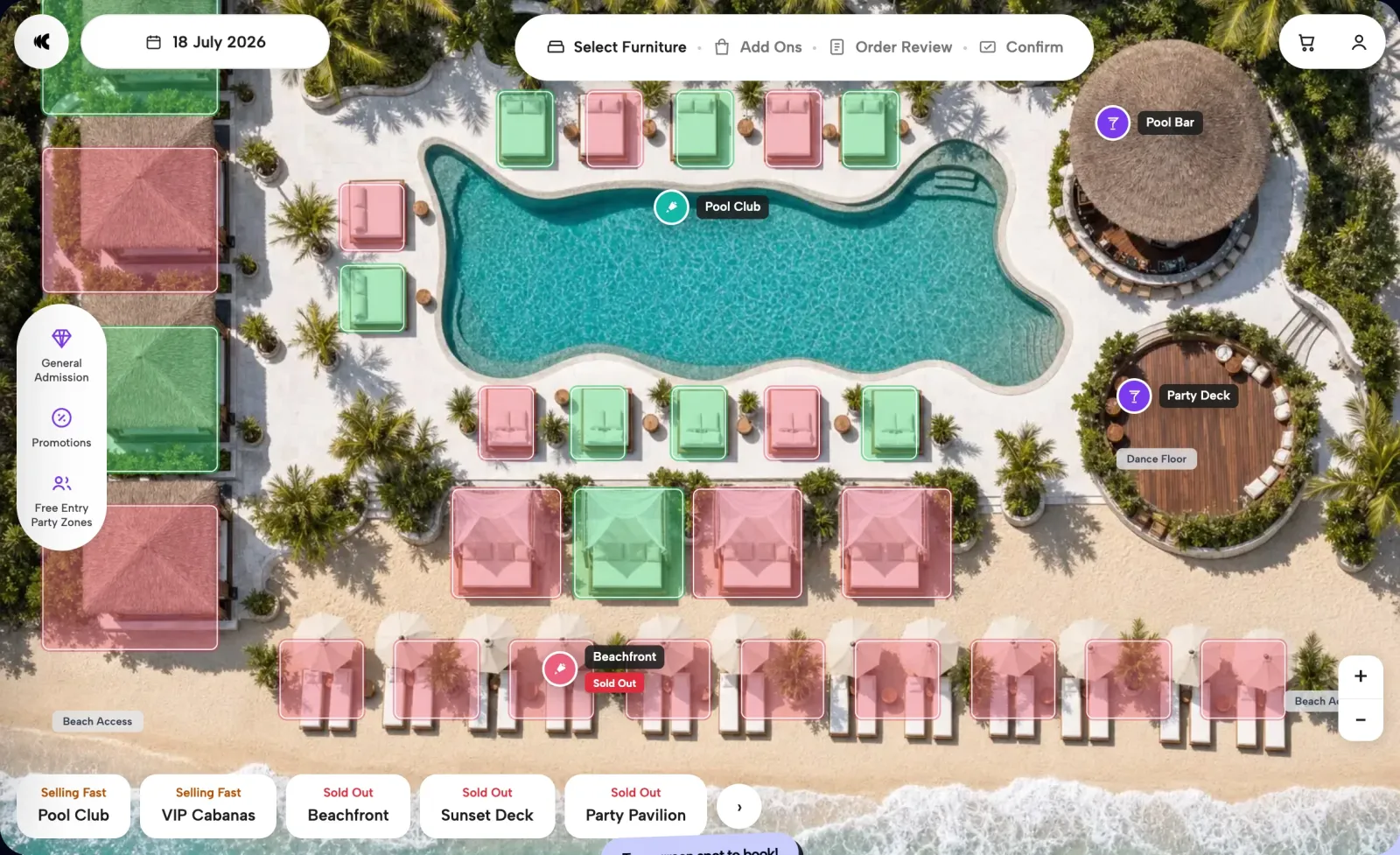
Count the furniture on a premium deck and the shape of the business shows up: two hundred sunbeds down the sand, a dozen daybeds on the front row, a few cabanas behind them. The sunbeds are volume. The cabanas are the statement. The daybeds are where the margin lives — few units, a group ticket, a minimum spend attached, and the row that hurts most when it sits empty.
Different tier, different selling problem. A sunbed is a decision one person makes in seconds. A daybed is a decision four people make in a group chat over two days, about one specific spot, at a price somebody must justify to the others.
The direct answer: what a daybed booking system has to do
A daybed booking system is your booking platform pointed at your highest-value furniture. The mechanics — map, checkout, floor plan, reporting — are covered on the sunbed booking system page. What changes here is the job.
Four things. Show the exact unit — front row, pool edge, shaded corner — on a 3D birds-eye map, because at this price the guest buys a position, not a category. Carry the package — bed only, party package, ultimate — with stackable add-ons priced in front of the guest. Hold the minimum spend inside the booking rather than at the host desk. And take the money before the day, so the bed is sold rather than held.
Clubtech runs that as one platform, white-label on the venue's own domain — processing $1M USD in weekly GMV, with venue partners in over 7 countries.
The tier ladder: sunbed, daybed, cabana
Each rung sells a different way.
- Sunbed — volume. Many units, small ticket, bought quickly. Its job is occupancy and spend through the bar.
- Daybed — margin. Few units, group ticket, a minimum spend attached, real deliberation before purchase. Its job is average booking value.
- Cabana — scarcity. A handful of units, the highest ticket, booked weeks out for an occasion rather than a day out. It sells on a different promise — covered in cabana booking software.
The ladder only works when the rungs are visible together. One price for "a sunbed" gives a group nothing to compare; three tiers on one map, each showing what it actually is, turns the question from whether to book into which one. How often a group moves up a rung is a number to read out of your own reports, not borrow from the industry.
The tier guests actually deliberate over
Deliberation is why the daybed needs more of the flow than the sunbed does. The group wants to know which bed, how close to the water, what is included. That is a legibility problem before it is a pricing problem.
Guests explore the deck from an overhead 3D view, tap the exact bed, watch the 360° walkthrough, and commit before the price is on screen. They buy the spot, not "a daybed." Add-ons land against a decision already made — usually late, since 82% of bookings happen on a phone after 10pm, when the group chat resolves and nobody at the venue is answering.
Attaching the package and the minimum spend to the tier
Price the furniture and you have sold a bed. Price the tier and you have sold an afternoon. Tiered packages run from bed only through a party package to the ultimate build, with stackable add-ons on top — bottles, cakes, transfers. Those add-ons sit in a full-screen, swipeable shop inside the booking journey rather than on a menu the guest first sees on arrival — the product experience behind an 80% increase in bottle add-ons. An order review step agrees the total before payment.
Minimum spends belong here for the same reason. One accepted inside the flow at 11pm on a Tuesday is a commitment; the same number raised at the host desk on Saturday, to a seated group, is a negotiation. Prepayments and deposits put money in the account ahead of the service day.
Dynamic pricing on twelve units is not dynamic pricing on two hundred
Dynamic pricing makes more money from the same furniture by pricing to demand; the signals and the guardrails are covered in dynamic pricing for beach clubs. What changes here is how thin the tier is.
Across 200 sunbeds, price moves are statistical: sell-through builds gradually and the curve is readable through the week. Across 12 daybeds, price moves are events. One booking takes out a twelfth of the tier. Two group bookings on a Tuesday and most of Saturday's front row is gone, weeks out, at the opening price — the signal arrived long after the price was set.
Let the scarce tier respond faster and further than the volume tier, anchored to how much is gone rather than how near the date is. A tier that sells out every week is not proof of a good price. It is proof the last bed went too cheap.
What an unsold daybed actually costs
A $450 daybed that walks at 2pm is $450 you never see again. Furniture is perishable: Saturday does not come back.
The sticker is the smaller half of the loss. That bed came with a party of six who would have ordered bottles, food and a second round, and with six guest records — the booker plus each guest supplying their own details — that marketing now does not have. And with a booking that would have fired to Meta, Google, TikTok and GA4 with its revenue value attached, teaching the campaigns which audience to bid on.
Prepayment closes the gap. It turns a held bed into money that arrived before the guest did. When the tier sells out, the flow still captures everyone who wanted a bed and missed it — sold out is not a lost guest, it is a list for next Saturday.
Reading the tier back
Run the daybeds as their own line and reporting stops being a booking log. Twenty-plus built-in reports read average value by variant, lead time by zone, product mix and repeat share for the daybed tier separately from the sunbeds — the difference between knowing the deck was busy and knowing the front row sold out eleven days early at a price set in April. Abandoned bookings fire within seconds, and WhatsApp or email returns the group to the exact zone, date and price they left.
Questions operators ask
What is a daybed booking system?
Software that sells a specific daybed to a specific group before the day, rather than holding it against a message. The guest picks the exact bed from a map of the venue, chooses a package with add-ons, accepts the minimum spend, and pays. The team starts service with the front row already sold.
How is selling a daybed different from selling a sunbed?
Scale and deliberation. A sunbed is a small, fast, individual purchase, so the flow has to be quick. A daybed is a group decision at a much higher ticket, usually with a minimum spend attached, so the flow has to be convincing: the exact position, the walkthrough, the package, the spend.
Should daybeds carry a minimum spend or a flat price?
Both work, and they combine — a bed price that includes bar credit, or a lower bed price with a spend commitment on top. What matters is that the number is attached to the booking, accepted online. Agreed inside the flow it is a commitment; raised at the host desk it is a negotiation.
Does dynamic pricing work on a small number of daybeds?
It matters more, not less. With a dozen units, one booking is a large share of the tier, so demand shows up as sudden sell-through, not a gentle curve. Price against how much of the tier is gone, not how near the date. Thin, high-margin inventory is what gets sold too cheap, too early.
What happens when every daybed is booked?
The tier keeps working. When furniture sells out the flow still captures the guests who wanted it, through priority-entry data capture rather than a dead end on a sold-out screen. Sold out is not a lost guest. It is a marketable list for next week, and evidence the tier was underpriced.
How much does a daybed booking system cost?
Commercials follow discovery. Every venue has a different mix of inventory, zones, payments, integrations, teams and rollout work, so a list price would be fiction. We map the operation on a call — units at each tier, what the packages look like, what the floor needs on a service day — and come back with a proposal built around the real scope.
Bring your deck plan and one sold-out Saturday. We will build the ladder on your own map — three tiers side by side, packages and minimum spends attached. Book a 30-minute demo