Integrations decide more venue software deals than features do, and they are the part of the evaluation most often answered with a logo wall. A logo tells you a connection exists somewhere. It does not tell you which direction data moves, whether it is live at a venue like yours, or whether your own POS vendor has to agree to it first. That gap is where implementations slip, and it is worth closing before a contract rather than after.
The direct answer: which integrations matter
Five categories carry the weight. Payments, because a gateway is mandatory and no online transaction happens without one. POS, so online spend and in-venue spend build one guest profile. PMS, if you sell pool or beach access inside a hotel. Ads and analytics, so bookings arrive as revenue-valued conversions rather than anonymous clicks. Messaging, so abandoned bookings get recovered. Everything else is a nice-to-have. Clubtech's own roster is grouped the same five ways on the integrations page, which is a useful shape to hold any vendor's list against.
1. Payments: the one that is not optional
A payment gateway is a requirement, not a feature. Without one the platform cannot take money, which means no prepayment, no deposits, no minimum spends, and no working float before service day.
Clubtech integrates Stripe and Airwallex for card processing and multi-currency settlement, Apple Pay and Google Pay for one-tap wallet authorization inside the flow, Midtrans for the Indonesian rails guests actually use — QRIS, GoPay, and OVO — and DOKU appears on the payment-gateway row alongside them. Multi-currency is supported.
Match this to your market rather than accepting a generic list. Midtrans means nothing in the Gulf, where the useful capability is cross-currency processing and settlement — international bookers pay on their own card currency and the venue settles cleanly. In Bali the reverse applies: international card coverage without local methods loses domestic bookers at checkout. Ask which methods and which currencies will be live for your guests on day one, and get the answer in writing.
2. POS: one guest, one purchase profile
The reason to connect a POS is not tidiness. It is that a guest who prepays a $600 cabana package online and then spends $400 at the bar is one guest worth $1,000, and if those two numbers never meet you will keep marketing to the $600.
As a category capability, online orders push to the venue's POS before the guest arrives, so the pre-arrival order and the in-venue tab build a single purchase profile. Clubtech names Oracle Micros, PouchNATION, Lightspeed, Abacus, and Quinos on its POS row.
Per-vendor depth is a discovery question, not a marketing one — and that is true of every vendor in this category, including the ones with the longest logo walls. Ask what specifically syncs for your till: order lines, totals, guest identity, or availability. The honest answer varies by POS.
3. PMS: the hotel deal-breaker
If your pool or beach club sits inside a hotel, the front office is where the objection lives. Opera PMS is claimable as an integration row for the hotel vertical, with exact scope confirmed property by property — which is the correct way to hold it, because PMS behavior genuinely differs between properties on the same product.
For an F&B director this is usually the make-or-break requirement, so get specific early: is the requirement availability sync, guest-profile matching, or charge posting? Those are three different projects. Any vendor that answers "yes, we integrate with Opera" without asking which one is describing a logo.
4. Ads and analytics: the booking as the conversion
This is the category most furniture-booking tools leave empty, and it is the one that changes what your marketing budget does.
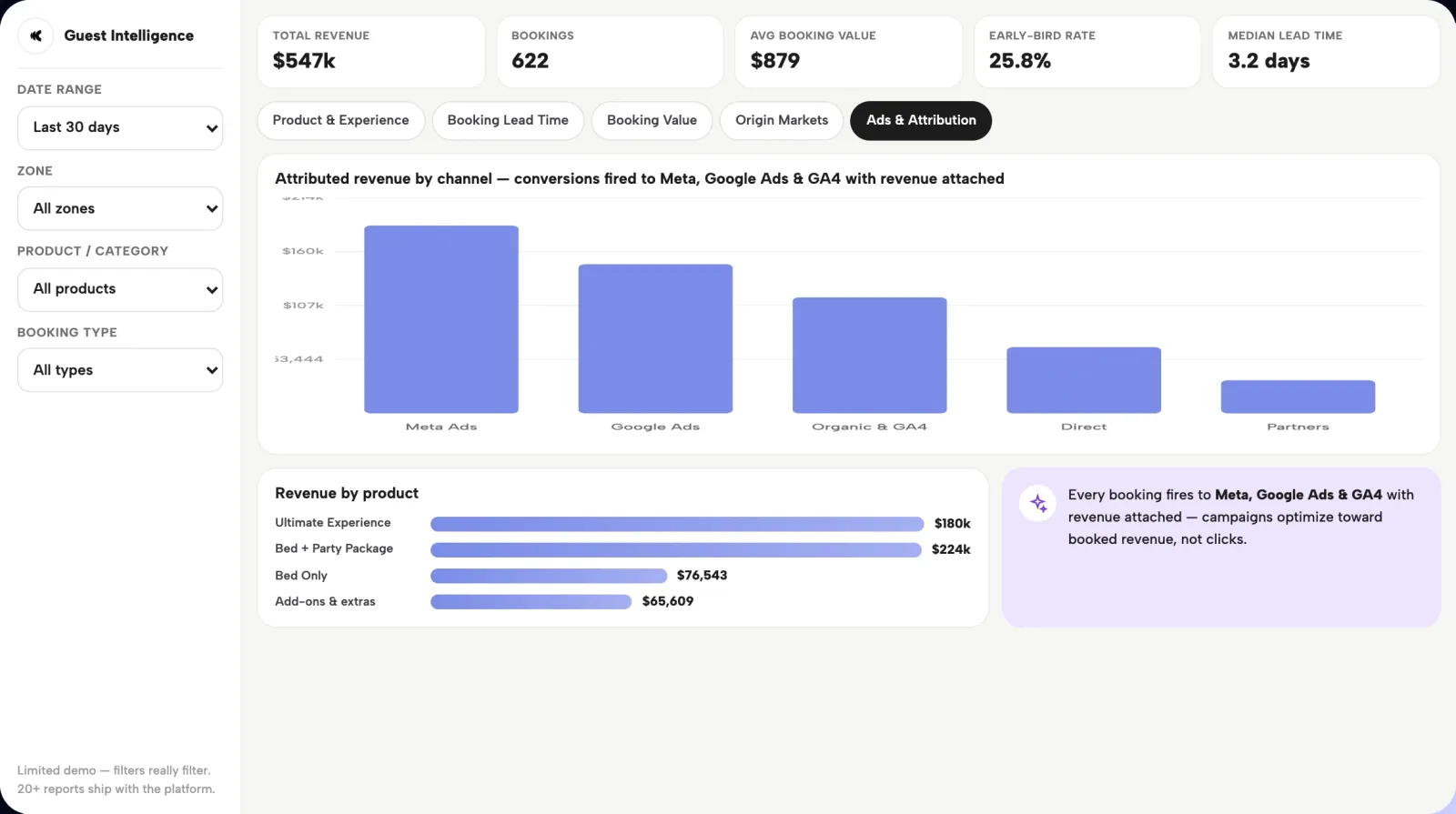
On Clubtech, bookings fire to Meta, Google, TikTok, and GA4 in real time with revenue values posted back, so campaigns optimize on money instead of on "a conversion". Abandoned-cart events fire within seconds. Lookalike audiences get seeded from your highest-LTV bookers rather than your follower count. GA4 means the booking and revenue data lands in the analytics your team or your agency already reads — the mechanics are in GA4 for venue bookings, and the server-side side of it in Meta Conversions API for venue bookings.
Venues also get a PostHog-powered product and marketing analytics dashboard for reading guest and product behavior, alongside the platform's own reporting. The analytics side of the platform documents what that surface covers.
5. Messaging and lifecycle: recovering what nearly closed
A guest who reached checkout and stopped is the most valuable email address in your database that day. Abandoned-booking recovery over WhatsApp and email returns them to the exact zone, date, and price they left, and the events that trigger it fire within seconds. SendGrid and Mailchimp appear on the marketing row for venues that run their own sending infrastructure.
Timing, template design, and consent mechanics are worth pinning down in discovery rather than comparing on a feature grid.
The eleven questions that separate a logo from a connection
Take these to every vendor on your shortlist, including us:
- Which direction does data move — one-way push, one-way pull, or two-way sync?
- Is this integration live at a venue comparable to mine, in my market?
- What exactly syncs: orders, totals, guest identity, availability, or all four?
- Who initiates the work, and does my POS or PMS vendor have to participate?
- Is there a sandbox I can see it running in before go-live?
- What happens to bookings when the connection drops, and how do I find out?
- Does the integration carry its own cost, and is it inside or outside the platform commercials?
- Which payment methods will be live for my guests in my currency at launch?
- If I add a second site or a second currency later, does anything need rebuilding?
- Who owns the guest data flowing through each connection?
- What is the realistic sequence — which integrations are live at launch and which follow?
Question 4 deserves emphasis, because it is the one that quietly sets your timeline. Integrations are contingent on the venue introducing the platform to its own vendor. Your POS provider's responsiveness becomes part of your project plan, whichever booking platform you choose, and a vendor who tells you that upfront is being straight with you.
What a complete stack looks like
Payments live so money moves. POS connected so spend consolidates into one guest profile. PMS in scope if you are inside a hotel. Meta, Google, TikTok, and GA4 receiving real bookings with real values. WhatsApp and email recovering the ones that nearly closed. Everything sitting on top of the stack you already run, with zero major IT changes, rather than replacing it. The full platform overview sets out how those pieces fit together.
Questions operators ask
Does beach club booking software integrate with our POS?
As a category capability, yes: online orders push to the venue's POS before the guest arrives, so pre-arrival and in-venue spend build one guest purchase profile. Clubtech names Oracle Micros, PouchNATION, Lightspeed, Abacus, and Quinos on its POS row. The exact scope for your specific till is a discovery question, and the work depends on you introducing the platform to your POS vendor.
Is a payment gateway required?
Yes. A payment gateway is mandatory — the platform cannot support online transactions without one, which means no prepayment, deposits, or minimum spends until it is in place. Clubtech works with Stripe, Airwallex, Midtrans for Indonesian methods including QRIS, GoPay, and OVO, plus Apple Pay and Google Pay for wallet checkout, with multi-currency support.
Can it connect to Opera PMS for a hotel pool?
Opera PMS is an integration row for the hotel vertical, with exact scope confirmed property by property. Before comparing vendors, decide which capability you actually need — availability sync, guest-profile matching, or charge posting — because those are three different pieces of work and PMS behavior differs between properties running the same product.
How do bookings reach Meta and Google Ads?
Bookings fire to Meta, Google, TikTok, and GA4 in real time with revenue values posted back, so campaigns can optimize on booking value rather than on click volume. Abandoned-cart events fire within seconds, and lookalike audiences are seeded from your highest-value bookers rather than follower counts.
How long do integrations take to go live?
That depends on scope and on your own vendors, which is why an honest answer is conditional rather than a fixed number. The platform side is configured during guided setup; the POS, gateway, or PMS side needs an introduction from you to that provider, and their pace sits inside your timeline. Agree the launch-day set and the follow-on set in discovery.
Which integrations should we insist on at launch?
Payments, without exception, because nothing transacts without a gateway. Then the ads and analytics connections, since every booking taken before they are live is a booking your campaigns cannot learn from. POS consolidation and PMS work can follow, provided the sequence is agreed rather than assumed.
Bring your stack to the call. Tell us your POS, gateway, and PMS and we will walk exactly what connects, in what order, and what needs your vendor. Book a 30-minute demo — no contracts, no credit card.