A nightclub table is not furniture. It is a revenue unit with a price, a capacity, a minimum spend, and a finite number of nights to earn its cost back. Buy it like furniture and you end up with a beautiful room that sells the same four booths every week and gives the rest away at the rope.
So this guide runs in two halves. The first is the buying half — where these tables actually come from, what to specify, and what to expect on lead time. The second is the half most fit-out guides skip: what has to be true after delivery for the table to earn.
The direct answer: four routes, and they are not interchangeable
Almost every nightclub table in a serious venue arrives through one of four channels.
Contract furniture manufacturers. Made to order against your drawings, built to commercial durability standards, usually the same firms that fit out hotel lobbies and airport lounges. This is the route for booths, banquettes and anything that has to survive ten years of a Saturday. Highest cost, longest lead time, lowest replacement rate.
Nightlife specialists. Smaller shops that build for clubs specifically — LED cocktail tables, illuminated bottle-service tables, DJ booth fronts, bottle display walls. They know what a room looks like at 1am, which the hotel contract houses often do not.
Regional hospitality suppliers and fit-out contractors. In Southeast Asia, the Gulf and the Mediterranean, the practical answer is often a local manufacturer who ships and installs in the same trip. Shorter freight, no import surprises, and someone you can put in a room when a batch is wrong.
Sourcing marketplaces. Alibaba and Global Sources put you directly in front of factories, mostly in China. Cheapest per unit and genuinely viable if you know exactly what you are specifying and can absorb a sampling round. Ruinous if you cannot.
The mistake is treating these as a price ladder. They are different risk profiles. A club that opens in eleven weeks cannot use route one. A venue with a five-year lease and a signature VIP tier should not be sourcing its hero booths off a marketplace listing.
What you are actually buying
The word "table" hides four different products with four different jobs.
The bottle service table. Low, narrow, built to be reached across from a seated position and strong enough to hold ice buckets and sparklers without racking. Common formats run around 26 inches deep and 21 to 24 inches high; a longer 48-inch top serves a full booth. Specify the top surface for spills, not for looks — this is where champagne lives.
The booth or banquette. The real spend, and the piece that defines your VIP tier. Straight, curved, U-shaped or corner, usually built in modules so the section can be reconfigured for an eight-top on Friday and a twenty on New Year's Eve. Curved backs buy service lane width behind the seating, which matters more than it sounds at 1am.
The high-top cocktail table. The volume tier. Cheap per unit, sold in numbers, and the layer most venues under-order because it does not photograph as well as the booths.
LED and illuminated pieces. A finish decision with a maintenance cost attached. Worth it where the table is doing marketing work in every guest photo; ask about driver access and replacement parts before you fall in love with it.
The specs worth insisting on
Contract-grade is a real standard, not a sales word. Ask for it in writing:
- Upholstery abrasion. Contract fabrics are rated in double rubs, and hospitality-grade material generally starts around 100,000 and runs to 500,000. A residential fabric will not survive a season of denim and spilled vodka.
- Fire compliance. Depending on your jurisdiction, the reference points are CAL 117 for upholstered filling materials, NFPA 701 for flame propagation in textiles, and BIFMA for structural durability. Your local fire authority sets the requirement; the supplier has to certify against it.
- Frame construction. Metal gauge, weld quality, and how the wood is reinforced at the joints. This is what separates a booth that lasts a decade from one that starts creaking in month eight.
- Clean-down. Every surface should tolerate the chemical your team actually uses at 4am, not the one in the care instructions.
- Lead time. Custom and made-to-order work commonly runs 12 to 16 weeks before freight. Quick-ship programs exist on curated ranges and are the honest answer for a compressed renovation.
Route one: contract manufacturers
Atlas Contract Furniture builds nightclub booth and banquette seating in-house from Christchurch in the UK, with the full range of curved and corner configurations and every dimension customizable to the room. A member of the Association of Master Upholsterers and Soft Furnishers, which tells you the upholstery is not subcontracted out to whoever was cheapest that month.
Nine Stars International is headquartered in Dubai and has been building bespoke contract-grade furniture since 2006, with factories in the UAE and in Brescia, Italy. Its portfolio runs to four- and five-star hotels, F&B venues, public areas and airport lounges — which is the right pedigree for a room where the seating has to look like the price you charge for it.
Both are the same shape of deal: you bring drawings or a designer, they engineer and build, and the number on the quote reflects a piece that is not getting replaced.
Route two: nightlife specialists
Customized Designs builds LED lounge and cocktail furniture to order in the US, including illuminated tables aimed squarely at pulling groups into the bottle service section. Dimensions, color and printed branding are all changeable, which makes it a route to a table that carries the venue's identity rather than a generic glow.
OUYEE manufactures in Guangzhou and covers the whole nightclub package — straight, curved and U-shaped booth seating, VIP sofas, LED cocktail tables, bar counters, DJ booth fronts and bottle display areas. They offer layout planning, 3D concepts and production drawings, which is the useful part: it turns a factory relationship into something closer to a design partner.
Route three: regional suppliers
If you run an open-air club, a rooftop, or a beach club that turns over to a night operation, your table problem is also a weather problem. Indonesia is the obvious source for that.
Zenddu exports teak outdoor furniture from Bali and Java built for sun, rain, humidity and salt air, with a poolside range covering sun loungers, daybeds and bar sets, and a dedicated hospitality line for hotels, resorts and restaurants.
DIDU works out of Seminyak in synthetic rattan and rope on precision-welded aluminium frames, alongside teak and bamboo, and claims more than 2,000 completed projects across 30-plus countries for hotels, resorts, restaurants, cafes and bars, with a three-year warranty.
In the Gulf, the equivalent play is a Dubai contract manufacturer or fit-out house that can handle FF&E and installation together — worth pricing against an import once freight, duty and a site supervisor are in the comparison.
Route four: marketplaces
Alibaba and Global Sources are where the factories behind a lot of the branded ranges already sit. Used well — a tight written spec, a paid sample before the production order, an inspection booked before the container ships — they are a legitimate way to fit a room. Used badly, they are how a venue ends up with forty stools at the wrong seat height and no recourse. If you cannot describe your fabric in double rubs and your frame in millimetres, buy the sample first.
The half that decides whether any of this pays
Here is the part the furniture quote does not tell you. Take the delivered cost of one booth, divide by the nights you trade in a year, and you have the number that table has to clear before it contributes anything. A four-figure booth across a two-hundred-night year is a small nightly hurdle — as long as it sells. Empty, it is a fixed cost sitting in the best square metres of your floor.
And nightclub tables have a specific failure mode. They get sold in the last four hours before doors, through Instagram DMs and a promoter's phone, on a promise with no money behind it. That is the same table, in the same room, earning a fraction of what it could — because the group who would have paid a premium to lock it in on Wednesday was never given the chance, and the group who did say yes at 9pm was never asked for anything they would lose by not showing.
The fix is not more staff on the phone. It is selling the table the way the rest of the room's revenue gets sold:
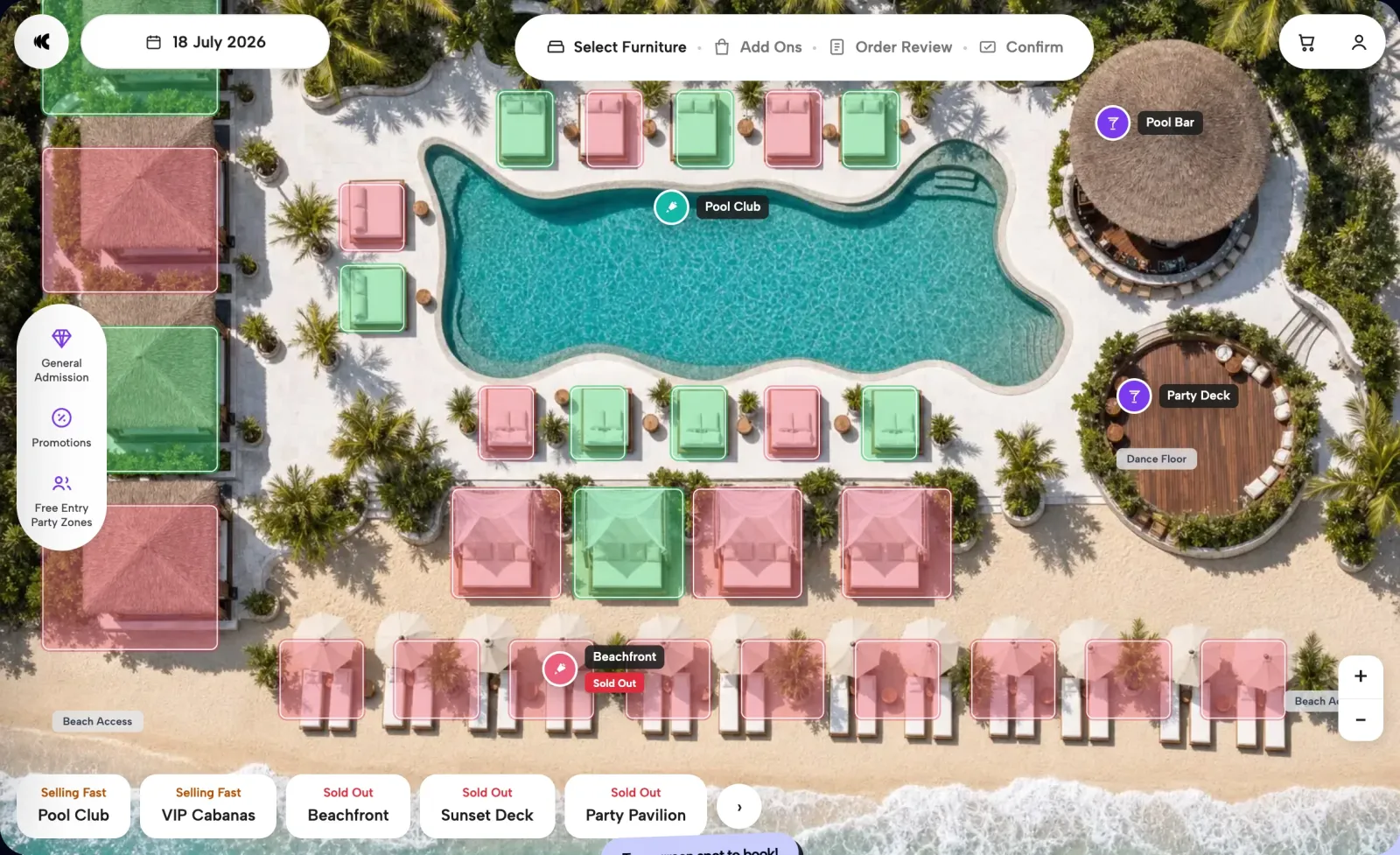
- Let guests pick the actual table. On a nightclub table booking system, the guest chooses their specific spot on a 3D birds-eye map of your floor — dancefloor booths, DJ-adjacent tables, mezzanine, terrace — with a 360° walkthrough of the room before they commit. They are not buying a category, they are defending a position they can already see themselves in. That is exactly the hierarchy you paid the designer to build into the seating plan, finally visible to the person spending the money.
- Take money at booking. Prepayment, deposits and minimum spends turn a held table into a committed one. A booth that no-shows at midnight is not just the lost spend — it is the group you turned away to protect it.
- Ladder the packages. Table only, table with bottles, the full party package, plus stackable add-ons. The upsell happens at booking as one tap rather than as a negotiation at the rope, and Clubtech's in-flow add-on shop has driven an 80% increase in bottle add-ons.
- Price to demand. Dynamic pricing stops a Friday booth and a Tuesday booth from carrying the same number, which is where the tiering you built into the room actually turns into margin.
- Read the floor early. Selling ahead means knowing on Wednesday which zones are gone and which tables need a push — and the same floor plan that sold them runs allocation on the night through nightclub management software.
Buy the tables properly. Then sell them before the doors open, on your own domain, with the guest data staying yours.
Questions operators ask
Where do nightclubs buy their tables?
Through four channels: contract furniture manufacturers who build to order against your drawings, nightlife specialists who focus on LED and bottle-service pieces, regional hospitality suppliers and fit-out contractors in your own market, and sourcing marketplaces such as Alibaba and Global Sources that connect you directly to factories. The right one depends on your lead time, your budget and how much specification risk you can carry.
How long does it take to get custom nightclub furniture made?
Custom and made-to-order contract furniture commonly runs 12 to 16 weeks in production before freight and installation, and international shipping adds several more weeks. Some manufacturers hold quick-ship programs on a curated range for compressed timelines. Plan the furniture order before the fit-out schedule, not after it, because it is usually the longest lead item in the room.
What specifications should I ask a nightclub furniture supplier for?
Ask for upholstery abrasion in double rubs, with hospitality-grade material generally starting around 100,000. Ask which fire standard the pieces certify against — CAL 117, NFPA 701 and BIFMA are the common references, and your local fire authority sets the requirement. Ask about frame gauge, weld quality and joint reinforcement, and confirm the finish tolerates the cleaning chemical your team actually uses.
What size is a bottle service table?
Bottle service tables are deliberately low and narrow so a seated guest can reach across them. Common formats run around 26 inches deep at 21 to 24 inches high, with 48-inch tops for a full booth. Size follows the booth capacity rather than the other way round, so settle the seating layout and the number of guests per table before ordering tops.
Should I buy nightclub tables from Alibaba?
It works if you can write a precise specification, pay for a sample before the production run, and book an inspection before the container ships. Marketplace sourcing is the cheapest route per unit and the least forgiving one, because there is no local recourse when a batch arrives wrong. For hero booths in a long-lease venue, a contract manufacturer is usually the better risk.
How do I make VIP tables actually sell in advance?
Put the real floor plan online and let guests choose the specific table, take payment or a deposit at the point of booking, and attach package tiers and add-ons to the booking flow rather than to a conversation at the door. Prepayment converts a held table into committed revenue, and selling days ahead gives you the demand data to price Friday and Tuesday differently.
Clubtech runs that whole loop — map-based table selection, prepayment, packages, dynamic pricing and guest data — white-label on your own domain, for venue partners in more than 7 countries. Book a 30-minute demo and we will map it against your floor plan.