Peak season is won on execution: the floor fills itself, and the job is moving people through a room that is already sold. The shoulder is different work: no queue to convert, so the money that arrives comes from decisions taken weeks earlier — what you priced, what you programmed, who you told. Peak is capped by capacity. The shoulder is capped by how far ahead you thought.
Where off-season beach club revenue actually comes from
Four places, and none of them is walk-up. Pre-selling further out, so a thin week is partly banked before it starts. Programming, so a quiet Wednesday has a reason to exist. Segments that ignore the tourist calendar — locals, residents, corporate, occasions. And price that follows demand instead of one rate card written for August.
Underneath sit the same four revenue levers you run in peak: prepayments and deposits, upsells and add-ons, dynamic pricing, and abandoned-booking recovery. Only the weight changes. In peak, prepayment is protection against no-shows. In the shoulder it is the week's number.
What changes in the shoulder
Walk-up thins first. It is the softest demand you have, and it goes before booked demand. The part of the floor that filled itself with people wandering in stops filling, and what you sold in advance is what you have.
The mix changes. Fewer first-timers, more repeat guests, more people who live within an hour. They know the venue already, so the sell is a reason for a date, not an introduction.
Lead time moves, because nothing is at risk of selling out. Do not assume the direction or size of that shift, read it: Clubtech ships 20+ reports, and lead time by zone tells you how much notice you are working with, which sets when campaigns and staffing calls land.
Price down, or program up
Discounting is the fastest lever available and the most expensive one you own. Cut the daybed rate in the shoulder and you teach the guest who would have paid full rate in peak to wait. A venue that marks down twice a year negotiates with its own customers year-round.
Programming up holds the number: same furniture, same price, more reason to be there. A residency, a long lunch, an early-evening session that turns a quiet afternoon into two sittings. Sell the occasion rather than the sunbed — tiered packages with stackable add-ons, or a native events widget with tiered tickets and QR check-in.
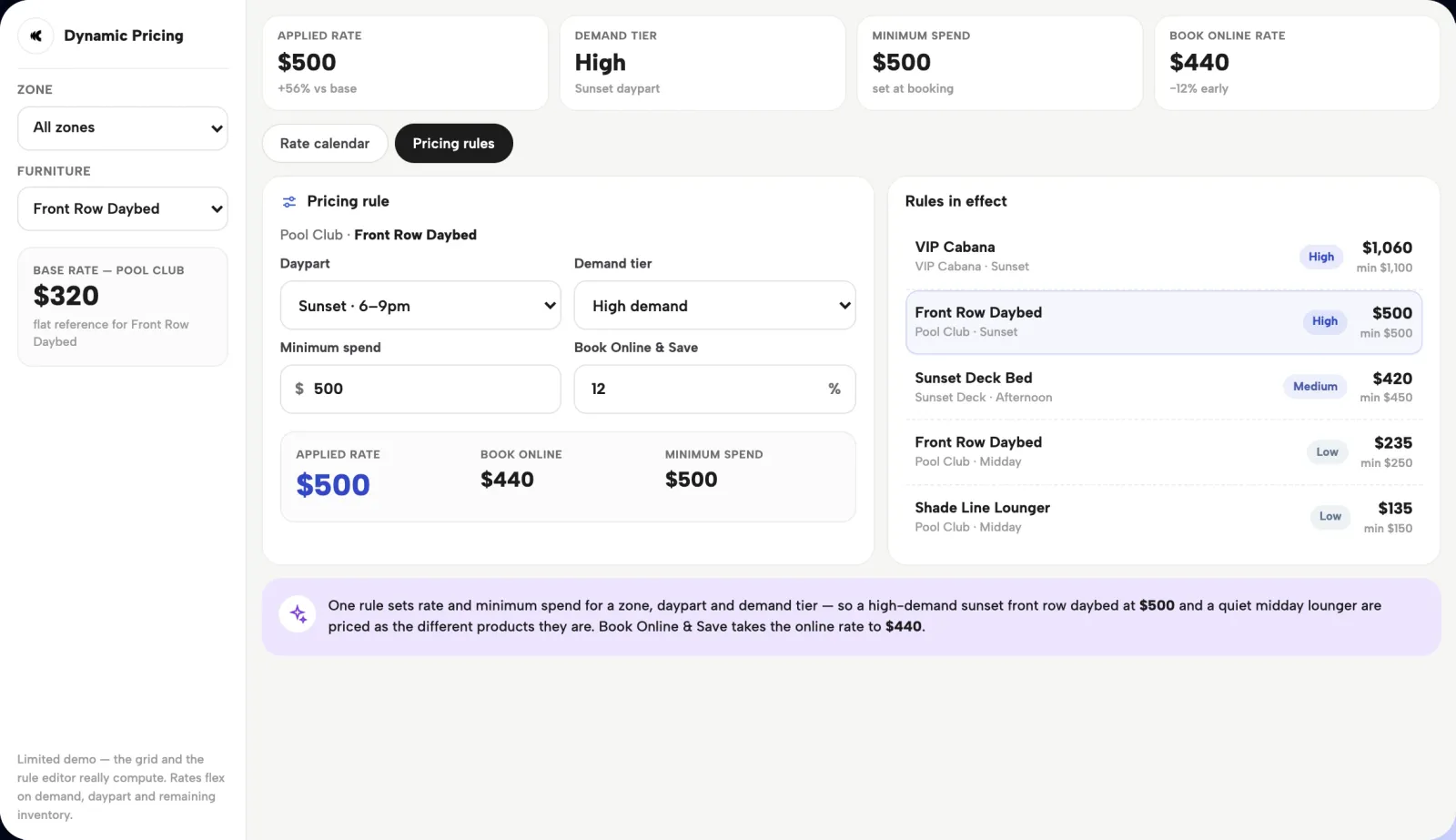
Dynamic pricing is the honest version of moving price, because it is not a markdown: it makes more money from the same seats by pricing to demand. In the shoulder that mostly means catching the days that are quietly strong instead of pricing them for a slow Tuesday. Early-commitment pricing pulls the decision forward and returns capacity data days ahead of service. The beach club revenue playbook covers the stack both sit inside; dynamic pricing for beach clubs goes deeper on the tier ladder.
The segments that travel off-peak
Locals and residents. Not on holiday, so they buy weekdays, early evenings, and repeat visits. A residents' rate people have to qualify for reaches them without moving the published rate.
Corporate. Team days, offsites, client entertaining, end-of-quarter dinners. Midweek, usually booked further out than anything else, carrying a minimum spend. Multi-unit and group bookings put the block through one flow, not a chain of emails.
Occasions. Birthdays, anniversaries, engagements, hen and stag groups. Date-fixed — the choice is you or the venue down the road, not October or July — and they buy add-ons: bottles, cakes, transfers.
Pre-sell further out to smooth the cash line
The shoulder problem is rarely only revenue. It is cash timing — payroll, rent, and supplier terms that do not soften because the deck is quieter. Prepaid deposits put money in the account before service day, attached to a real booking on a real date. That is working float you can plan against, and a pre-sold shoulder week runs differently from a hopeful one at the same revenue.
Recovery matters more here, because there is less traffic to lose. Abandoned-cart events fire within seconds, and WhatsApp and email return the guest to the exact zone, date, and price they left. In August a lost cart is replaced by the next person. In October it is lost.
Run a smaller floor well, not a full floor badly
A half-empty deck reads as a failing venue even when the numbers are fine. A concentrated one reads as a good day. Set the sellable inventory to the shoulder, not to peak: close the far zones, sell the ones with the view, staff the smaller room.
Online inventory syncs to the internal floor plan in real time, and automatic seating allocation places parties in the zones you left open — the team works one room instead of spreading a thin night across the property. When a zone sells out — and in a shrunk plan it will — priority capture still takes the guest's details.
Use the shoulder for the work peak season makes impossible
Build the list. Peak generates guest data faster than anyone can use it, especially when every guest in a party supplies their own details, not just the booker. The shoulder is when you segment it: highest spenders, repeat bookers, corporate contacts, everyone who came as someone's guest.
Train the team. Configuration, pricing, and training belong in the quiet weeks, which is why venues buy a platform before their season, not during it.
Test the flow. Book your own venue on your own phone, on a slow connection, the way a guest does. Watch where it loses you, and what the add-on shop shows first. A quiet week is a cheap place to be wrong.
The shoulder is a different month in every market
The playbook does not move; the calendar does. Northern Mediterranean venues run May to September, so the shoulder is the weeks at either end. Dubai's outdoor season runs roughly October to May, so summer is not a shoulder at all — it is a different business, indoors and later. Bali trades year-round with peaks around July–August and December–January, giving it two. Singapore is events-driven, so the thinking applies to the gaps. The work is identical, and the deadline is earlier than it feels.
Questions operators ask
What is shoulder season for a venue?
The weeks either side of peak trade, when demand is real but thin — not the dead months and not the busy ones. For a Mediterranean beach club that is roughly May and September; for a Bali venue, the stretch between its two annual peaks. The defining feature is not weather but that walk-up no longer fills the floor.
Should we discount to fill the venue off-peak?
Discounting works once and costs you the rate card. If guests learn the price falls in quiet months, the ones who would have paid full rate in peak start waiting. Hold the price and add reasons instead: events, packages, inclusions, a residents' rate that is qualified, not public. Where price should genuinely move, dynamic pricing prices to demand instead of marking down.
How far ahead should we pre-sell shoulder weeks?
Further ahead than peak weeks, because no urgency is doing the work for you. Early-commitment pricing pulls the decision forward and returns capacity data days in advance, corporate and occasion bookings tend to land furthest out, and prepaid deposits arrive as working float before service day. Your own lead-time reporting sets the windows.
Which guests actually book off-peak?
Locals and residents, corporate groups, occasion bookings, and your existing guest list. None follow the tourist calendar, and each needs its own offer: weekday and early-evening value for residents, minimum spends and group blocks for corporate, add-ons for occasions, a reason to return for past guests.
How much does it cost?
Commercials follow discovery. Every venue has a different mix of inventory, zones, payments, integrations, teams, and rollout work, so a published price would be fiction. We map the operation on a call and come back with a proposal built around the real scope.
Bring your quietest month to the call. We will show that week as a booking map, priced to demand, with the pre-sell, the recovery, and the reporting attached. Book a demo