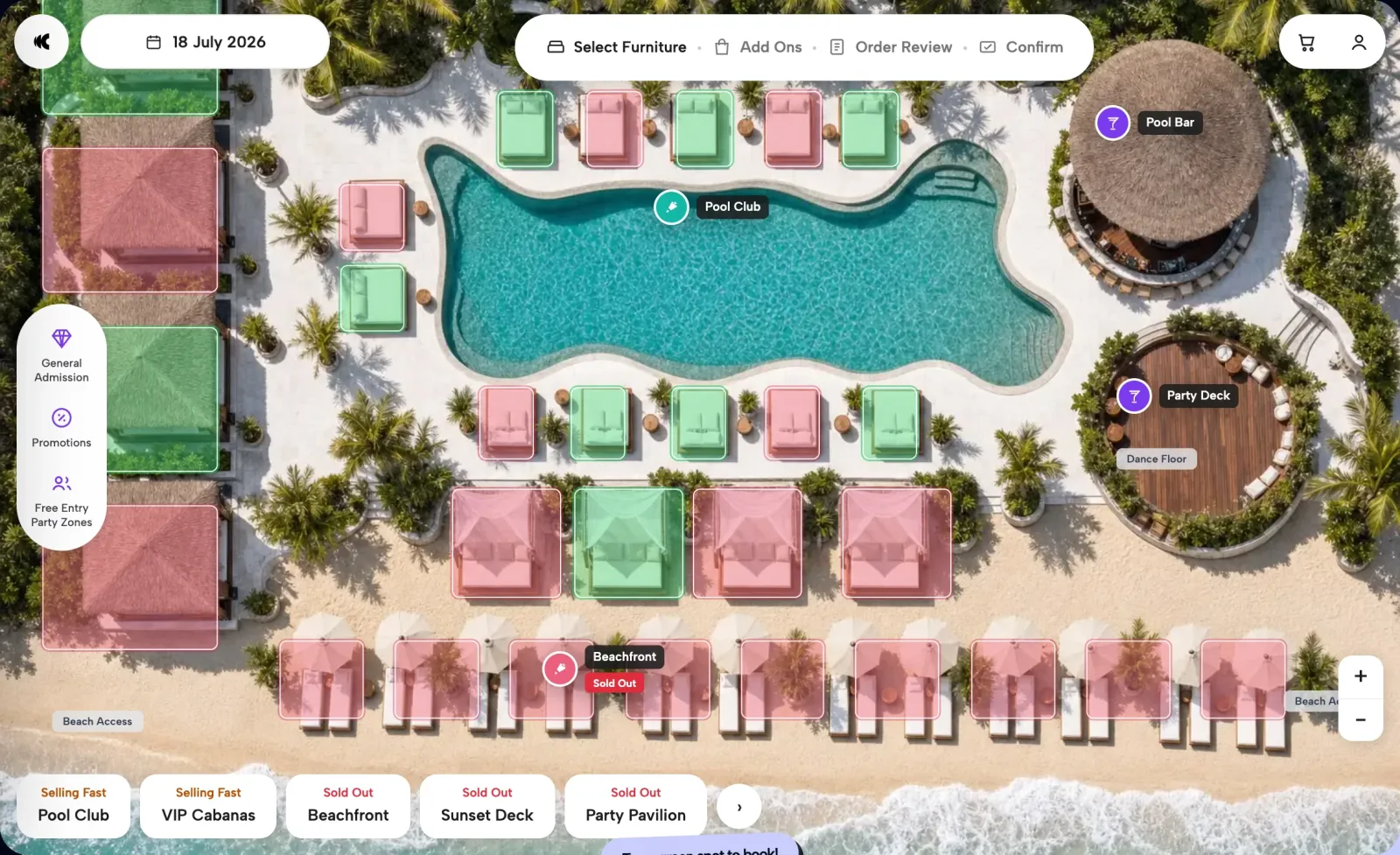
There are two ways to sell the same daybed. One sends the guest to a booking page on your own domain and brand, where you set the package ladder and the money lands before service day. The other puts that daybed in someone else's storefront, next to the venue down the beach, where a guest who has never heard of you books it today.
Both produce a booking on Saturday. By next season they have produced two different businesses.
The short answer
A marketplace listing is a demand rental. You rent reach you have not built, and the rent is paid in the relationship: the guest transacts with the marketplace, and the record of who they are and what they spent stays there.
An owned channel asks more of you up front, because you generate the demand yourself. What you get back is an asset — every booking adds a name and a spend history to a list that belongs to you. Neither is a moral position. The question is which share of the room is worth renting, and for how long.
What each channel is genuinely good at
A marketplace is good at reach you have not earned. It sits in front of people planning a trip who do not know your venue exists, converts them without you running an ad, and moves inventory on a quiet Tuesday. For a venue with no list and no recognition in a source market, that is a real capability.
An owned channel is good at everything after the guest knows who you are: price, merchandising, upsell, follow-up, data. It is where a first-time booker becomes a repeat one. Those mechanics are covered in the complete guide to beach club booking systems.
The trap is not using a marketplace. It is letting the rented channel quietly become the only channel.
The four things a listing keeps
The brand at the moment of decision. The comparison happens inside the marketplace's design, next to your competitors, sorted by rules you do not write. Your venue becomes a tile with a price on it, and the positioning you paid for flattens into a row.
The guest contact. This is the one that compounds. Your own channel captures the booker and, if the flow is built for it, every guest in the party — a party of eight is eight marketable records, not one. What a listing passes back to you is a term in your agreement rather than a given, so read yours before you assume the audience is being built on your side.
The add-on and package upside. Marketplaces sell a clean unit of inventory, because clean units browse fast. Bottles, cakes, transfers, the tier above the one they clicked — that revenue lives in the flow you control. It is the difference between selling a daybed and a day.
Pricing control. A listing constrains how and when you move price. Your own channel prices to demand, pulls bookings forward with early-commitment pricing, and holds rate on a night you know will sell instead of discounting to stay visible in someone else's sort order.
When renting demand is the right call
Three situations, honestly.
A new venue with no list. If nobody has your email address, an owned channel has nothing to send to. Renting reach while you build the list is the right sequence, not a compromise.
A shoulder month. Inventory that expires unsold is worth nothing at midnight. Renting demand to fill a quiet week is a rational trade, provided you capture those guests on arrival so the second visit is yours.
A new origin market. A new source country or airline route is what a marketplace is for. Rent the introduction, then work out which of those guests are worth marketing to directly.
In all three the listing has a defined job and an end date. That is the whole discipline.
Running both without the listing becoming the default
Make the owned channel the better place to book. Put the tier ladder, the add-ons, and the specific furniture there, so the guest has a reason to finish with you rather than in someone else's grid.
Budget the listing like paid acquisition, because that is what it is: a number, a purpose, a review date. If it is filling shoulder inventory, judge it on that rather than total covers. And convert what it sends you — a marketplace booking turned into a direct guest has paid for itself twice.
Then measure repeat rate by source. That number says whether you are building an audience or renting one, and it is hard to read when the reporting sits in someone else's dashboard.
Where Clubtech sits in this
Clubtech is built for the owned side of that split. The booking journey runs white-label on the venue's own domain and design, so the guest never leaves the brand to buy. Every guest in the party supplies their own details, not just the booker, so the marketable audience grows with each reservation. Reservation data becomes guest intelligence rather than a booking log — revenue by hour, lead time by zone, product mix, origin markets across 20+ reports — and lookalike audiences start from your highest-value bookers, not your follower count. More in why first-party data is the future of beach club marketing.
The stance underneath it: guest data belongs to the venue, never pooled, resold, or marketed against the operator who collected it.
The compounding difference
FINNS has 240,251 guest profiles captured through its own booking channel. That is not a marketing statistic — it is a balance-sheet item, an audience the venue can open a season with, launch an event into, and build ad audiences from, without paying for the introduction again.
A listing is reach you rent again on every booking. A list is an audience you build once and spend for years. Rent demand where it makes sense. Own the relationship either way.
Questions operators ask
What is the difference between an owned booking channel and a marketplace listing?
An owned channel is a booking page on your own domain and brand, where you set the pricing, the packages, and the follow-up, and the guest record belongs to you. A marketplace listing puts your inventory inside a third party's storefront, which supplies the demand and holds the transaction. One builds an audience, the other rents one.
Do we get the guest's contact details from a marketplace booking?
That depends on the platform and your contract, so read the terms rather than assuming. As a rule, the guest relationship is what a marketplace sells, so the record of who booked, what they spent, and when they return sits with it. On your own channel that record is yours by default, including the rest of the party, not only the person who paid.
Should a new venue with no audience start with a marketplace?
Often yes, as a deliberate first step rather than a permanent arrangement. If nobody has your email address, an owned channel has nothing to send to, so renting reach while you build the list is the right sequence. The discipline is capturing those guests on arrival and giving the listing a review date, so it stays a launch tactic.
Can we run a marketplace listing and our own booking channel at the same time?
Yes, and most venues should. Treat the listing as paid acquisition with a budget and a specific job, such as shoulder inventory or a new source market, and make your own channel the better place to book, with the full package ladder and add-ons. Then track repeat rate by source, which says whether you are building an audience or renting it.
How much does an owned booking channel cost?
Commercials follow discovery. Every venue has a different mix of inventory, zones, payments, integrations, teams, and rollout work, so we map the operation on a call and come back with a proposal built around the real scope.
Bring one real weekend to the call. We will show your inventory as a booking map on your own domain, priced in packages, with the guest capture and reporting attached. Book a 30-minute demo