Pre-selling the whole floor sounds like the finish line. It is not. A venue that is fully committed three days out has spent every option it had: no room to move the group that grew from six to ten, nothing left for the guest who converts on the day the forecast turned good, and no upside on the Saturday the weather beats the forecast. The target is not maximum pre-sold capacity. It is the right share of it, derived from your own booking data rather than borrowed from someone else's venue.
The short answer
There is no benchmark percentage worth publishing — anyone who hands you one is quoting a different climate, calendar, and furniture mix. The workable definition is that the right share is the point where the last unit you sold in advance would not have sold better on the day.
You find that point three ways at once — per day of week, per zone, and per season — by reading how far ahead each zone actually books, how often you close out, and what the units that sold late were worth against the ones you committed early. Pre-sell enough to cover the cost of opening the doors and to make the week's decisions on numbers instead of instinct. Hold back the inventory that historically sells last, and let price rather than a hard cap arbitrate the rest.
What pre-sold capacity actually buys
Three things, and they compound.
Certainty. Early-commitment pricing — the "Book Online & Save" spread between the online price and the door — converts guests days ahead and gives you predictable revenue and capacity data before the service day exists as a problem. Knowing on Wednesday what Saturday is worth is a different job from finding out at 4pm on Saturday.
Working float. Prepayments and deposits put predictable cash in the account before service day, attached to the exact furniture, package, and date — working float you can see before the doors open, not revenue you find out about on Monday.
Decisions on data. Capacity data days ahead is what turns the Thursday stock order and the weekend roster into arithmetic. Under-ordering on a sold-out Saturday and over-staffing a quiet Tuesday are the same mistake made from the same missing number.
What over-committing costs
Four costs, and none of them show up in a revenue report, which is why over-committing is easy to do and hard to notice.
The hot-day upside. Demand is not evenly spread across your calendar. The days when walk-up and late booking spike are exactly the days you sold out cheaply three weeks earlier.
Flexibility on the floor. Groups grow, parties merge, a booking needs relocating away from the speaker stack. A floor with nothing spare turns every one of those into a refusal.
The guest who converts on the day. Late demand is real demand, and it often arrives on the back of spend you have already made. If there is nothing left to sell it, you paid for the interest and handed the booking away.
Your own pricing power. If your best furniture consistently sells at the earliest and cheapest tier, you converted your scarcest inventory at your lowest price and called it a strong week.
The line moves by day of week, and again by season
Saturday and Tuesday are different businesses that share a parking lot. A weekend day with reliable demand and a long lead time carries a much larger pre-sold share, because you already know late demand is coming and you can price for it. A midweek day where most bookings land inside 48 hours cannot — commit that floor early and you have discounted inventory that was going to sell anyway. One number applied across seven days is wrong six times.
Season moves it a second time. In peak, lead times stretch and the residual demand is deep enough to fill whatever you held back, so a bigger pre-sold share is both achievable and safe. In the shoulder months the curve compresses: guests decide later, the weather decides for them, and the share that was prudent in peak becomes a commitment made blind. Re-derive at each season change rather than carrying a peak setting into a quiet month.
Zones do not book alike
Front-row cabanas, poolside daybeds, and the back loungers have different lead-time curves, and they should have different pre-sold shares. The premium tier typically commits far out — it is the reason people plan a trip around your venue. The entry tier is where late demand lands.
That is what makes zone-level reading non-optional. A healthy-looking venue-wide sell-through can be a sold-out premium row sitting next to a half-empty back section, and the two call for opposite actions.
Hold back the tier that sells last
The instinct is to protect the best furniture. The arithmetic says otherwise. Inventory held back is inventory you are betting on late demand to clear, so it should be the tier with the shortest lead time and the most reliable on-the-day conversion — usually the entry or mid tier, not the signature cabana that books a month out and never walks.
Held-back premium furniture is the most expensive empty seat in the building. Held-back entry furniture is a Saturday afternoon's flexibility.
Read your own numbers in four passes
Clubtech ships 20+ reports, and the question resolves into four readings off them.
- Lead time by zone. Plot how many days ahead each zone books. Find where the curve flattens — that is the point after which pre-selling stops being a forecast and starts being a discount.
- Sell-through by day of week. Which days close out, how early, and which ones never fill. Days that close out days ahead are days you were pricing too low, not days you executed well.
- Average value by variant, early versus late. If your late bookings carry a higher average value, the units you released early were underpriced. If they carry a lower one, hold back less.
- What sold out did to you. When a zone closes early, priority capture keeps taking guest details — sold out is not a lost guest. The size of that list is your clearest read on how much demand you turned away, and it is the argument for holding more back next time.
Then change one thing. One zone, one day of week, one direction, held for four weeks. Move three variables at once and the data will not tell you which one worked. The beach club revenue playbook covers the wider revenue stack this sits inside.
Let price do the arbitration
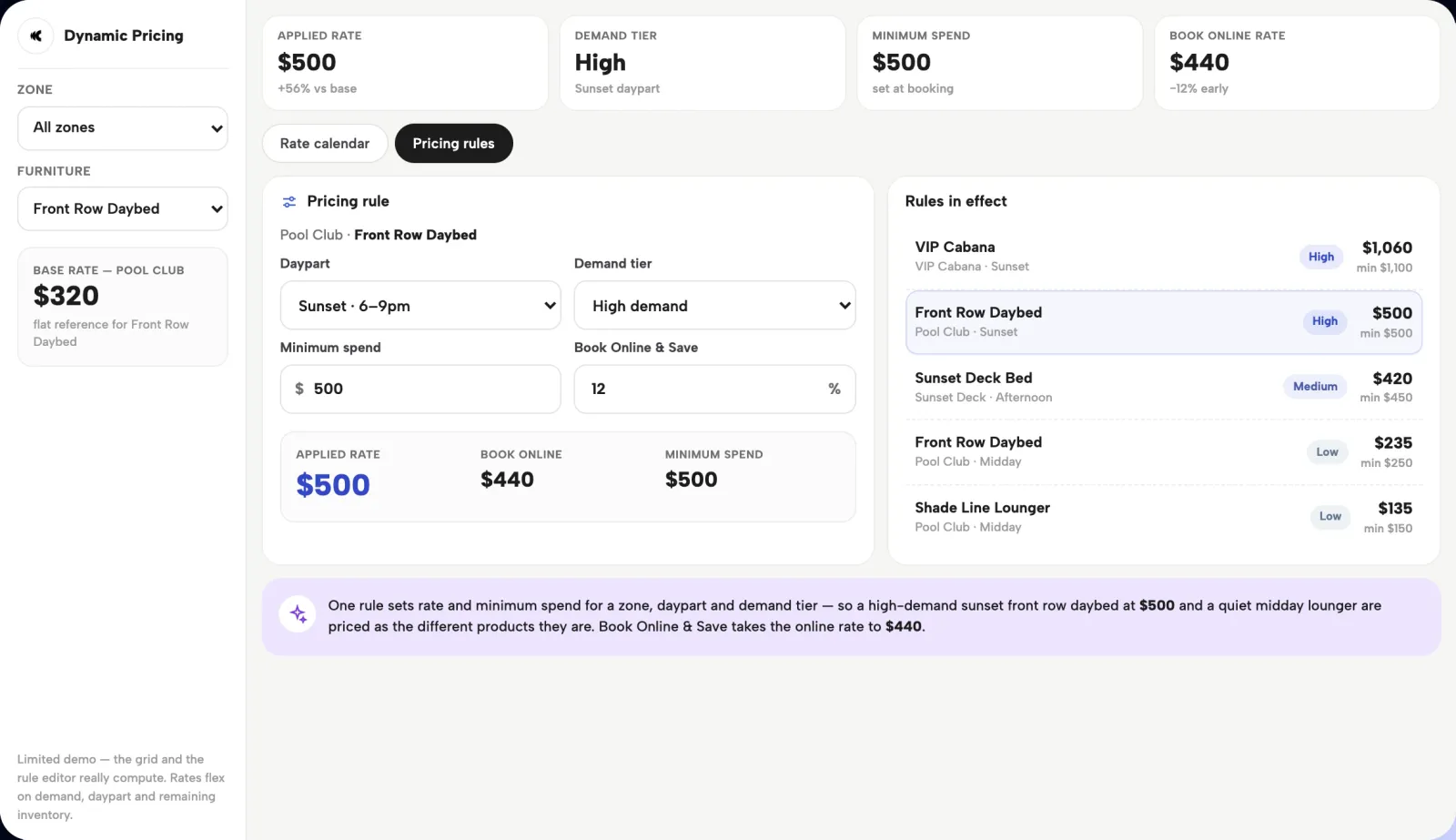
The best version of this is not a fixed cap at all. Dynamic pricing lets rates flex with demand and remaining inventory, so the pre-sold share settles where the market puts it: the floor fills early at a price that reflects how early it is, and whatever is still there on the day is priced for a guest who has run out of alternatives. You stop guessing at a percentage and start managing a curve. The mechanic is worked through in dynamic pricing for beach clubs.
None of it works from a booking log. It works from a system that records lead time, zone, variant, and value on every reservation and reports them back without a CSV export — which is how operators stop picking a share and start deriving one.
Questions operators ask
What percentage of capacity should a venue pre-sell?
There is no single figure, and treating another venue's number as a target is how operators over-commit. The right share is specific to your day of week, season, and zone. Derive it from your own lead-time curve, your sell-through, and the value of late bookings against early ones, then adjust one variable at a time and measure over about four weeks.
How do I know if I am pre-selling too much?
Three signals. Zones close out well before the service day at your lowest tier price. Your on-the-day average value is consistently higher than your advance average value. And your team is turning away groups, upgrades, or relocations because there is nothing spare on the floor plan. Any one of those means you released too much inventory too early, or priced the early release too cheaply.
Should the pre-sold share change by day of the week?
Yes. Weekend days with long lead times and deep late demand support a much higher pre-sold share than midweek days where most bookings land inside two days. Applying one venue-wide number across the week means it is wrong on most of them. Derive and set the share per day of week, then re-check it when the season turns.
Which inventory should a venue hold back?
Hold back the tier with the shortest lead time and the most reliable on-the-day conversion, which is usually entry or mid-tier furniture rather than the signature cabanas. Held-back inventory is a bet on late demand clearing it, and premium furniture that books a month ahead is the worst possible thing to bet on. Protect flexibility, not prestige.
What happens when a zone sells out early?
The booking flow keeps capturing guests after the furniture is gone through priority and free-entry registration, so a sold-out zone still adds contacts to the venue's own database. That list is also a measurement: it tells you how much demand you could not serve, which is the evidence you need to hold back more of that zone next time, raise its price, or both.
How much does it cost?
Commercials follow discovery. Every venue has a different mix of inventory, zones, payment methods, integrations, teams, and rollout work, so a list price would be fiction. We map the operation on a call and come back with a proposal built around the real scope of what you run.
Bring one real month of bookings to the call. We will read your lead-time curve by zone with you and show what the same floor looks like priced to demand. Book a 30-minute demo