One group booking outweighs the couples around it, and it behaves nothing like them. A party of fourteen arrives as a conversation, not a decision: a headcount that moves for a week, an occasion that sets the budget, an approval chain running through someone who may not be coming, and a spend that keeps climbing through the add-ons.
Most booking flows are built for the couple — two covers, one contact, one price. Point that flow at a group and it holds nothing, learns nothing, and hands the party back to a WhatsApp thread with your host.
The direct answer: what group booking software has to do
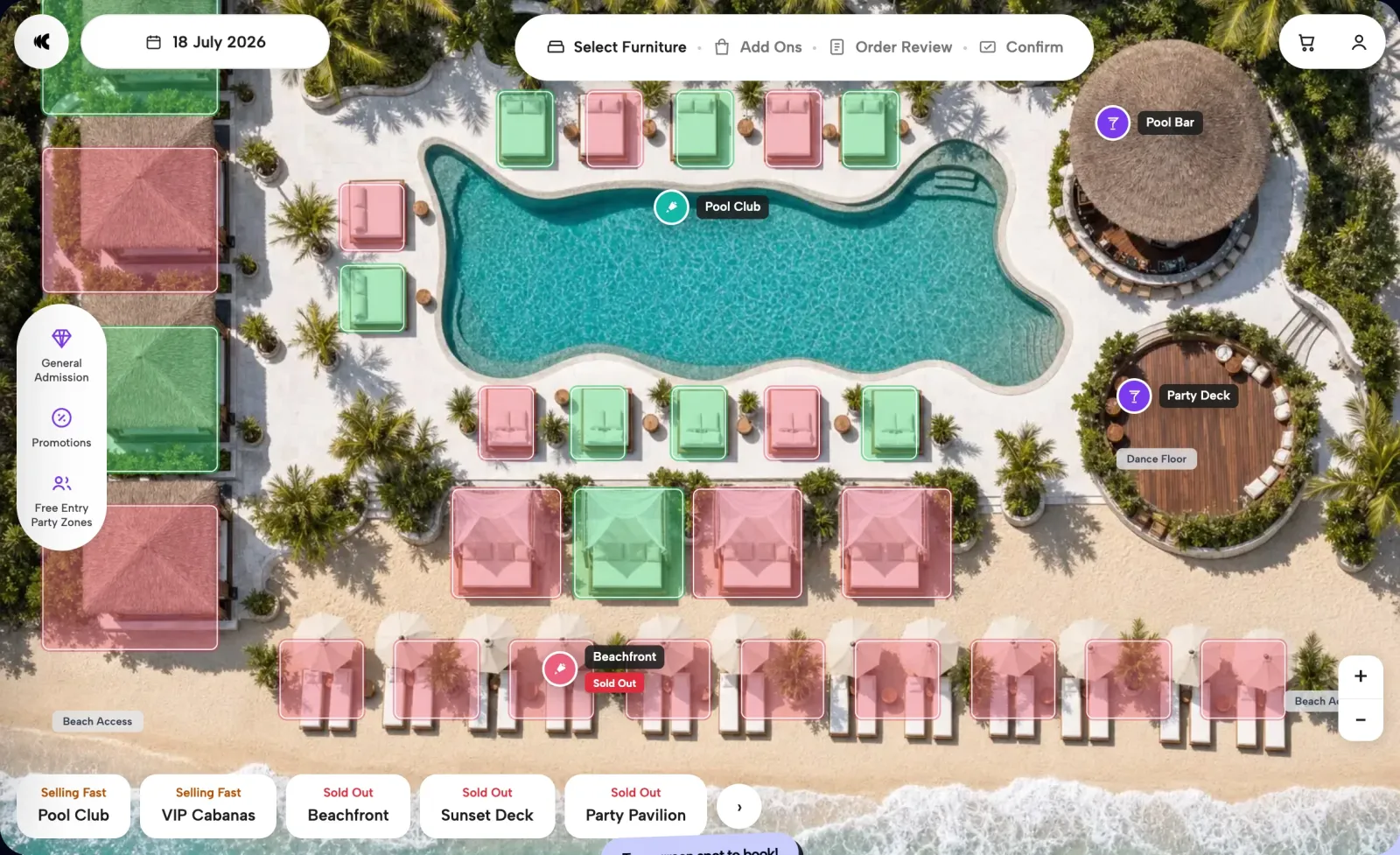
Four jobs. It sells multiple units as one reservation — a row of daybeds or a pair of booths, on one confirmation, from a map of your actual floor. It prices the occasion, not the seat, through tiered packages with stackable add-ons and a minimum spend on prime furniture. It holds the commitment with money while the numbers finalize, so the inventory is neither given away nor sitting dead. And it captures every guest in the party, not only the person who paid.
Clubtech does those four on one platform, white-label on the venue's own domain, processing $1M USD in weekly GMV across venue partners in over 7 countries. Its 3D booking map supports multi-unit and group bookings on live availability.
Why a flow built for two breaks on a party of fourteen
The count moves. Twelve becomes sixteen becomes fourteen. A system that treats headcount as a fixed field at the moment of booking forces the group to pad the number, or under-book and argue at the door.
The decision is long and shared. Nobody in a group of fourteen decides alone. The booking gets opened, discussed elsewhere, and returned to hours later — often the following night, since 82% of bookings happen on a phone after 10pm. Abandoned-booking events fire within seconds on Clubtech, and WhatsApp or email returns the guest to the exact zone, date, and price they left — a couple would simply have re-booked, but a party does not reassemble as easily.
Holding inventory for a party that is still forming
Hold the front row for a group that never confirms and you have run a Saturday with dead inventory in your best zone. Hold nothing and the party goes to whoever answers first.
Money is the only reliable hold. Prepayments, deposits, and minimum spends turn a maybe into a commitment, and they are the mechanics that kill no-shows. A deposit against specific furniture on a specific date changes a group's behavior in a way a pencil mark never has, and it lands as working float before the service day.
The operator side keeps control around that: manual booking and override, area-blocking and all-day blocking, and inventory that syncs to the internal floor plan in real time.
Minimum spends and packages are the natural shape of group intent
A group is not buying a seat. It is buying an occasion — a birthday, a farewell, a client dinner — and the occasion sets the budget. Package pricing matches that intent: bed only through party package to ultimate, with bottles, cakes, and transfers stacked on inside the flow.
That is also where the money is. Clubtech's mobile add-on shop runs full-screen bottle video and swipeable product discovery inside the booking journey, and that experience has driven an 80% increase in bottle add-ons. An order review step sits before payment, so the group confirms the whole order in one place rather than at the table. Add-ons are one of four revenue levers here, alongside prepayments, dynamic pricing, and abandoned-booking recovery — the wider architecture is in the guide to beach club revenue streams.
A minimum spend does the job a package cannot: it puts a floor under prime furniture while leaving the group free to choose what they order. It also speaks the language the group is already using: a party planning a night out is usually working from a per-head number.
The corporate variant: an organizer who is not attending
Corporate demand is the same shape with three differences.
The organizer is not the guest. An events lead or an assistant is booking for people they may never sit with, optimizing for defensibility rather than atmosphere: the right room, the right number, no surprises.
The budget is fixed before you are contacted. It was set elsewhere, as a number per head. A package with a stated inclusion list and a known minimum is easier to buy than an open tab, because it turns your venue into a line item they can commit to without a second approval.
There is a paper trail. Corporate money moves through finance, which wants documentation before and after. That part is the venue's own sales practice — the named contact, the written confirmation of scope and numbers, the timings agreed for a final headcount, the venue's terms. Clubtech carries the booking and the money; the paperwork stays where it already sits.
The platform carries the booking: multi-unit selection on the map, tiered packages, multi-currency prepayment inside the flow through Stripe, Airwallex, Apple Pay, and Google Pay, and a group-bookings report in the venue's own admin. Where the booking is a company party rather than a table, the native events widget handles tiered tickets and QR-code check-in at the door.
The data prize: one booking, a whole address book
A group booking is the only reservation that can hand you the entire party. On Clubtech the booker invites the group and each ancillary guest supplies their own details, rather than hiding behind one payer — a party of fourteen at the daybeds can arrive as fourteen profiles, not one. The marketable audience grows with every reservation, and that compounds: FINNS has 240,251 guest profiles captured. A corporate booking feeds the same machine: an office party is a room full of people who have now been to your venue once and are reachable afterwards.
The data belongs to the venue — white-label, on your domain, never pooled or marketed against you, which is the difference between an owned booking channel and a marketplace, and the reason the beach club solution is built the way it is. From there, 20-plus reports read the behavior back: lead time by zone, average value by package variant, product mix, repeat share, origin markets. And when the group cannot be seated at all, priority capture still takes the details — sold out is not a lost guest, it is a party you can call first next month.
Questions operators ask
What is group booking software?
Software that lets a party reserve multiple units of furniture as one booking, price the occasion through packages and minimum spends, pay before arrival, and register every guest rather than only the payer. It differs from ordinary reservation software in three places: multi-unit inventory, commitment mechanics that survive a moving headcount, and per-guest data capture.
Can we capture details for everyone in the party, not just the booker?
Yes. The booker invites the party and each ancillary guest supplies their own details, so a fourteen-person reservation can grow the marketable database by fourteen profiles rather than one. That is why group bookings are worth more than their revenue line suggests: the guest data is owned by the venue, on its own domain, and reusable for every campaign after.
How do you hold inventory for a group that has not confirmed numbers yet?
With money and with operator controls. A deposit or minimum spend attached to specific furniture on a specific date is the only hold that reliably survives, and it puts cash in the account before service day. Alongside that, the reservations dashboard carries manual booking and override, area-blocking and all-day blocking, and real-time inventory sync, so the team can take a zone off sale while the party firms up.
Can it handle a corporate booking where the organizer is not attending?
The booking itself, yes: multi-unit map selection, tiered packages with a stated inclusion list, prepayment inside the flow, and a group-bookings report afterwards. The paperwork corporate finance expects around it — written confirmation of scope, agreed final-numbers timings, your venue's own terms — is a practice your sales lead runs, and worth raising in discovery.
How much does it cost?
Commercials follow discovery. Every venue has a different mix of inventory, zones, payments, integrations, teams, and rollout work, so we map the operation on a call — including how your group and corporate bookings come in today — and come back with a proposal built around the real scope.
Bring one real group booking to the call. We will show it as a multi-unit reservation on a map of your floor, priced as a package with a minimum, every guest in the party captured. Book a 30-minute demo