Two venues can protect the same Saturday and end Friday with very different bank balances. One takes a deposit when the booking is made and collects the rest when the guest arrives. The other takes the whole ticket up front. Both have removed the no-show. Only one is holding the money.
That is the real trade, and it is a cash-flow decision. Prepayments, deposits, and minimum spends kill no-shows the moment money changes hands before the service day. What stays open is how much of the ticket sits in the account before doors, and what you give up at the point of decision to get it there.
The direct answer: same no-show protection, different cash
A deposit buys commitment at the lowest barrier. The guest is in for a smaller number, the decision is easier on a phone at midnight, and a group that has not finalized numbers can still lock the furniture. What it leaves behind is a balance: money you do not have yet, collectable only on the busiest day of your week.
Full prepayment buys the whole ticket. The revenue is banked, the working float is visible before you buy stock or roster staff, and the service day arrives with nothing left to collect. What it costs is a higher barrier at the moment the guest is deciding, and it asks a group to finalize a number it may not have.
Neither model is right for a whole venue. The right answer belongs to a piece of inventory, on a lead time, in a season.
Lead time is the first variable
The further ahead a booking sits, the more full prepayment asks. A guest committing eight weeks out to a cabana, before flights are booked, is a different buyer from one deciding at 11pm on Thursday for Saturday. A deposit asks that booker for a smaller number against a plan that is not finished, and it still holds inventory you would otherwise hold on a promise, with cash landing well before that service day's costs.
Short lead time flips it. When the decision and the visit are days apart, the barrier mostly disappears; the guest is already committed in every sense but the transfer. The friction that matters then is checkout, not amount. 82% of bookings happen on a phone after 10pm, and in Clubtech the full booking completes in four taps with one-tap wallet authorization. Asking for the whole ticket inside a flow like that costs very little; asking for it through a redirect and a form costs plenty.
Furniture tier changes the math
At the bottom of the ladder, splitting the collection is not worth the admin. Half now and half later doubles the touchpoints on a single sunbed to protect an amount most venues would never chase.
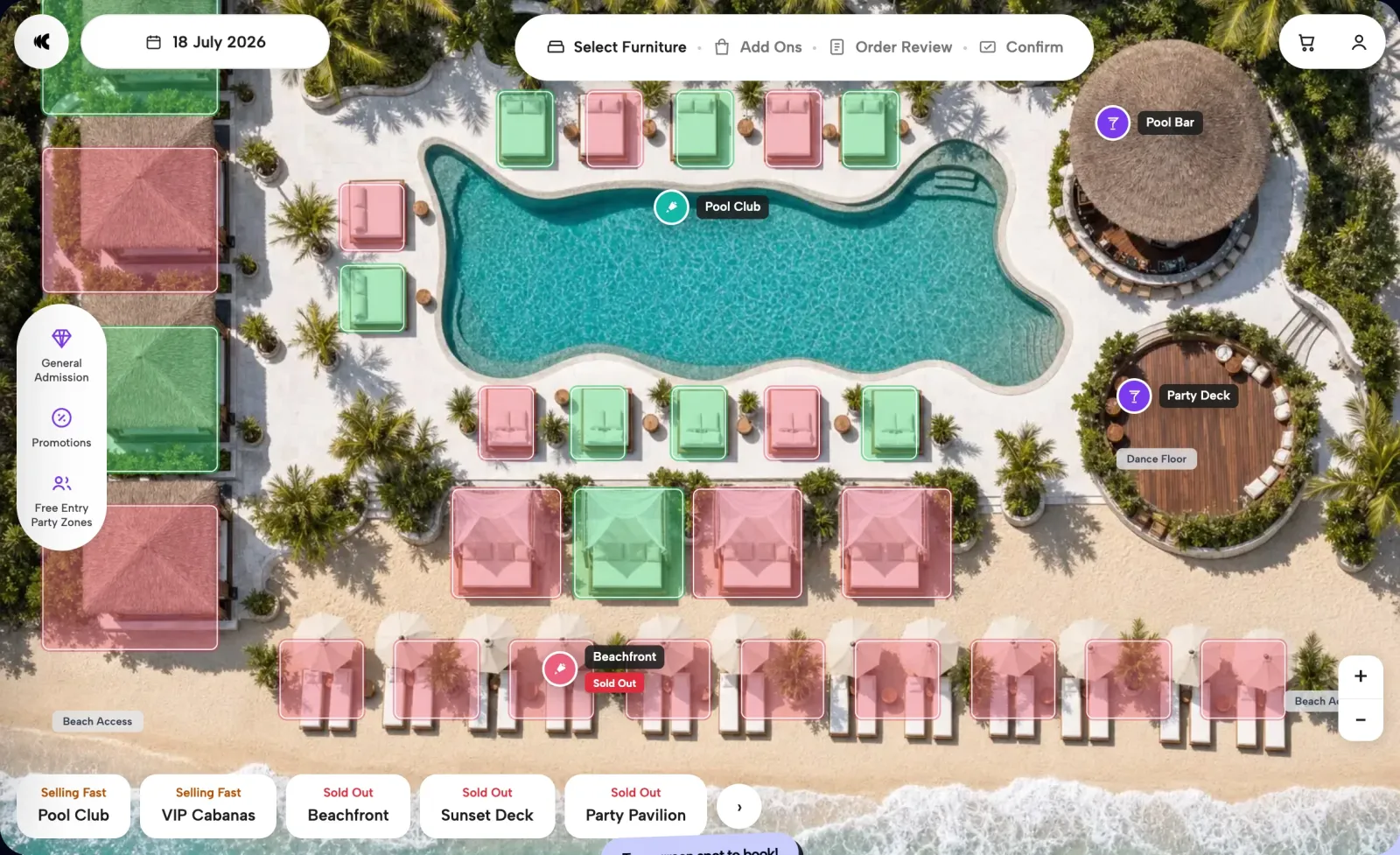
At the top of the ladder the logic reverses. A cabana with a party package and bottles is a number people want to think about, and a deposit gets it committed while the group is still enthusiastic. The second reason to prefer a deposit on premium inventory: the ticket is not finished at booking. Clubtech's add-on shop sits inside the booking flow with full-screen bottle video and swipeable product discovery, and it has driven an 80% increase in bottle add-ons. Closing the total at the earliest possible moment can quietly cap it.
Group size and who is fronting the money
One payer for one seat is simple. One payer for fourteen people is not, because the organizer carries the whole number personally until friends settle up. A deposit lets them commit for the group without funding the group. Capturing the party is unaffected either way: the booker invites the group, and each additional guest supplies their own details.
Season decides how much barrier you can afford
In peak weeks, when demand exceeds the furniture you have, a higher barrier costs little — the daybed sells regardless, and whoever took the full ticket is carrying the cash. Peak is also when costs run heaviest, so pre-paid revenue is working float you can see before doors, worth most when outgoings spike.
Shoulder season inverts the argument. Conversion is the constraint, not capacity, and every point of friction is a booking that goes elsewhere. That is where a deposit earns its keep, and where the rest of the flow matters just as much — the case for taking the money at booking is covered in how to reduce no-shows.
The collection burden lands on your floor team
Every deposit writes a task into the service day: someone collects the balance at a table while the venue is at its busiest, on the same shift running food, drinks, and the door. That work lands on the people with the least time, on the day you can least afford errors, and across a full Saturday of part-paid bookings it carries a labor cost that never shows up in the revenue comparison.
Full prepayment removes the task. The team arrives to a service day with nothing outstanding, and the Clubtech operator console shows what is booked before doors. For table-led venues, the minimum spend is the third instrument worth having in the conversation — it sets commitment at the value level rather than the collection level.
What happens when a guest cancels or moves a booking sits outside this decision entirely. That is governed by your own terms with your own guests, and it belongs there rather than in your payment configuration.
The mixed model most venues actually run
The sensible setup is not a venue-wide rule — it is a rule per inventory type. Full prepayment on the low-ticket, short-lead, single-payer furniture, where the amount is small and checkout is the only friction that matters. Deposits on the premium tiers, the long-lead bookings, and the large groups, where the barrier is what stands between you and a confirmed booking.
Then read it back. Lead time by zone, average value by variant, and product mix all sit in Clubtech's reporting, so whether your deposit tiers convert better than your prepaid ones is answerable from your own data inside a season rather than argued from instinct. Structuring the rest of the revenue around that answer is covered in the beach club revenue playbook.
Questions operators ask
Is a deposit or full prepayment better for cash flow?
Full prepayment, by definition — the whole ticket is in the account before the service day, which is float you can see before you buy stock or roster staff. A deposit banks a portion and leaves the rest to collect on the day, in exchange for a lower barrier on the high-value bookings that hesitate at a large number.
Does a deposit protect against no-shows as well as full prepayment?
Both remove the no-show. Prepayments, deposits, and minimum spends all do that job — money down before the service day is the mechanism, not the size of the number. The difference is exposure, not protection: full prepayment protects the whole ticket, a deposit protects the commitment and leaves the balance uncollected.
How does booking lead time change the decision?
Long lead times favor deposits. A guest committing weeks ahead is being asked for money against a plan that is not finished, so a smaller number is the easier ask and still holds the inventory. Short lead times suit full prepayment, because the guest has already decided and the only friction left is checkout.
Should large groups pay a deposit instead of the full amount?
Usually. The organizer of a large booking fronts the whole ticket personally until the rest of the group settles up, and that hesitation happens inside your checkout. A deposit lets them commit for the group without funding it. Capturing every guest's details is unaffected either way.
What does Clubtech cost?
Commercials follow discovery. Every venue runs a different mix of inventory, zones, payment methods, integrations, teams, and rollout work. We map the operation on a call and come back with a commercial proposal built around the real scope.
Bring one real weekend to the call. We will model your furniture both ways and show what each does to the cash in your account before doors. Book a 30-minute demo