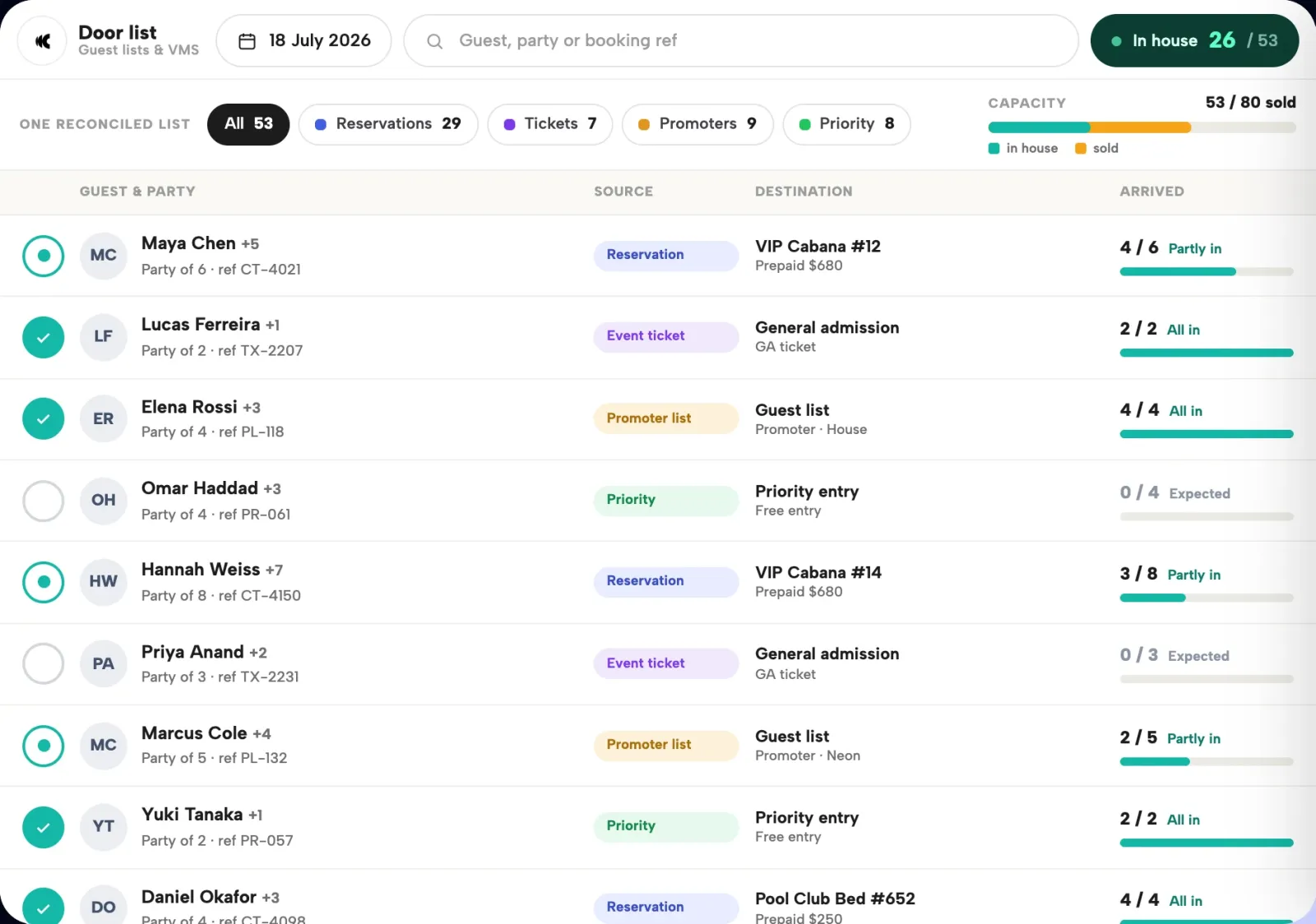
Most nightclubs run on promoters, and most promoters run on their phones. A dozen names here, a comp list there, a WhatsApp thread that is the guest list for Saturday. It works right up until the promoter leaves — and takes the audience with them. That's the quiet problem with club promoter software: it's built to help the promoter manage their people, and the venue ends up renting access to its own guests.
Club promoter software is the category of tools that let promoters build guest lists, hand out comps, and check names at the door. Useful work. But for the operator, the question isn't whose list moves faster — it's who owns the data when the night is over. This is a guide to what promoter tooling does, what to look for, and where a venue booking platform like Clubtech fits alongside it.
What club promoter software is meant to do
Strip away the branding and most promoter tools cover the same jobs:
- Build and share guest lists for a night or a recurring event.
- Manage comps and reduced-entry names so the door knows who gets what.
- Check names at the door, ideally faster than a printed sheet.
- Give each promoter their own view of the list they're responsible for.
None of that is wrong. The gap is what happens to the data those lists generate — and who it belongs to.
The problem the venue inherits
A guest list is a marketing asset. Every name on it is someone who chose your room on a busy night. When that list lives inside a promoter's tool or a promoter's phone, three things happen:
- The audience isn't yours. You can't market to guests you never captured. The promoter can; you can't.
- It walks when they walk. Promoters move between venues. The list — and the relationships — tend to go with them.
- The data is thin. A door list is names and maybe a phone number. It rarely ties back to what the guest spent, when they book, or whether they came back.
So the venue fills the room and still doesn't own the room's audience. The fix isn't a better promoter app. It's making sure the guest data lands in a system the venue controls.
What a venue actually needs
The operator's requirement is narrower than "manage promoters" and more valuable: capture the guests, own the data, run the door from one screen. A booking platform handles that directly.
- One list, not five phones. Reservations, tickets, priority registrations, and promoter names arrive in the same system, so the door works from a single live list instead of reconciling sources under the rope. (More on that in the guest list management breakdown.)
- QR check-in at the door. Guests are checked in with a tap against that live list — no name-hunting, no duplicate entries, no queue while a host scrolls a phone. See door check-in and QR scanning for how the door becomes a data moment.
- Every guest, not just the name at the top. When the booker invites their group and each guest supplies their own details, a table of eight becomes eight records — captured under the venue's brand, on the venue's domain, in the venue's database.
- Priority capture when you sell out. Demand you can't seat still becomes contact data you can market to next weekend.
The point isn't to replace the promoter. It's to make sure that when the promoter's list hits your door, the guests end up in your database — not just theirs.
Where promoter tools still fit
A booking platform is not a promoter-payout system, and this piece won't pretend otherwise. If you pay promoters on heads or spend and need to manage those commercial arrangements, a dedicated promoter or agency tool may earn its place next to your booking platform. The division of labor that works: let the promoter tool handle the promoter relationship, and let the nightclub management platform own the booking, the door, and the guest data. The mistake is letting the promoter layer become the only place your guest data lives.
Clubtech runs the whole night from one platform — VIP table booking, front-of-house operations, and marketing — white-label on your domain, with the venue owning its guest data. Promoters can still fill the room. The difference is that the room's audience stays yours.
Questions operators ask
What is club promoter software?
It's software that helps promoters build guest lists, manage comps and reduced-entry names, and check guests in at the door for club events. It's built around the promoter's workflow. For the venue, the thing to check is where the resulting guest data lives — inside the promoter's tool, or inside a system the venue owns.
Does Clubtech replace promoter software?
Not exactly. Clubtech is a venue booking and guest-list platform, not a promoter-commission tool. It consolidates promoter names, reservations, and tickets into one door list, checks guests in by QR, and — critically — captures the guest data under the venue's own brand. If you also need to manage promoter payouts, a dedicated promoter tool can run alongside it.
Why does it matter who owns the guest data?
Because the guest list is a marketing asset. If it lives on a promoter's phone or inside a promoter's app, you can't market to those guests, and the audience leaves when the promoter does. Capturing guests into a platform the venue controls turns a one-night door list into an audience you keep.
Can promoter guest lists and table bookings live in one place?
Yes. On Clubtech, promoter names arrive in the same live list as reservations, tickets, and priority registrations, so the door isn't juggling five phones. The host sees who's booked, which tables are prepaid, and who each guest belongs to, all from one screen.
How does the door check guests in?
Guests are checked in with a QR-code tap against the live list, rather than a host scrolling a phone or crossing names off a printout. Ticketed guests, reservations, and promoter names all appear in the same door view, so check-in stays fast even when the queue builds.
See it on your floor plan. Review nightclub management, then book a demo around your door workflow.