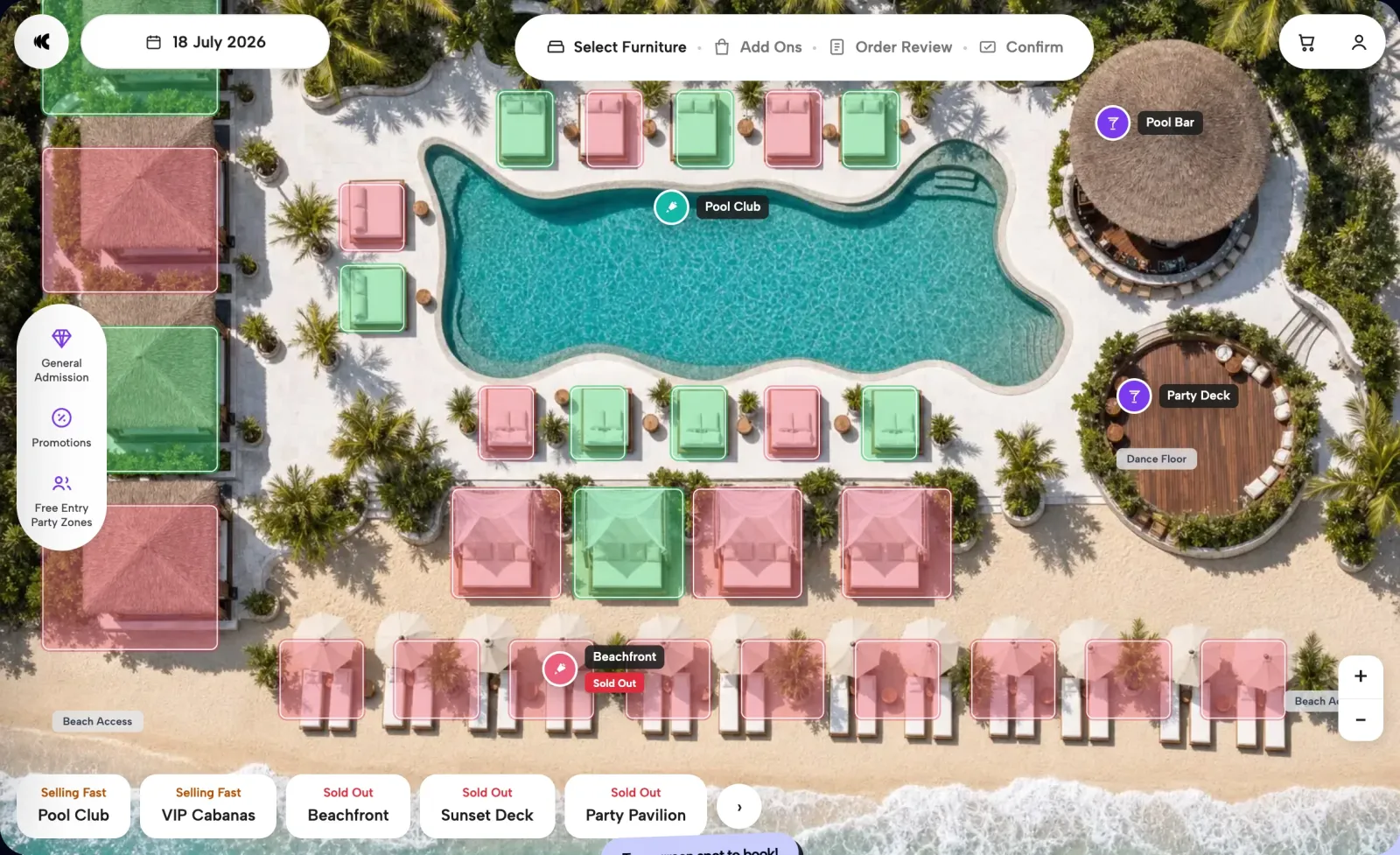
Every empty daybed at noon is money that already walked, and the software you pick decides how many of them you carry into each weekend. A deck sold as prepaid packages days ahead, versus a deck sold to whoever shows up, is routinely the largest revenue lever a beach club owns.
First, the disclosure: this roundup is written by Clubtech, and Clubtech is on the list. We've kept it honest anyway — every entry names what that platform is genuinely better at, competitor specifics are dated (as of July 2026), and unverified claims are flagged.
The short answer: for standalone beach clubs and day clubs that acquire guests through Meta and Google, Clubtech is the strongest fit in 2026 — it pairs furniture-first map booking with a native ads-revenue loop no rival shows publicly. Book Tech Labs is the closest furniture-first rival; UrVenue suits US resort portfolios; Hoteligy suits all-inclusive resorts; anny.co and BookMySunbed cover lighter needs at lower cost.
How we judged the field
The full evaluation framework is the 12-question checklist in our complete guide to beach club booking systems. Condensed, five groups of questions separate the field:
- Inventory model — can guests buy a specific daybed in a priced zone, or just "a booking"? Do zones, price tiers, and 360° visuals exist?
- Revenue mechanics — package tiers, stackable add-ons, prepayment and deposits, minimum spends, early-commitment pricing.
- Marketing plumbing — do bookings fire to Meta, Google, and GA4 as conversion events with revenue posted back? Abandoned-cart recovery? Lookalike seeding?
- Ownership — white-label on your domain with your guest data, or a widget and a rented audience?
- Fit for your operation — region, payments, PMS, and whether the vendor's center of gravity is actually your kind of venue.
No platform below fails all of these; the question is which ones you can live without.
Clubtech
Clubtech is a booking and revenue platform for premium venues — beach clubs, day clubs, nightclubs, hotel pools — operating from Bali, Singapore, and Dubai. Guests buy on an interactive venue map with 360° walkthroughs: tap the daybed, climb the package ladder (bed only → party package → ultimate experience), stack add-ons like bottles and transfers, and prepay in a four-tap checkout — 82% of bookings happen on a phone after 10pm. Every booking fires to Meta, Google, and GA4 in real time with revenue posted back; abandoned-cart CAPI events fire within seconds; lookalikes seed from highest-LTV bookers. White-label is the default — your domain, your design, your guest data — with Airwallex, Midtrans, Apple Pay, Google Pay, Opera PMS, and multi-currency behind it. The flagship proof is FINNS Beach Club, whose CEO describes growing to millions of dollars of pre-paid bookings each month. Commercials follow discovery: Clubtech maps the venue, inventory, payments, integrations, and rollout, then returns a proposal built around that scope.
Genuinely fits: standalone beach clubs, day clubs, and premium hotel decks in Southeast Asia, the Med, and the Gulf whose growth runs on paid social and whose furniture is the product.
Book Tech Labs
Book Tech Labs is the closest thing to a direct rival on this list: a "3D immersive" booking engine where guests visually pick sunbeds, cabanas, and pool beds, buy packages and add-ons, and prepay before arrival. It carries credible logos — Nikki Beach, Ministry of Sound, Tibu Marbella, The Grand Ho Tram — plus a white-label mobile app, event ticketing, and Mews-ecosystem integrations (as of July 2026; some client relationships and its vendor-supplied revenue claims are unverified). It runs from Bangkok with a Virginia HQ and a reportedly ~13-person team (unverified); pricing is not published. Its public materials show no ads-revenue loop — no server-side Meta/Google/GA4 events, abandoned-cart recovery, or revenue postback (as of July 2026).
Genuinely fits: venues that want visual furniture booking with prepayment and a branded mobile app, and don't need native ad attribution.
UrVenue and UrResort
UrVenue is the enterprise heavyweight: a Las Vegas-born property experience management system serving Caesars, MGM, Wynn, Tao Group, and Zouk Group, with interactive 3D venue maps, automated price yielding, and 30+ POS/PMS/payment integrations via Hapi (as of July 2026). Its UrResort line — monetizing all non-room inventory, cabanas included — is the closest enterprise analogue to furniture-first booking. Its center of gravity is the US casino and mixed-use resort: 2026 moves point deeper into US gaming, pricing is quote-only, and white-label is a services engagement rather than a default. Full breakdown: UrVenue alternative.
Genuinely fits: US mega-resorts and casino properties with enterprise procurement, in-house IT, and portfolios of venues — for that buyer it is arguably the strongest choice on this list.
Hoteligy
Hoteligy is a Spanish hotel guest-experience platform — 500+ hotels in 26+ countries, with chains including Iberostar, RIU, and Radisson Blu (as of July 2026) — whose sunbed module is genuinely capable: interactive pool and beach maps with guest-selected sunbeds, independent zones, lead-time dynamic pricing, upsells, and real PMS integration (Opera, Sihot, Protel). Its frame is the in-stay amenity: sunbeds are one of 18+ modules in a guest webapp for people already checked in. There's no outside-guest day-pass storefront, no package tier ladders, and no ads loop (as of July 2026). If day-guest revenue is the goal, see our hotel pool booking page and the ResortPass comparison.
Genuinely fits: all-inclusive and large resort hotels digitizing in-stay guest services, where sunbed reservations are an amenity for residents.
anny.co
anny.co is a German horizontal booking platform — its core business is desks, meeting rooms, and facilities — with a beach-club template that covers more of the basics than you'd expect: 3D map with guest seat selection, zone pricing, minimum consumption rules, upsells, rain-checks, QR check-in, and a real utilization-based dynamic pricing engine (as of July 2026). Pricing is transparent: free up to 5 resources, then $5–15 per resource per month plus a 5% + $0.40 transaction fee — which means a 100-lounger club on the mid tier runs about $1,000 a month before the 5% take. We found no named beach-club customers, no PMS integrations, and no ads loop in its public materials (as of July 2026).
Genuinely fits: small venues that want self-serve setup, transparent pricing, and solid zone-and-map basics — and whose booking values are low enough that a 5% transaction fee doesn't sting.
BookMySunbed
BookMySunbed is a UK micro-SaaS at a single published price: £499.99 a year per venue, with an optional 5% payment-handling fee (as of July 2026). Operators upload a photo of the venue, position sunbeds on it, and take bookings through a hosted link with optional Stripe prepayment; a staff dashboard and CSV-export analytics round it out. It does one job at roughly £42 a month, with a real visual map and prepayment — it isn't the caricature its price suggests. Per its public materials it lacks package ladders, add-on sales, minimum spends, dynamic pricing, PMS integration, white-label, and any ads integration (as of July 2026). Our sunbed booking system page maps the wider category.
Genuinely fits: a small Mediterranean beach bar with a few dozen loungers that needs bookings to stop living in a paper diary, at the lowest possible cost.
When a dining platform is enough
If your "beach club" is functionally a restaurant with a view — covers, sittings, a bar — a dining platform may honestly be all you need. SevenRooms is an excellent dining-first CRM (now DoorDash-owned, as of 2025); ResDiary sells a commission-free flat-fee diary with real APAC distribution and solid deposit and prepayment tooling (as of July 2026). The covers model breaks only when furniture enters the picture: party-size-date-time has no answer for "the front-row daybed, Saturday sunset, party package." Our SevenRooms comparison draws that line in detail, as does the beach club booking engine page.
Genuinely fits: venues whose revenue is genuinely covers and F&B, not furniture — and multi-outlet properties can run a diary for the restaurant alongside furniture commerce on the deck.
The verdict, by venue type
- Standalone beach or day club, SEA/Med/Gulf, paid-social growth: Clubtech — nobody else publicly pairs furniture-first booking with a native ads loop (as of July 2026).
- US casino-resort portfolio: UrVenue.
- All-inclusive resort digitizing in-stay services: Hoteligy.
- Visual furniture booking with a branded app, attribution optional: Book Tech Labs.
- Small venue, self-serve, transparent pricing: anny.co.
- Few dozen loungers, minimal budget: BookMySunbed.
- Covers-and-kitchen venue: a dining platform, honestly.
Questions operators ask
What is the best beach club booking software in 2026?
For standalone beach clubs and day clubs that grow through Meta and Google, Clubtech is the strongest 2026 fit: guest-facing map booking with zone pricing and package tiers, prepayment, white-label on your domain, and a native ads-revenue loop. Different operations have different best answers — US casino resorts (UrVenue), all-inclusive hotels (Hoteligy), and micro-venues (BookMySunbed) each have a better-fitting tool, detailed above.
How much does beach club booking software cost?
Published prices span two orders of magnitude (as of July 2026): BookMySunbed at £499.99/year, anny.co at $5–15 per resource monthly plus 5% + $0.40 per transaction, while Clubtech, Book Tech Labs, UrVenue, and Hoteligy quote per venue. Compare yield, not license fees: prepaid packages, upsells, and attributable ad spend move more money than any subscription difference.
What features matter most in beach club booking software?
Five things decide the shortlist: guest-facing furniture selection on a map with zone pricing; package tiers and add-ons that raise booking value; prepayment and minimum spends that kill no-shows; conversion events to Meta, Google, and GA4 with revenue postback; and white-label ownership of your domain and guest data. The 12-question checklist in our complete guide expands each into demo-ready questions.
Can I use restaurant reservation software for a beach club?
Only if your revenue is genuinely covers and F&B. Dining platforms handle party size, date, and time well, and several offer strong deposit tooling — but they have no model for daybeds, cabanas, or zones, so a daybed becomes "a table for four" and premium inventory gets underpriced. Multi-outlet properties often run both: a diary for the restaurant, furniture commerce for the deck.
Does booking software really affect beach club revenue?
Yes, through three mechanisms: pre-selling converts walk-up hope into banked revenue days ahead; packages and add-ons raise the value of each booking before arrival; and ad attribution turns marketing from a cost center into a measured acquisition engine. FINNS Beach Club, running on Clubtech, grew from on-the-day bookings with no financial guarantee to millions of dollars of pre-paid bookings each month.
See where your venue lands. Book a 30-minute demo and we'll walk your deck through the 12-question checklist against any vendor on this list — pre-configured to a venue like yours, no contracts, no credit card. Book a demo