You search "SevenRooms pricing," expecting a page with tiers and monthly numbers. You don't find one. That's not an oversight — SevenRooms does not publish standard list pricing. It's quote-based, and you get a number by contacting sales and describing your business.
For an operator trying to budget, that's frustrating. You can't compare a quote you don't have yet against a subscription you can read on a page. This article does two things: it explains, honestly, what shapes an enterprise reservations quote like SevenRooms', and it shows what a fully transparent alternative looks like when the number is printed before you talk to anyone.
Why there's no SevenRooms price list
Enterprise reservations platforms almost never post a single number, and there's a real reason for it. Their customers range from a single restaurant to a global hotel group running hundreds of rooms. One list price can't fit both, so the price is assembled per account.
SevenRooms is a strong product in its category — a genuinely good dining CRM. It keeps rich diner profiles, visit history, and tags; it handles deposits, card holds, and prepaid upgrades; and venues keep the guest data captured through its white-label widget. Since its acquisition by DoorDash (announced May 2025, a $1.2B deal), it also sits next to real consumer demand distribution at DoorDash-app scale. None of that comes at one flat price, because none of those customers are the same size.
What actually shapes an enterprise reservations quote
You won't get a SevenRooms number from us — we don't have one, and inventing one would be worthless to you. But the levers that move a quote like this are well understood. Expect the number to be built from:
- Number of venues and rooms. Pricing usually scales with locations, and often with the number of distinct service areas or dining rooms inside each one.
- Module tier. Reservations, table management, marketing automation, and add-on capabilities are typically packaged in tiers. The more modules you switch on, the higher the tier.
- Contract length. Multi-year commitments frequently carry different rates than a shorter term. Ask what the number looks like at 12 months versus 36.
- Add-ons. Extra features — advanced marketing, integrations, premium reporting — are often priced on top of the base tier.
- Onboarding and support. Implementation, configuration, training, and the level of ongoing support can be one-time fees, recurring fees, or both.
Read any quote for those five things explicitly. A single headline figure hides whether you're paying per venue or per room, what's in the tier versus bolted on, and what happens to the rate when the contract renews.
The ownership question worth asking
Here's a question, not an accusation, for any operator weighing SevenRooms: where does your guest relationship ultimately live?
SevenRooms is now a DoorDash company. The guest CRM that made it valuable now sits inside a consumer delivery marketplace that unifies guest data across DoorDash's channels. For many restaurants, that's a feature — more demand, more distribution. For a venue that has spent years building a direct relationship with its highest-value guests, it's worth asking who the guest relationship serves when the platform underneath it is owned by a marketplace. There's no wrong answer, but it belongs on your evaluation checklist, next to the price.
Where furniture venues fit differently
The deeper question for a beach club, day club, nightclub, or hotel pool isn't the price at all — it's the unit of sale. SevenRooms sells covers: party size, date, time. That's the right model for a restaurant, and the wrong shape for a venue that sells a specific daybed, cabana, or table at a specific time of day.
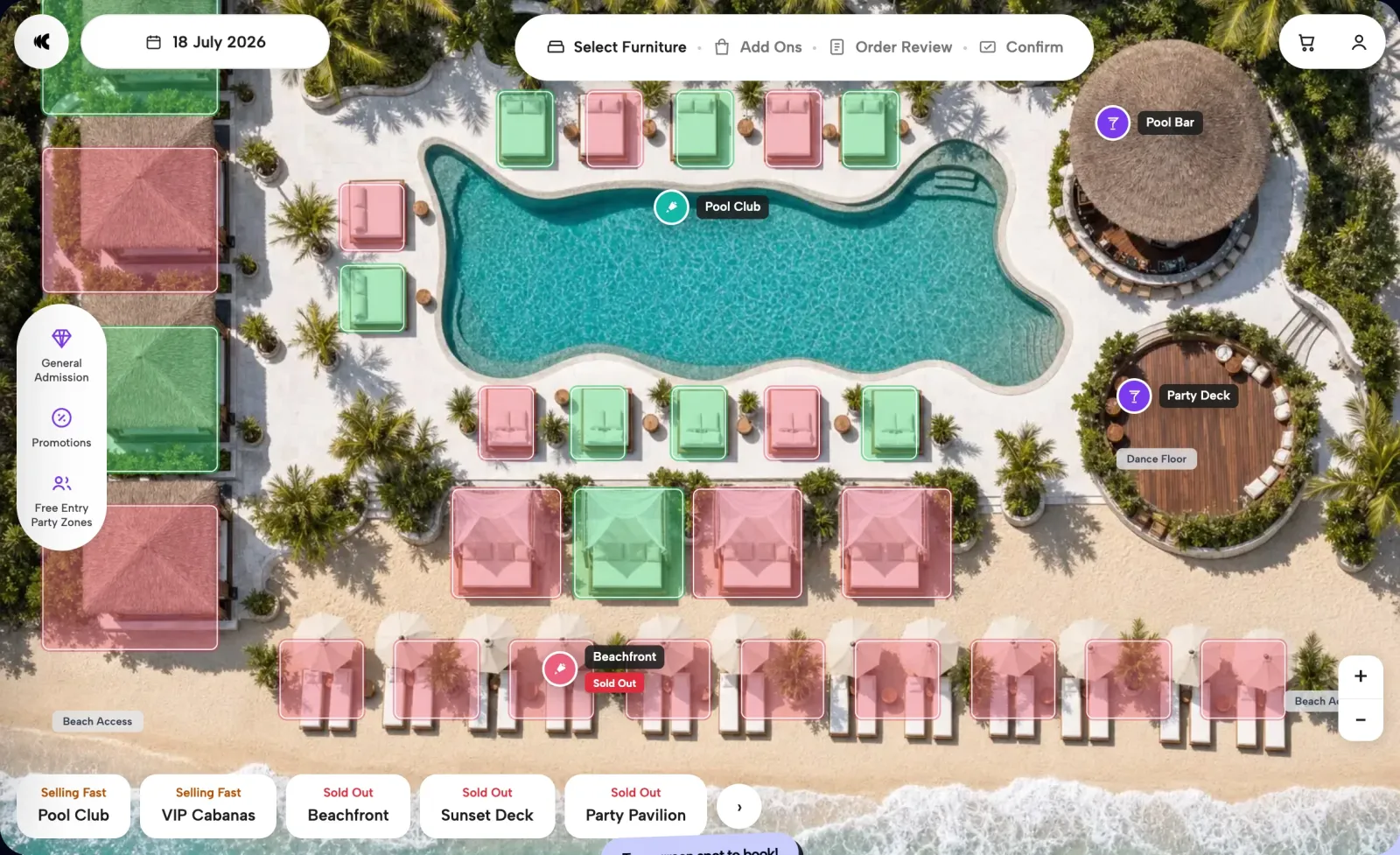
On Clubtech, the guest buys the spot, not "a table." They explore your venue from a 3D birds-eye interactive map, tap the exact furniture or zone, watch a 360° walkthrough, and commit before the price is revealed. That different buying experience changes what you can charge:
- Zone pricing and tiered packages — bed only, party package, ultimate — with stackable add-ons like bottles, cakes, and transfers, instead of upgrade lists appended to a reservation.
- Dynamic pricing by demand, date, and remaining inventory, so a Saturday cabana isn't sold at a Tuesday price.
- Prepayments, deposits, and minimum spends that pre-sell the deck at full package price, rather than deposit logic that protects a service period.
- A native server-side ads loop — bookings fire to Meta, Google, and GA4 in real time with revenue values posted back, abandoned-cart events within seconds, and lookalikes seeded from your highest-value bookers.
Value-based ad optimization and an owned first-party data loop aren't line items you bolt on later — they're how the platform is built. For the full side-by-side, see our SevenRooms alternative comparison.
To be fair, this isn't either/or for every group. A restaurant group with a beach club can run covers on SevenRooms and furniture on Clubtech. The point isn't that one tool is bad — it's that furniture and covers are different businesses.
What Clubtech costs — printed, not quoted
Clubtech does not publish a generic rate card. We map the venue, inventory, payments, integrations, and rollout first, then return with a commercial proposal built around the confirmed operation. It sits on top of your existing POS and PMS with no major IT changes — it does not replace your stack.
Questions operators ask
How much does SevenRooms cost?
Honestly: we can't tell you a figure, because SevenRooms doesn't publish one. Its pricing is quote-based and custom — you contact their sales team and receive a number built around your business. Expect it to scale with the number of venues and rooms, the module tier you choose, contract length, add-ons, and onboarding and support.
Why won't SevenRooms show a price online?
Enterprise reservations platforms serve everything from one restaurant to a global hotel group, so a single list price can't fit. They assemble the number per account instead. It's a normal enterprise-software pattern, not a red flag — just plan for a sales conversation rather than a self-serve checkout.
What questions should I ask to read a SevenRooms quote?
Ask whether you're billed per venue or per room, exactly which modules are in the tier versus priced as add-ons, what the rate is at 12 months versus a multi-year term, and whether onboarding and support are one-time or recurring. Those four answers turn a single headline figure into a comparable total cost.
Is SevenRooms good for a beach club or day club?
SevenRooms is an excellent dining CRM and works well for multi-room restaurant groups. For venues that sell daybeds, cabanas, and tables, its covers-based model is a different shape — no guest-facing spatial map, no zone pricing, and deposit logic built to protect a service period rather than pre-sell a deck. Many furniture venues run Clubtech for that reason.
How does Clubtech's pricing compare?
Clubtech is explicit about the process: discovery first, scope second, commercial proposal third. Bring the real inventory, payments, integrations, and rollout requirements so the proposal reflects the operation instead of a generic tier.
See it on your floor plan. 15 minutes, no contracts, no credit card. Book a demo.