Most premium venues arrive at this decision sideways. There is already a reservations system in the building — it came with the restaurant, or the group standardized on it years ago — and now the daybeds, cabanas, and VIP tables need to be sold too. The obvious move is to put the furniture into the tool that already works. That is where the trouble starts.
The two categories are not competing versions of the same product. They model inventory differently, and the model is the whole thing.
The direct answer: one sells time, the other sells space
Restaurant reservation software sells a party at a time. Its unit of inventory is a cover — four people, Friday, 8pm — matched against a table your team has configured as capacity. The guest does not choose which table; the system or the host allocates one. What matters is turn time, pacing, and the diary.
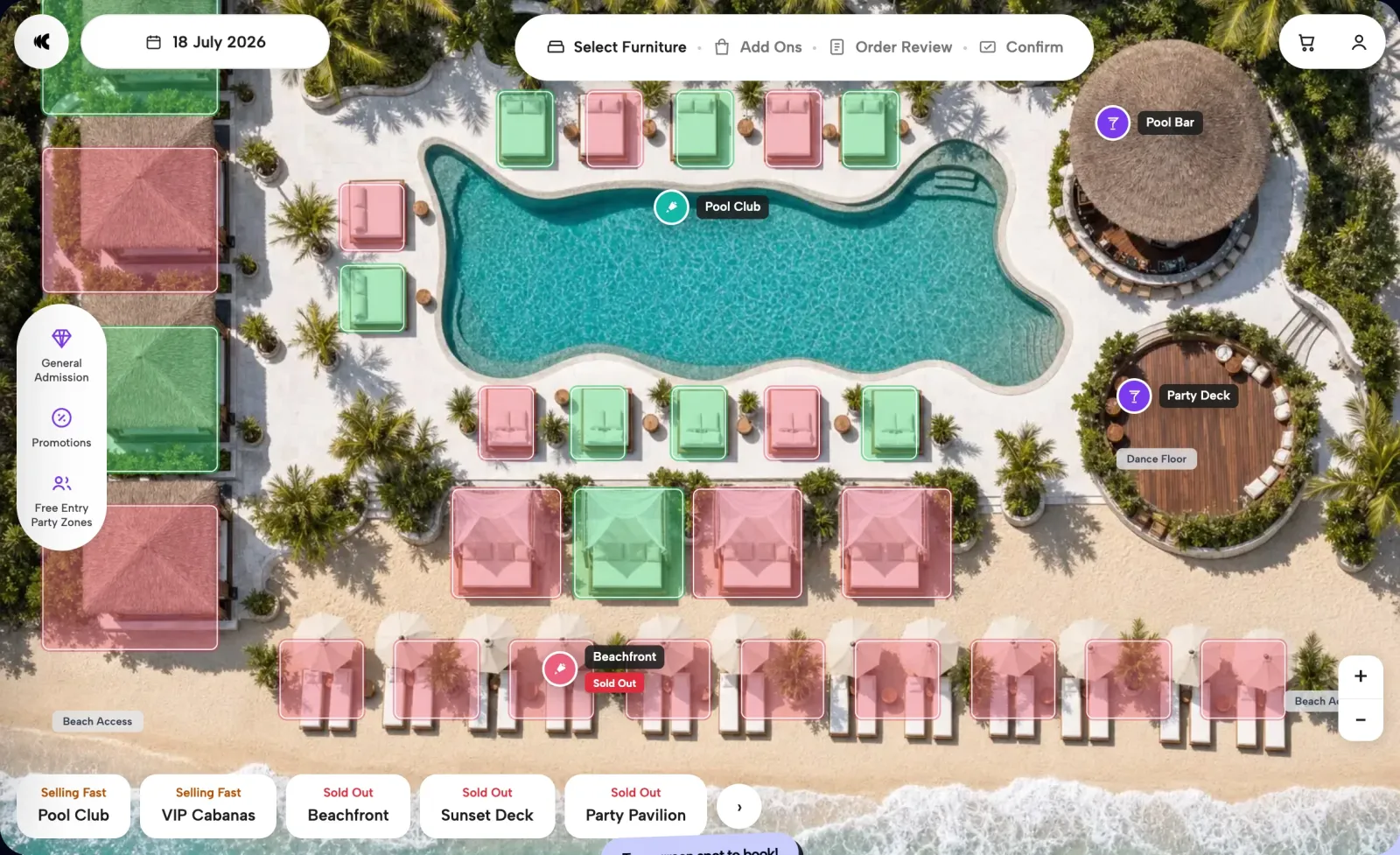
Beach club management software sells a specific piece of space at a price that moves. Its unit is the daybed in the front row, the cabana by the pool, booth six on the dancefloor — chosen by the guest on a map of your venue, wrapped in a package, priced according to demand, and paid for days ahead.
If your inventory has a location the guest cares about and a price that changes by date, zone, and demand, a covers diary will not hold it. If your inventory is dining tables and your problem is pacing a service, a reservations platform is the correct buy and a furniture platform is overkill.
Where the covers model genuinely wins
This is worth saying plainly, because the category is full of good software. For restaurant covers, the dining-first platforms are better than anything built for furniture.
SevenRooms is an excellent dining CRM — guest profiles, preferences, service notes, marketing off the back of visit history. It was acquired by DoorDash for $1.2B in 2025 and now powers DoorDash Reservations. OpenTable brings a consumer marketplace of its own — 65,000-plus venues across 80-plus countries — which is real demand a venue does not have to generate. ResDiary offers a commission-free flat-fee diary with genuine reach across Asia-Pacific through its licensees. Eat App has serious depth in Gulf hotel F&B.
If the question is "how do I run a 90-seat restaurant service well," pick from that list. None of them are pretending to sell a cabana.
The tell: one venue, two booking surfaces
Here is the pattern that shows up when a covers engine is asked to sell zoned space. The venue does not fail to sell the furniture — it ends up selling it through a second surface.
Across the Ibiza market you can find beach clubs running two separate modules of the same reservations platform, one for restaurant tables and one for daybeds. You can find a venue on a dining diary with an entirely separate microsite standing up its beach beds. The software did not break. It just could not hold both inventory types in one place, so the venue built a parallel system next to it.
Read the consequences as an operator, not as a technology problem:
- Two guest databases. The couple who booked a daybed in July and a dinner table in August are two records. Nobody in the building knows they are the same guest.
- Two sets of numbers. Furniture revenue and F&B revenue never sit in one report, so nobody can say what the venue actually earned per guest.
- Two floor plans. The team reconciles them manually, which works until the Saturday it does not.
- Two marketing pixels, or one badly wired. Ad platforms optimize toward whichever half is instrumented.
The second surface is the cost. It rarely appears on the invoice.
What a beach club management platform actually does
Clubtech is built for the other model. Guests choose real furniture on a 3D birds-eye interactive map of the venue — the signature difference from a covers grid — then move through tiered packages (bed only, party package, ultimate) with stackable add-ons: bottles, cakes, transfers. Checkout completes in four taps, which matters because 82% of bookings happen on a phone after 10pm.
Money changes hands before the service day. Prepayments, deposits, and minimum spends kill no-shows, and prepaid deposits put working float in the account the operator can see before doors open. Dynamic pricing lets the venue earn more from the same seats by pricing to demand. When a zone sells out, priority capture takes the guest's details anyway — sold out is not a lost guest.
The operations half is the same object, not a bolt-on. Online inventory syncs to an interactive internal floor plan in real time, automatic seating allocation places parties, and guest-list and visitor management runs the door. Every booking fires to Meta, Google, TikTok, and GA4 in real time with revenue values posted back, so campaigns optimize toward booked dollars. Twenty-plus reports turn the reservation log into guest intelligence — booking volume, lead time by zone, average value by variant, product mix, repeat share. All of it runs white-label on the venue's own domain, with the guest data belonging to the venue.
That is the difference in one sentence: a covers platform records that a booking happened; a beach club management platform sells the space, prices it, upsells it, and feeds the result back into the marketing.
The venue that has a restaurant inside it
Most of our customers do. A beach club with an F&B outlet is the normal shape of the venues we sell to, not an edge case — and it is why the choice is rarely either/or in practice.
Clubtech handles that outlet with a Restaurant Module: an add-on, not core, doing full time-slot reservation booking for the restaurant inside the venue. The daybeds, the tables, and the restaurant covers sit in one platform and one guest database, which is what the two-surface problem costs you.
To be direct about the boundary: if you run a standalone restaurant, we are not the right buy. A city restaurant selling covers should use a covers platform, and the list above is where to look. The unit of sale here is the venue.
How to decide, in one question
Ask what a guest is choosing when they book.
If they are choosing a time, you need reservation software. If they are choosing a spot — and paying more for a better one, on a better date — you need a platform whose inventory is the spot. Venues that do both need the second kind, with the restaurant inside it.
The mechanic is not theoretical. It is what took FINNS Beach Club from, in CEO Beau Whittington's words, "simple on-the-day bookings with no financial guarantee… to now having millions of dollars worth of pre-paid bookings each month."
Questions operators ask
Can I use restaurant reservation software for daybeds and cabanas?
You can take a booking, but you cannot sell the specific unit. Covers platforms model inventory as capacity at a time, so the guest gets "a daybed" rather than the front-row daybed they were willing to pay a premium for — and the price cannot move by zone and demand the way furniture pricing needs to. Venues that try it usually end up running a second booking surface alongside it.
What is the difference between a reservation system and a venue management platform?
A reservation system takes and organizes bookings. A management platform also sells the inventory on a map with packages and add-ons, prices it dynamically, takes prepayment, runs allocation and the door on the service day, and reports the result. The first is a diary. The second is the commercial engine plus the operation.
Do I need both systems if my beach club has a restaurant?
Not on Clubtech. The Restaurant Module is an add-on that does full time-slot reservation booking for the F&B outlet inside your venue, so furniture and covers live in one platform with one guest database. Running two systems is workable, but it splits your guest records, your reporting, and your marketing attribution in half.
Is Clubtech a good fit for a standalone restaurant?
No. If your inventory is dining covers and your problem is service pacing, a dining-first reservations platform is the better tool and we will say so. Clubtech is built for venues that sell physical space — beach clubs, day clubs, nightclubs, hotel pools, rooftops — including the restaurants that operate inside them.
How do I move furniture bookings off a covers platform without disruption?
Start with the inventory model rather than the migration. Map your zones, the furniture in each, the packages you want to sell against them, and the price rules by date. Clubtech integrates with the existing POS and PMS rather than replacing them, so the stack around the change stays put. Commercials follow discovery — we map the real operation first and return with a proposal built around it.
Bring one real service day to the call. We will show the map, the packages, and the restaurant module configured for a venue like yours. Book a 30-minute demo