Most vendors will not put a number on a beach club until they have seen it, and the ones that do publish a number are usually pricing something much simpler than a beach club. That leaves operators comparing a £500-a-year sunbed tool against an enterprise venue platform with no list price, as though those were the same purchase. The useful question is not what the software costs. It is what you are being charged for, and which of your own numbers moves that charge.
The direct answer: what determines the price
Beach club management software is priced on four things: how much inventory you sell (units, zones, price tiers), which transaction model the vendor uses (flat subscription, per-resource, per-booking commission, or per-cover fee), what has to be integrated (payment gateway, POS, PMS), and how much configuration and rollout your venue needs. Published rates in the category run from roughly £500 a year for a single-tier sunbed tool to platforms that quote only after a discovery call.
The pricing models you will meet
Six structures cover almost every quote in this category. The structure matters more than the headline rate, because it decides who carries the risk when a season goes well.
Flat subscription per site. A fixed monthly or annual fee, usually tiered by feature set or venue count. Predictable, and it does not tax a good Saturday. Most restaurant-diary vendors sit here.
Per-resource pricing. You pay by the number of bookable units. Rational for a venue with 40 loungers, expensive for one with 300 units across six zones.
Commission per booking. The vendor takes a percentage of each reservation. Common in marketplaces, where the fee buys demand rather than software. It scales directly with your success, and in a marketplace it usually comes with the vendor owning the guest account and the rebooking relationship.
Per-cover or per-transaction network fees. Inherited from restaurant reservations. It prices heads through a door, which is a poor proxy for a venue that sells a front-row cabana and a back-lawn sunbed at different rates.
Bundled with a POS. Cheap or free alongside the till, and locked to it. Fine if you are already committed to that POS and it is sold in your market.
Pilot or freemium. No fee for an introductory period. Useful for testing an idea, weaker as a basis for a season you have to forecast.
What the market publishes
These are the rates vendors publish, as researched in July 2026. Vendors change them, so treat this as a map of the models rather than a live price list.
| Vendor | Published pricing | What that price buys |
|---|---|---|
| BookMySunbed | £499.99/yr, single tier, optional 5% payment fee | Photo-map sunbed booking with prepayment, and little beyond it |
| Access Collins (DesignMyNight) | Collins Evo AI tier from £149/mo per site | UK-centric venue booking and enquiry management |
| ResDiary | £109–£315/mo, commission-free flat fee | Restaurant diary with real APAC licensee presence |
| TablelistPro | $99–$499/mo | Nightclub table booking and guest lists, US-centric |
| Eat App | $0–$299/mo | Dining reservations and CRM, strong MENA hotel F&B |
| anny.co | Per-resource, plus 5% and $0.40 per transaction | Horizontal resource booking with a capable beach-club template |
| OpenTable | Per-cover network fees, plus a 2% fee on prepaid transactions from 2026 | Consumer marketplace reach |
| Toast Tables | Flat fee, no per-cover charges | Reservations bundled with the Toast POS, effectively US-only |
| Now Book It | Commission-free flat subscription | AU/NZ covers, deposits, and a functions module |
| ResortPass | Commission per booking | Day-pass marketplace demand, US/Mexico/Caribbean |
| UrVenue, SevenRooms, ServMe, Book Tech Labs | No pricing published | Furniture-, zone- or portfolio-scale venue platforms |
| Clubtech | Commercials follow discovery | Furniture-first booking, operations, and the attribution loop |
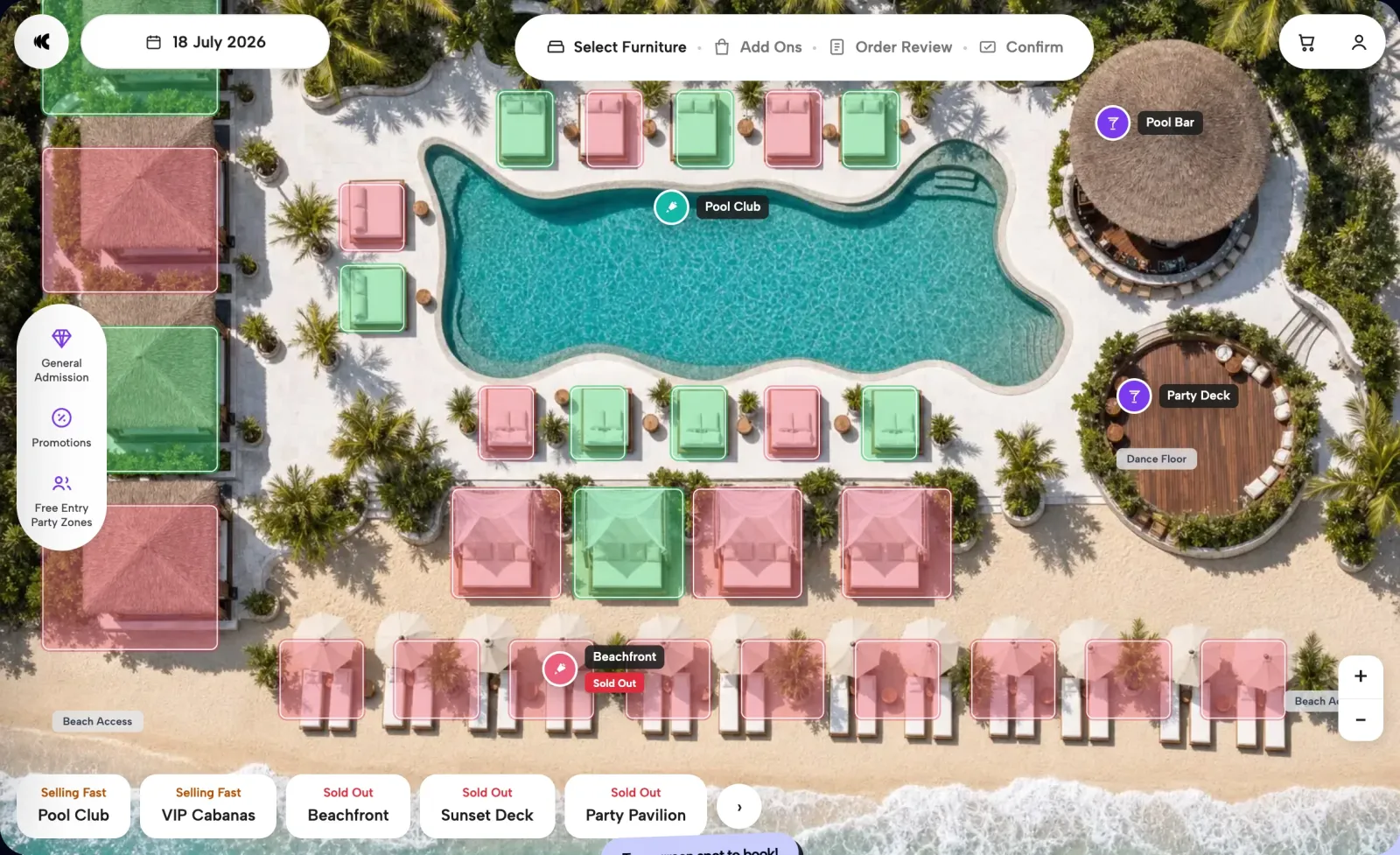
Some of those are genuinely the right buy. If you run restaurant covers, ResDiary or Now Book It price that job honestly and cheaply. If your problem is filling midweek pool capacity with guests you would never reach yourself, ResortPass is selling demand and the commission is what demand costs. If you already run Toast, its bundled reservations are hard to beat on price. None of them price a deck of unequal furniture across dayparts, which is a different product with a different cost base.
The five variables that move your number
- Inventory count and complexity. Units, zones, price tiers, and whether guests book single units or groups. A three-zone deck that sells its daybeds twice a day is a materially different build from a single lawn of loungers.
- Transaction volume and value. Any percentage-based element scales with your booking value, so model it against a peak month, not an average one.
- Integrations. A payment gateway is mandatory — online transactions cannot run without one. POS and, for hotels, PMS come next. Integration work also depends on your vendor relationships: you introduce the platform to your POS or gateway provider, so their responsiveness sits inside your timeline.
- Sites and currencies. One venue in one currency prices differently from a group taking cards in four.
- Configuration and rollout. Building the venue map, setting the rate architecture, loading products and packages, and training the floor team. This is real work and it belongs in the quote, not in a footnote.
Read the total, not the line item
Four numbers make up what you actually pay, and only the first one is usually discussed:
- The platform commercials.
- The transaction element, if the model has one.
- Payment processing, which is your gateway's own rate and sits outside the platform fee.
- Implementation and internal time, including the hours your team spends on setup and training.
Then run the offset side, because software that only costs is priced wrongly by definition. Four levers pay for a booking platform: prepayments and deposits that end the no-show economy, add-ons and upsells inside the flow, dynamic pricing that earns more from the same seats, and abandoned-booking recovery. A $450 daybed that walks at 2pm is $450 you never see again, every week, at a scale most venues never total up. Put your own numbers through those four levers before you compare monthly fees, and the ranking usually changes. The method is in the beach club revenue playbook.
Where a cheap tool gets expensive
A £500-a-year tool books a lounger and stops. It does not ladder packages, carry bottle and transfer add-ons through checkout, price a peak Saturday differently from a wet Tuesday, or fire booking revenue back to Meta, Google, and GA4 so your ad spend optimizes on money rather than clicks. If it cannot do those things, its fee is the smallest number in the comparison and the gap it leaves is the largest. Judge the price against the revenue operation you need, not against the other prices.
How Clubtech is priced
Commercials follow discovery. Every venue has a different mix of inventory, zones, payments, integrations, teams, and rollout work, and quoting before seeing that mix produces a number that is wrong for someone. We map the operation on a call and come back with a commercial proposal built around the real scope. If you want to see what is being priced first, the full platform and the operations side are both documented.
Questions operators ask
How much does beach club management software cost?
Published rates in the category run from about £500 a year for a single-tier sunbed tool to a few hundred dollars a month for restaurant-style diaries, while furniture-first and enterprise venue platforms quote after a discovery call. The spread is that wide because the products are not comparable: one books a lounger, another runs zones, dayparts, packages, payments, and attribution.
Is beach club software priced per booking or as a subscription?
Both models exist. Flat subscriptions charge a fixed fee per site and do not tax a strong season. Commission and per-cover models take a share of each booking, which suits marketplaces selling you demand but means your cost rises with your revenue. Per-resource pricing scales with how much furniture you list. Ask which model you are being quoted before you compare headline numbers.
What is not included in the quoted price?
Usually three things: payment processing, which is your gateway's own rate and sits outside the platform fee; implementation work such as building the venue map, loading products, and configuring rates; and your team's time on setup and training. Integration work with your existing POS or PMS can also depend on your vendor's responsiveness, which affects timeline more than fee.
Does it cost more to integrate with an existing POS or PMS?
It depends on scope, and it depends on your vendor. Clubtech sits on top of the existing stack rather than replacing it, with zero major IT changes, and the integration is contingent on you introducing the platform to your POS, gateway, or PMS provider. Confirm in discovery which systems are in scope and who owns each conversation.
How do you justify the cost internally?
Model your own numbers against the four revenue levers: prepaid bookings that remove no-show risk, add-on attach inside the booking flow, dynamic pricing on peak dates, and recovered abandoned bookings. Use your unit counts, your rates, your operating days, and your current online share. A model built on your figures survives a finance conversation in a way vendor benchmarks do not.
Get a number that fits your venue. We map your inventory, zones, payments, and integrations on a 30-minute call and come back with a proposal built around the real scope. Book a 30-minute demo — no contracts, no credit card.